11 Accelerated Gradient Methods
In the preceding chapters we established that gradient descent converges at a rate of O(1/k) for smooth convex functions and at a linear rate of O\!\bigl((1 - 1/\kappa)^k\bigr) for strongly convex functions with condition number \kappa = L/\mu. A natural question is: can we do better? Are these rates the best achievable by any first-order method, or is there room for improvement?
The idea of using momentum — exploiting the history of past iterates to build inertia — dates back to Polyak’s heavy-ball method1, which achieves optimal rates for quadratic functions. However, the full breakthrough came with Yurii Nesterov in 19832, who showed that a carefully designed momentum schedule can close the gap to information-theoretic lower bounds for all smooth convex functions. This chapter develops both methods: the heavy-ball method as a warm-up, and Nesterov’s accelerated gradient method, which achieves an O(1/k^2) rate for convex functions and an O\!\bigl(\exp(-k/\sqrt{\kappa})\bigr) rate for strongly convex functions — both provably optimal among first-order methods.
Acceleration is one of the most celebrated results in continuous optimization. Beyond its theoretical elegance, it has profound practical impact: the accelerated proximal gradient method (FISTA) is the workhorse algorithm for large-scale problems in signal processing, imaging, and machine learning. We will also study restart strategies that make acceleration robust in practice when the strong convexity parameter is unknown.
 A companion notebook accompanies this chapter with runnable Python implementations of Nesterov’s accelerated gradient, FISTA for Lasso, momentum trajectory visualization, condition number dependence experiments, and adaptive restart strategies.
11.1 What Will Be Covered
- Issues with gradient descent and the idea of momentum
- The heavy-ball method (Polyak, 1964): optimal acceleration for quadratics
- Lower bounds for first-order methods and why gradient descent is suboptimal
- Nesterov’s accelerated gradient method and its ODE interpretation
- Convergence analysis via Lyapunov functions
- FISTA: accelerated proximal gradient for composite optimization
- Restart strategies for practical acceleration
11.2 Motivation
11.2.1 Recap: Gradient Descent Rates
Recall from Chapter 6 the convergence rates of gradient descent x^{k+1} = x^k - \frac{1}{L}\nabla f(x^k), where f is L-smooth:
| Setting | Convergence rate |
|---|---|
| Convex, L-smooth | f(x^k) - f(x^*) \leq \dfrac{L\|x^0 - x^*\|_2^2}{2k} |
| \mu-strongly convex, L-smooth | f(x^k) - f(x^*) \leq \dfrac{L}{2}\Bigl(1 - \dfrac{\mu}{L}\Bigr)^k \|x^0 - x^*\|_2^2 |
In terms of iteration complexity:
- Convex: O(L/\varepsilon) iterations for an \varepsilon-suboptimal solution.
- Strongly convex: O(\kappa \cdot \log(1/\varepsilon)) iterations, where \kappa = L/\mu is the condition number.
11.2.2 Issues with Gradient Descent
Can we do better? Two fundamental issues with gradient descent suggest the answer is yes:
Short-sightedness. Gradient descent focuses entirely on local improvement: each step minimizes a quadratic upper bound at the current point. This greedy strategy can be suboptimal globally — a step that looks slightly worse locally might lead to much better progress overall.
Zigzagging. On ill-conditioned problems (\kappa \gg 1), gradient descent oscillates (zigzags) in the high-curvature directions while making slow progress in the low-curvature directions. The optimal step size \alpha = 2/(L+\mu) reduces but does not eliminate this oscillation, leading to the O(\kappa) dependence in the convergence rate.
A natural remedy is to exploit the history of past iterates: rather than determining x^{k+1} solely from the gradient at x^k, we can incorporate a momentum term that accumulates information from previous steps, yielding a smoother trajectory and faster convergence. This is the core idea behind both the heavy-ball method and Nesterov’s acceleration.
11.2.3 First-Order Oracle Model
To reason rigorously about whether gradient descent is optimal, we need to formalize what we mean by a “first-order method.” The following model captures any algorithm that generates iterates using only gradient information accumulated so far.
Definition 11.1 (First-Order Oracle Model) A first-order method generates iterates x^0, x^1, x^2, \ldots such that x^k \in x^0 + \operatorname{span}\{\nabla f(x^0), \nabla f(x^1), \ldots, \nabla f(x^{k-1})\}. \tag{11.1} That is, each iterate lies in the affine subspace spanned by all previously observed gradients.
This model captures gradient descent, momentum methods, conjugate gradient, and any method that combines past gradient information linearly.
11.2.4 Lower Bounds for First-Order Methods
With the oracle model in hand, we can now ask: what is the fastest possible convergence rate achievable by any first-order method? The following classical results, due to Nesterov (1983), establish fundamental limits by constructing explicit “hard instances” — functions for which no first-order method can converge faster than the stated rate.
Theorem 11.1 (Lower Bound (Convex, Smooth)) For any k \leq (n-1)/2 and any first-order method, there exists an L-smooth convex function f:\mathbb{R}^n \to \mathbb{R} such that f(x^k) - f(x^*) \geq \frac{3L\|x^0 - x^*\|_2^2}{32(k+1)^2}. \tag{11.2}
Theorem 11.2 (Lower Bound (Strongly Convex, Smooth)) For any k \leq (n-1)/2 and any first-order method, there exists a \mu-strongly convex, L-smooth function f:\mathbb{R}^n \to \mathbb{R} such that f(x^k) - f(x^*) \geq \frac{\mu}{2}\left(\frac{\sqrt{\kappa} - 1}{\sqrt{\kappa} + 1}\right)^{2k} \|x^0 - x^*\|_2^2.
Both lower bounds follow the same proof strategy, which is worth understanding at a conceptual level before diving into the details.
The minimax argument. To show that no first-order method can converge faster than a given rate, it suffices to exhibit a single hard function for which every first-order method is slow. This is a worst-case (minimax) argument: if there exists even one function f in the class (e.g., L-smooth convex) where every first-order method requires at least T(\varepsilon) iterations for an \varepsilon-suboptimal point, then no first-order method can guarantee fewer than T(\varepsilon) iterations on all functions in that class. In other words, we prove a lower bound by finding the adversary’s best response: the hardest possible function.
The hard instance. Both constructions use explicit quadratic functions on \mathbb{R}^n whose Hessians are tridiagonal. The tridiagonal structure creates an information bottleneck: gradient evaluations can only “see” neighboring coordinates, so starting from x^0 = \mathbf{0}, each iteration reveals at most one new coordinate direction. After k iterations, the iterate x^k lives in a k-dimensional subspace, but the optimum x^* has all n coordinates nonzero — leaving a gap that cannot be closed faster than the stated rates. The proofs are elegant and illuminate why acceleration is necessary.
11.2.5 Proof of Theorem 11.1 (Convex Case)
Proof. Step 1 (Hard instance). Define the n \times n tridiagonal matrix
A = \begin{pmatrix} 2 & -1 & & \\ -1 & 2 & -1 & \\ & \ddots & \ddots & \ddots \\ & & -1 & 1 \end{pmatrix},
and consider the quadratic function f(x) = \frac{L}{4}(x^\top A x - 2e_1^\top x) on \mathbb{R}^n with n \geq 2k+1. Since x^\top A x = x_1^2 + \sum_{i=1}^{n-1}(x_i - x_{i+1})^2 \geq 0, the matrix A is positive semidefinite, and one can verify \|A\| \leq 4 (the maximum row sum). Thus f is convex and L-smooth.
The minimizer satisfies Ax^* = e_1. By direct substitution, x^* = \mathbf{1} (the all-ones vector), since (A\mathbf{1})_1 = 2 - 1 = 1, (A\mathbf{1})_i = -1 + 2 - 1 = 0 for interior i, and (A\mathbf{1})_n = -1 + 1 = 0.
Step 2 (Span property). Starting from x^0 = \mathbf{0}, the gradient \nabla f(\mathbf{0}) = -\frac{L}{2}e_1 lies in \operatorname{span}(e_1). Since A is tridiagonal, multiplying by A can introduce at most one new coordinate: if v \in \operatorname{span}(e_1, \ldots, e_j), then Av \in \operatorname{span}(e_1, \ldots, e_{j+1}). By induction on the span condition (11.1), after k iterations of any first-order method:
x^k \in \operatorname{span}(e_1, \ldots, e_k), \qquad \text{i.e.,} \quad x^k_i = 0 \;\text{ for all }\; i > k.
Step 3 (Subspace lower bound). Since f(x^k) - f(x^*) = \frac{L}{4}\|x^k - x^*\|_A^2 (completing the square and using Ax^* = e_1), we need to lower-bound \|x - x^*\|_A^2 over all x with x_i = 0 for i > k.
Using the quadratic form x^\top A x = x_1^2 + \sum_{i=1}^{n-1}(x_i - x_{i+1})^2 and the fact that x^*_i = 1 for all i (so consecutive differences of x^* vanish), we obtain
\|x - x^*\|_A^2 = (x_1-1)^2 + \sum_{i=1}^{n-1}\big((x_i - 1) - (x_{i+1} - 1)\big)^2 = (x_1-1)^2 + \sum_{i=1}^{n-1}(x_i - x_{i+1})^2.
Minimizing over x_1, \ldots, x_k with x_i = 0 for i > k, the first-order conditions give a linear recurrence with solution
x_i^{\mathrm{opt}} = 1 - \frac{i}{k+1}, \qquad i = 1, \ldots, k.
The minimum value is (x_1^{\mathrm{opt}} - 1)^2 + \sum_{i=1}^{k-1}\frac{1}{(k+1)^2} + (x_k^{\mathrm{opt}})^2 = \frac{k}{(k+1)^2} + \frac{1}{(k+1)^2} = \frac{1}{k+1}.
Step 4 (Conclude). Therefore, for any first-order method,
f(x^k) - f(x^*) \geq \frac{L}{4} \cdot \frac{1}{k+1}.
Since \|x^0 - x^*\|_2^2 = n \geq 2k + 1 \geq 2(k+1), we obtain
f(x^k) - f(x^*) \geq \frac{L}{4(k+1)} \geq \frac{L\|x^0 - x^*\|_2^2}{8(k+1)^2}.
This establishes the \Omega(1/k^2) lower bound (the constant 3/32 in Theorem 11.1 comes from a tighter computation). \blacksquare
11.2.6 Proof of Theorem 11.2 (Strongly Convex Case)
Proof. The strongly convex case uses the same tridiagonal structure but brings in the elegant theory of Chebyshev polynomials.
Step 1 (Hard instance). Define the quadratic
f(x) = \frac{1}{2}x^\top A x - e_1^\top x, \qquad A = \frac{L - \mu}{4}T + \mu I,
where T is the tridiagonal matrix from the convex case. Since T \succeq 0 and \|T\| \leq 4, the eigenvalues of A lie in [\mu,\, \mu + (L-\mu)] = [\mu, L]. Thus f is \mu-strongly convex and L-smooth. The minimizer is x^* = A^{-1}e_1.
Step 2 (Krylov subspace property). Starting from x^0 = \mathbf{0}, any first-order method produces iterates in the Krylov subspace:
x^k \in \mathcal{K}_k(A, e_1) = \operatorname{span}(e_1,\, Ae_1,\, A^2 e_1,\, \ldots,\, A^{k-1}e_1).
This follows from the span condition (11.1) by induction: \nabla f(x^0) = -e_1, and each subsequent gradient \nabla f(x^j) = Ax^j - e_1 adds at most one power of A to the span.
Therefore x^k = q_{k-1}(A)e_1 for some polynomial q_{k-1} of degree \leq k-1.
Step 3 (Reduction to polynomial approximation). The error can be written as
x^k - x^* = q_{k-1}(A)e_1 - A^{-1}e_1 = -\big(I - Aq_{k-1}(A)\big)A^{-1}e_1 = -p_k(A)\,x^*,
where p_k(t) = 1 - t\,q_{k-1}(t) is a polynomial of degree \leq k satisfying p_k(0) = 1. The optimality gap becomes
f(x^k) - f(x^*) = \frac{1}{2}\|p_k(A)\,x^*\|_A^2 = \frac{1}{2}\sum_{j=1}^n \lambda_j\, c_j^2\, p_k(\lambda_j)^2,
where \lambda_j are the eigenvalues of A, and c_j = v_j^\top x^* are the components of x^* in the eigenbasis. Since A is tridiagonal and e_1 has nonzero projection onto every eigenvector, all c_j \neq 0. Therefore,
\frac{f(x^k) - f(x^*)}{f(x^0) - f(x^*)} \geq \left(\min_{\substack{p_k:\,\deg p_k \leq k \\ p_k(0) = 1}} \;\max_{\lambda \in [\mu,\, L]}\; |p_k(\lambda)|\right)^{\!2}.
Step 4 (Chebyshev polynomial bound). The classical minimax polynomial approximation on [\mu, L] is solved by the shifted Chebyshev polynomial:
p_k^*(t) = \frac{T_k\!\Big(\dfrac{L + \mu - 2t}{L - \mu}\Big)}{T_k\!\Big(\dfrac{L + \mu}{L - \mu}\Big)},
where T_k(\cos\theta) = \cos(k\theta) is the Chebyshev polynomial of the first kind. The minimax value is
\min_{p_k:\, p_k(0)=1} \;\max_{t \in [\mu, L]}\; |p_k(t)| = \frac{1}{T_k\!\Big(\dfrac{L+\mu}{L-\mu}\Big)}.
Step 5 (Evaluate the Chebyshev bound). Using T_k(x) \geq \frac{1}{2}(x + \sqrt{x^2 - 1})^k for x > 1, we compute
\frac{L+\mu}{L-\mu} + \sqrt{\left(\frac{L+\mu}{L-\mu}\right)^2 - 1} = \frac{L + \mu + 2\sqrt{L\mu}}{L - \mu} = \frac{(\sqrt{L} + \sqrt{\mu})^2}{(\sqrt{L} - \sqrt{\mu})(\sqrt{L} + \sqrt{\mu})} = \frac{\sqrt{\kappa} + 1}{\sqrt{\kappa} - 1}.
Therefore T_k\big(\frac{L+\mu}{L-\mu}\big) \geq \frac{1}{2}\big(\frac{\sqrt{\kappa}+1}{\sqrt{\kappa}-1}\big)^k, and
\frac{f(x^k) - f(x^*)}{f(x^0) - f(x^*)} \geq \frac{1}{T_k^2} \geq 4\left(\frac{\sqrt{\kappa} - 1}{\sqrt{\kappa} + 1}\right)^{2k}.
Since f(x^0) - f(x^*) = \frac{1}{2}\|x^*\|_A^2 \leq \frac{L}{2}\|x^0 - x^*\|_2^2, we obtain the desired lower bound. \blacksquare
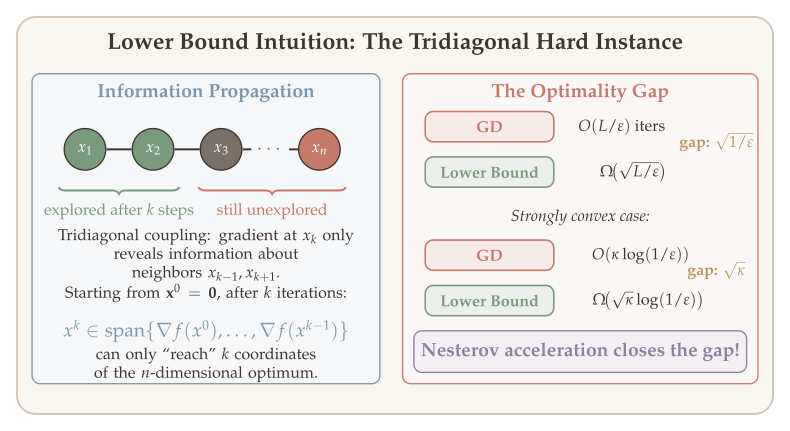
The lower bounds give the following iteration complexity requirements:
| Setting | GD rate | Lower bound | Gap |
|---|---|---|---|
| Convex, L-smooth | O(L/\varepsilon) | \Omega(L/\sqrt{\varepsilon}\,) | \sqrt{1/\varepsilon} |
| \mu-strongly convex, L-smooth | O(\kappa\log(1/\varepsilon)) | \Omega(\sqrt{\kappa}\log(1/\varepsilon)) | \sqrt{\kappa} |
In both cases, the gap is a factor of a square root. Can we design first-order methods that close this gap? We begin with the heavy-ball method, which achieves the optimal rate for quadratic functions, and then present Nesterov’s method, which achieves the optimal rate for all smooth convex functions.
11.3 Heavy-Ball Method
The first momentum-based optimization method was proposed by Boris Polyak in 1964. The idea is intuitive: just as a heavy ball rolling downhill builds up inertia and can traverse flat regions more quickly, we add a momentum term to gradient descent that remembers the previous direction of travel.
11.3.1 The Algorithm
Initialize: x^0, x^{-1} \in \mathbb{R}^n (typically x^{-1} = x^0).
For k = 0, 1, 2, \ldots: x^{k+1} = x^k - \eta\,\nabla f(x^k) + \theta\bigl(x^k - x^{k-1}\bigr). \tag{11.3}
The update has two components: a gradient step -\eta\,\nabla f(x^k) and a momentum term \theta(x^k - x^{k-1}) that pushes the iterate in the direction of the previous displacement. When \theta = 0, this reduces to standard gradient descent.
The momentum term serves as a buffer that smooths the trajectory: in the zigzagging regime, the oscillating gradient components tend to cancel in the momentum accumulation, while the consistently signed components reinforce each other. This dampens oscillations and amplifies progress in the correct direction.
11.3.2 State-Space Analysis for Quadratics
To understand when and why heavy-ball accelerates, consider the quadratic f(x) = \frac{1}{2}(x - x^*)^\top Q\,(x - x^*), where Q \succ 0 has eigenvalues \mu = \lambda_{\min}(Q) \leq \cdots \leq \lambda_{\max}(Q) = L. Since \nabla f(x) = Q(x - x^*), the heavy-ball update in terms of the error e^k = x^k - x^* becomes e^{k+1} = (1 + \theta)e^k - \eta\,Q\,e^k - \theta\,e^{k-1} = \bigl[(1+\theta)I - \eta Q\bigr]\,e^k - \theta\,e^{k-1}.
Introducing the augmented state z^k = \begin{bmatrix} e^k \\ e^{k-1} \end{bmatrix}, this becomes a linear dynamical system: z^{k+1} = H\,z^k, \qquad H = \begin{bmatrix} (1+\theta)I - \eta Q & -\theta\,I \\ I & 0 \end{bmatrix}. \tag{11.4}
The convergence rate is controlled by the spectral radius \rho(H): we have \|z^k\| \lesssim \rho(H)^k \|z^0\|. Since Q is symmetric, the system decouples in the eigenbasis of Q. For each eigenvalue \lambda_i of Q, the corresponding 2 \times 2 block is H_i = \begin{bmatrix} 1 + \theta - \eta\lambda_i & -\theta \\ 1 & 0 \end{bmatrix}, with characteristic polynomial z^2 - (1 + \theta - \eta\lambda_i)\,z + \theta = 0. \tag{11.5}
The roots have product \theta and sum 1 + \theta - \eta\lambda_i. A key observation: if the discriminant (1+\theta - \eta\lambda_i)^2 - 4\theta \leq 0, then the two roots are complex conjugates with equal magnitude \sqrt{\theta}. If the discriminant is positive, the roots are real and the larger one exceeds \sqrt{\theta}.
Therefore, to minimize \rho(H) = \max_i \rho(H_i), we want the discriminant to be non-positive for every eigenvalue \lambda_i \in [\mu, L]: (1 + \theta - \eta\lambda_i)^2 \leq 4\theta \qquad \text{for all } \lambda_i \in [\mu, L]. \tag{11.6}
This requires -2\sqrt{\theta} \leq 1 + \theta - \eta\lambda_i \leq 2\sqrt{\theta}, which gives (1 - \sqrt{\theta})^2 \leq \eta\lambda_i \leq (1+\sqrt{\theta})^2.
11.3.3 Convergence of Heavy-Ball for Quadratics
Theorem 11.3 (Convergence of Heavy-Ball (Quadratic Functions)) Let f(x) = \frac{1}{2}(x - x^*)^\top Q(x - x^*) where Q is \mu-strongly convex and L-smooth with \kappa = L/\mu. Set \eta = \frac{4}{(\sqrt{L} + \sqrt{\mu})^2}, \qquad \theta = \left(\frac{\sqrt{\kappa} - 1}{\sqrt{\kappa} + 1}\right)^{\!2}. Then the heavy-ball iterates (11.3) satisfy \left\|\begin{bmatrix} x^{k+1} - x^* \\ x^k - x^* \end{bmatrix}\right\|_2 \lesssim \left(\frac{\sqrt{\kappa} - 1}{\sqrt{\kappa} + 1}\right)^k \left\|\begin{bmatrix} x^1 - x^* \\ x^0 - x^* \end{bmatrix}\right\|_2. In particular, the iteration complexity is O(\sqrt{\kappa}\log(1/\varepsilon)).
Proof. We need to show \rho(H) \leq (\sqrt{\kappa}-1)/(\sqrt{\kappa}+1) with the stated choice of \eta and \theta.
Step 1: Ensuring complex roots. We need condition (11.6) to hold for all \lambda_i \in [\mu, L], i.e., (1-\sqrt{\theta})^2 \leq \eta\mu and \eta L \leq (1+\sqrt{\theta})^2.
To minimize \sqrt{\theta} (and hence maximize the convergence rate), we solve for equality at both endpoints simultaneously: \frac{(1-\sqrt{\theta})^2}{\mu} = \frac{(1+\sqrt{\theta})^2}{L} = \eta. Cross-multiplying: (1-\sqrt{\theta})/(1+\sqrt{\theta}) = \sqrt{\mu/L} = 1/\sqrt{\kappa}, which yields \sqrt{\theta} = \frac{\sqrt{\kappa} - 1}{\sqrt{\kappa} + 1}, \qquad \theta = \left(\frac{\sqrt{\kappa}-1}{\sqrt{\kappa}+1}\right)^{\!2}.
Step 2: Computing \eta. From the equality \eta L = (1+\sqrt{\theta})^2: \eta = \frac{(1+\sqrt{\theta})^2}{L} = \frac{\left(1 + \frac{\sqrt{\kappa}-1}{\sqrt{\kappa}+1}\right)^2}{L} = \frac{\left(\frac{2\sqrt{\kappa}}{\sqrt{\kappa}+1}\right)^2}{L} = \frac{4\kappa}{L(\sqrt{\kappa}+1)^2} = \frac{4}{(\sqrt{L}+\sqrt{\mu})^2}.
Step 3: Spectral radius bound. With these choices, all eigenvalues of H_i are complex with magnitude exactly \sqrt{\theta}. Therefore: \rho(H) = \sqrt{\theta} = \frac{\sqrt{\kappa} - 1}{\sqrt{\kappa} + 1}, which completes the proof. \blacksquare
Comparison with gradient descent (strongly convex quadratics):
| Method | Contraction rate | Iteration complexity |
|---|---|---|
| Gradient Descent | \dfrac{\kappa - 1}{\kappa + 1} \approx 1 - \dfrac{2}{\kappa} | O(\kappa \log(1/\varepsilon)) |
| Heavy-Ball | \dfrac{\sqrt{\kappa} - 1}{\sqrt{\kappa} + 1} \approx 1 - \dfrac{2}{\sqrt{\kappa}} | O(\sqrt{\kappa} \log(1/\varepsilon)) |
The heavy-ball method achieves a quadratic improvement in the dependence on \kappa, matching the lower bound from Theorem 11.2.
11.3.4 Limitations: Beyond Quadratics
Despite its elegant performance on quadratics, the heavy-ball method has fundamental limitations:
Requires knowing L and \mu. The optimal parameters \eta and \theta depend on both the smoothness constant L and the strong convexity parameter \mu. In practice, \mu is often unknown or zero.
Does not accelerate for general convex functions. The state-space analysis exploits the linearity of the gradient \nabla f(x) = Q(x - x^*) for quadratics. For general convex functions, the heavy-ball method with fixed \eta, \theta can fail to achieve the O(1/k^2) rate — and may even diverge if the parameters are poorly tuned.
No O(1/k^2) rate in the convex (non-strongly-convex) case. Unlike Nesterov’s method, the heavy-ball method with constant momentum does not achieve the optimal O(1/k^2) rate for convex functions when \mu = 0.
These limitations motivate the search for a more robust acceleration scheme. Nesterov’s insight was to use a time-varying momentum coefficient that adapts as the algorithm progresses, yielding optimal rates for all smooth convex functions — not just quadratics.
11.4 Nesterov’s Accelerated Gradient: Smooth Convex Case
Having established that gradient descent leaves a \sqrt{\kappa} gap relative to the lower bounds, and that the heavy-ball method closes this gap for quadratics but not general convex functions, we now present Nesterov’s accelerated gradient method, which achieves optimal rates universally. The key innovation is a time-varying momentum coefficient that increases toward 1 as the algorithm progresses.
11.4.1 The Algorithm
We consider the problem \min_{x \in \mathbb{R}^n} f(x), where f is convex and L-smooth (i.e., \nabla f is L-Lipschitz continuous).
Initialize: x^0 = y^0 \in \mathbb{R}^n, \theta_0 = 1.
For k = 0, 1, 2, \ldots: \begin{aligned} y^{k+1} &= x^k - \frac{1}{L}\nabla f(x^k), \\ \theta_{k+1} &= \frac{1 + \sqrt{1 + 4\theta_k^2}}{2}, \\ x^{k+1} &= y^{k+1} + \frac{\theta_k - 1}{\theta_{k+1}}\bigl(y^{k+1} - y^k\bigr). \end{aligned} \tag{11.7} The momentum coefficient \beta_k = (\theta_k - 1)/\theta_{k+1} is time-varying and increasing. Since \theta_k \geq (k+2)/2, we have \beta_k \approx k/(k+3) for large k, but the exact \theta_k recursion is needed for the convergence proof.
The following plot shows the \theta_k sequence and the resulting momentum coefficient \beta_k = (\theta_k - 1)/\theta_{k+1}.
Left: the sequence \theta_k grows linearly, lower-bounded by (k+2)/2. Right: the momentum coefficient \beta_k = (\theta_k - 1)/\theta_{k+1} increases toward 1, closely tracking the approximation k/(k+3). The exact \theta_k recursion (not the approximation) is what makes the Lyapunov proof work.
The algorithm maintains two sequences: \{y^k\} (gradient steps) and \{x^k\} (extrapolated points). The following table compares the update formulas side by side with the heavy-ball method, making the structural difference transparent:
| Heavy-Ball | Nesterov’s AGD | |
|---|---|---|
| Step 1 | Gradient at current x^k | Momentum (look-ahead) |
| \quad\to\; x^k - \eta\,\nabla f(x^k) | \quad\to\; y^k = x^k + \beta_k(x^k - x^{k-1}) | |
| Step 2 | Add momentum | Gradient at look-ahead y^k |
| \quad\to\; x^{k+1} = x^k - \eta\,\nabla f(x^k) + \theta(x^k\!-\!x^{k-1}) | \quad\to\; x^{k+1} = y^k - \frac{1}{L}\nabla f(y^k) | |
| \nabla f evaluated at | Current iterate x^k | Look-ahead point y^k |
| Momentum coeff. | Fixed \theta = \bigl(\frac{\sqrt{\kappa}-1}{\sqrt{\kappa}+1}\bigr)^2 | Time-varying \beta_k = \frac{\theta_k - 1}{\theta_{k+1}} \approx \frac{k}{k+3} \to 1 |
| Scope | Quadratics only | All smooth convex f |
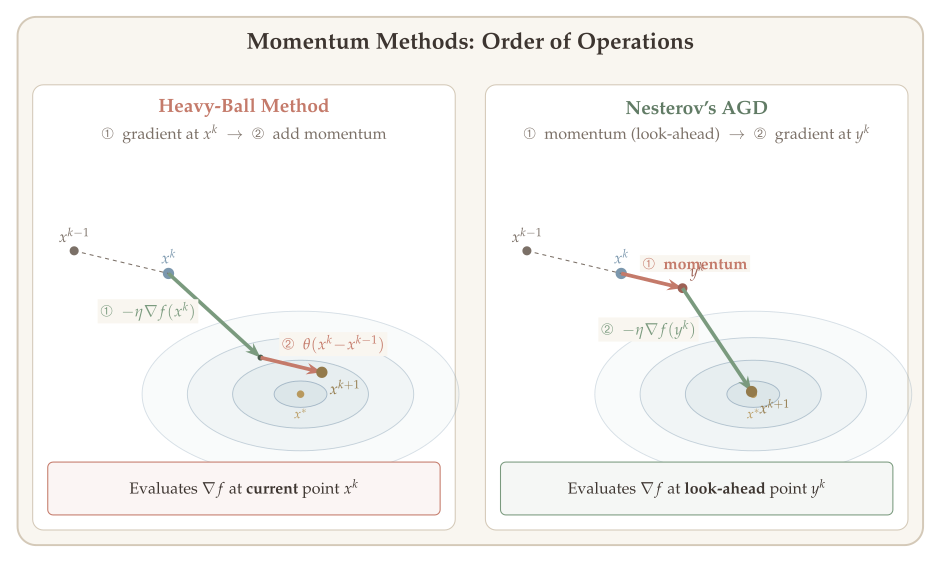
Two key differences separate Nesterov’s method from heavy-ball:
Order of operations. Heavy-ball evaluates \nabla f at the current iterate x^k and adds momentum afterward. Nesterov first extrapolates to a look-ahead point y^k and evaluates \nabla f there, using more up-to-date curvature information.
Time-varying momentum. Heavy-ball uses a fixed coefficient \theta, which must be tuned to the (unknown) strong convexity \mu. Nesterov’s coefficient \beta_k = (\theta_k - 1)/\theta_{k+1} is time-varying and increasing toward 1. This schedule is not chosen by hand — it is derived from the convergence analysis: the recursion \theta_{k+1} = (1+\sqrt{1+4\theta_k^2})/2 satisfies the key identity \theta_k(\theta_k - 1) = \theta_{k-1}^2 (see (11.12) in the proof of Theorem 11.4), which is precisely what makes the Lyapunov function decrease. Since \theta_k \geq (k+2)/2, the momentum coefficient satisfies \beta_k \approx k/(k+3) for large k.
Together, these two innovations are what enable Nesterov’s method to achieve optimal rates for all smooth convex functions, not just quadratics.
11.4.2 Interpretation via Differential Equations
Nesterov’s momentum coefficient \beta_k = (\theta_k - 1)/\theta_{k+1} \approx k/(k+3) = 1 - 3/(k+3) is particularly mysterious at first sight. Why does it approach 1 at a rate governed by the constant 3? A beautiful explanation comes from the continuous-time limit of the algorithm, discovered by Su, Boyd, and Candès3.
Heuristic derivation. We derive the ODE in three steps.
Step 1: Rewrite the recursion. Combining both lines of (11.7) into a single recursion on \{x^k\} and using step size \eta = 1/L, the update takes the form x^{k+1} - x^k = \frac{k-1}{k+2}\bigl(x^k - x^{k-1}\bigr) - \eta\,\nabla f(y^k). Dividing both sides by \sqrt{\eta}: \frac{x^{k+1} - x^k}{\sqrt{\eta}} = \frac{k-1}{k+2}\cdot\frac{x^k - x^{k-1}}{\sqrt{\eta}} - \sqrt{\eta}\,\nabla f(y^k).
Step 2: Pass to continuous time. Introduce a continuous-time variable \tau = k\sqrt{\eta}, so that each discrete step corresponds to a time increment \Delta\tau = \sqrt{\eta}. Define X(\tau) \approx x^k as the continuous interpolation. Taylor-expanding around \tau: x^{k+1} = X(\tau + \sqrt{\eta}) \approx X(\tau) + \dot{X}(\tau)\sqrt{\eta} + \tfrac{1}{2}\ddot{X}(\tau)\,\eta, so the finite differences become \frac{x^{k+1} - x^k}{\sqrt{\eta}} \approx \dot{X}(\tau) + \tfrac{1}{2}\ddot{X}(\tau)\sqrt{\eta}, \qquad \frac{x^k - x^{k-1}}{\sqrt{\eta}} \approx \dot{X}(\tau) - \tfrac{1}{2}\ddot{X}(\tau)\sqrt{\eta}. Meanwhile, the momentum coefficient satisfies \frac{k-1}{k+2} = 1 - \frac{3}{k+2} \approx 1 - \frac{3\sqrt{\eta}}{\tau}.
Step 3: Substitute and simplify. Plugging into the recursion: \dot{X} + \tfrac{1}{2}\ddot{X}\sqrt{\eta} \;\approx\; \Bigl(1 - \frac{3\sqrt{\eta}}{\tau}\Bigr)\!\Bigl(\dot{X} - \tfrac{1}{2}\ddot{X}\sqrt{\eta}\Bigr) - \sqrt{\eta}\,\nabla f(X). Expanding the right-hand side and collecting terms of order \sqrt{\eta}: \sqrt{\eta}\Bigl[\ddot{X} + \frac{3}{\tau}\dot{X} + \nabla f(X)\Bigr] \approx 0. Dividing by \sqrt{\eta} yields the second-order ODE: \ddot{X}(\tau) + \frac{3}{\tau}\,\dot{X}(\tau) + \nabla f\bigl(X(\tau)\bigr) = 0. \tag{11.8}
Physical interpretation. This is a damped oscillator: \nabla f(X) acts as a restoring force pulling X toward the minimizer, while (3/\tau)\dot{X} is a time-varying friction that decreases as \tau grows. The decreasing friction allows the system to build up momentum over time — explaining why the discrete algorithm’s momentum coefficient grows toward 1.
Convergence of the ODE. Define the Lyapunov function \mathcal{E}(\tau) = \tau^2\bigl(f(X(\tau)) - f(x^*)\bigr) + 2\!\left\|X(\tau) + \frac{\tau}{2}\dot{X}(\tau) - x^*\right\|_2^2. We show in the appendix (see ?sec-ode-lyapunov) that a direct computation using (11.8) and convexity of f gives \dot{\mathcal{E}}(\tau) \leq 0. Therefore f(X(\tau)) - f(x^*) \leq \mathcal{E}(\tau)/\tau^2 \leq \mathcal{E}(0)/\tau^2 = O(1/\tau^2), recovering Nesterov’s O(1/k^2) rate in the continuous limit.
Connection to the discrete proof. The continuous Lyapunov \mathcal{E}(\tau) is the blueprint for the discrete one in Theorem 11.4. The correspondence is:
| Continuous (\tau = k\sqrt{\eta}) | Discrete |
|---|---|
| \tau^2 | \theta_{k-1}^2 |
| f(X(\tau)) - f(x^*) | f(y^k) - f(x^*) |
| X + \frac{\tau}{2}\dot{X} - x^* | u^k = \theta_{k-1}(y^k - x^*) - (\theta_{k-1}-1)(y^{k-1} - x^*) |
The auxiliary sequence u^k discretizes X + \frac{\tau}{2}\dot{X} - x^* via the approximation \dot{X} \approx (y^k - y^{k-1})/\sqrt{\eta}. The discrete identity \theta_k(\theta_k - 1) = \theta_{k-1}^2 (11.12) is the algebraic counterpart of the continuous condition \dot{\mathcal{E}} \leq 0.
The constant 3 in (11.8) is the smallest damping coefficient that guarantees O(1/\tau^2) convergence. Replacing 3/\tau with \alpha/\tau for any \alpha \geq 3 still yields O(1/\tau^2), but \alpha < 3 does not. In this sense, 3 minimizes the pre-constant in the convergence bound, and Nesterov’s choice \beta_k \approx k/(k+3) is the tightest possible momentum schedule.
11.4.3 Convergence Analysis
We now establish the convergence rate of the accelerated gradient method (11.7). The following theorem shows that it achieves an O(1/k^2) convergence rate, which is a quadratic improvement over gradient descent and matches the lower bound from Theorem 11.1.
Theorem 11.4 (Convergence of Accelerated Gradient (Convex)) Let f be convex and L-smooth. Then the iterates of (11.7) satisfy f(y^k) - f(x^*) \leq \frac{2L\|x^0 - x^*\|_2^2}{(k+1)^2}. \tag{11.9}
Comparison with gradient descent:
- GD: f(x^k) - f(x^*) = O(1/k).
- Accelerated GD: f(y^k) - f(x^*) = O(1/k^2).
This is a quadratic improvement in the convergence rate. In terms of iteration complexity, to achieve f(y^k) - f(x^*) \leq \varepsilon:
- GD: k = O(L/\varepsilon).
- Accelerated GD: k = O(\sqrt{L/\varepsilon}).
The accelerated rate matches the lower bound (11.2) up to constants.
Proof. We prove Theorem 11.4 by constructing a Lyapunov function (energy) that is non-increasing along the iterates — a direct discretization of the continuous-time argument in ?sec-ode-lyapunov. The proof reveals where the momentum schedule comes from: the \theta_k recursion in the algorithm (11.7) is uniquely determined by the requirement that the Lyapunov function decreases.
Step 1: Fundamental inequality. Since y^{k+1} = x^k - \frac{1}{L}\nabla f(x^k), combining the descent lemma (L-smoothness) with convexity and completing the square yields: for any z \in \mathbb{R}^n, f(y^{k+1}) - f(z) \leq \frac{L}{2}\|z - x^k\|_2^2 - \frac{L}{2}\|z - y^{k+1}\|_2^2. \tag{11.10} (This follows from: f(y^{k+1}) \leq f(x^k) - \frac{1}{2L}\|\nabla f(x^k)\|^2 \leq f(z) + \langle \nabla f(x^k), x^k - z \rangle - \frac{1}{2L}\|\nabla f(x^k)\|^2 = f(z) + \frac{L}{2}\|z - x^k\|^2 - \frac{L}{2}\|z - y^{k+1}\|^2, where the last equality uses y^{k+1} = x^k - \frac{1}{L}\nabla f(x^k) to complete the square.)
Step 2: The momentum sequence \theta_k. Define \theta_0 = 1 and \theta_{k+1} = \frac{1 + \sqrt{1 + 4\theta_k^2}}{2}. \tag{11.11} This recursion is the positive root of \theta_{k+1}^2 - \theta_{k+1} = \theta_k^2, which we write as the key algebraic identity: \theta_k(\theta_k - 1) = \theta_{k-1}^2. \tag{11.12} By induction, \theta_k \geq (k+2)/2 for all k \geq 0. This is exactly the \theta_k sequence used in the algorithm (11.7), giving the momentum coefficient \beta_k = (\theta_k - 1)/\theta_{k+1}.
Where does this recursion come from? The answer emerges in Step 4: it is the unique choice that makes the Lyapunov function decrease.
Step 3: Lyapunov function. Define the auxiliary sequence u^k = \theta_{k-1}(y^k - x^*) - (\theta_{k-1} - 1)(y^{k-1} - x^*), with u^1 = y^1 - x^* (since \theta_0 = 1). The Lyapunov function is \mathcal{E}_k = \theta_{k-1}^2\bigl(f(y^k) - f(x^*)\bigr) + \frac{L}{2}\|u^k\|_2^2. This combines the optimality gap (weighted by \theta_{k-1}^2) with a distance-like term. We will show \mathcal{E}_{k+1} \leq \mathcal{E}_k.
Step 4: Lyapunov decrease (the key step). Apply (11.10) with the specific choice z = \frac{1}{\theta_k}\,x^* + \left(1 - \frac{1}{\theta_k}\right)y^k. A direct computation using the definition of u^k and the extrapolation x^k = y^k + \beta_{k-1}(y^k - y^{k-1}) shows: z - x^k = -\frac{u^k}{\theta_k}, \qquad z - y^{k+1} = -\frac{u^{k+1}}{\theta_k}. Substituting into (11.10): f(y^{k+1}) - f(z) \leq \frac{L}{2\theta_k^2}\bigl(\|u^k\|_2^2 - \|u^{k+1}\|_2^2\bigr). By convexity of f, the evaluation point z satisfies f(z) \leq \theta_k^{-1}f(x^*) + (1 - \theta_k^{-1})f(y^k), so f(y^{k+1}) - f(x^*) \leq \left(1 - \frac{1}{\theta_k}\right)\bigl(f(y^k) - f(x^*)\bigr) + \frac{L}{2\theta_k^2}\bigl(\|u^k\|_2^2 - \|u^{k+1}\|_2^2\bigr). Multiplying both sides by \theta_k^2 and using the identity \theta_k(\theta_k - 1) = \theta_{k-1}^2 from (11.12): \theta_k^2\bigl(f(y^{k+1}) - f(x^*)\bigr) + \frac{L}{2}\|u^{k+1}\|_2^2 \leq \theta_{k-1}^2\bigl(f(y^k) - f(x^*)\bigr) + \frac{L}{2}\|u^k\|_2^2. That is, \mathcal{E}_{k+1} \leq \mathcal{E}_k. This is where the identity (11.12) — and hence the \theta_k recursion — is essential: it is precisely the algebraic condition needed for the weighted optimality gap to telescope.
Step 5: Concluding the rate. Telescoping from k down to 1: \mathcal{E}_k \leq \mathcal{E}_1. Since \theta_0 = 1 and u^1 = y^1 - x^*: \mathcal{E}_1 = f(y^1) - f(x^*) + \frac{L}{2}\|y^1 - x^*\|_2^2. Applying (11.10) at k = 0 with z = x^*: f(y^1) - f(x^*) \leq \frac{L}{2}\|x^0 - x^*\|_2^2 - \frac{L}{2}\|y^1 - x^*\|_2^2. Thus \mathcal{E}_1 \leq \frac{L}{2}\|x^0 - x^*\|_2^2.
Therefore: \theta_{k-1}^2\bigl(f(y^k) - f(x^*)\bigr) \leq \mathcal{E}_k \leq \frac{L}{2}\|x^0 - x^*\|_2^2. Since \theta_{k-1} \geq (k+1)/2: f(y^k) - f(x^*) \leq \frac{L\|x^0 - x^*\|_2^2}{2\theta_{k-1}^2} \leq \frac{2L\|x^0 - x^*\|_2^2}{(k+1)^2}. \blacksquare
Unlike gradient descent, the accelerated method does not guarantee monotone decrease of f(x^k). The function values can oscillate. The proof works through a carefully constructed Lyapunov function rather than a descent argument. This makes acceleration fundamentally different from standard gradient methods, and its deep mechanism remains an active area of research.
11.4.4 Visualization: GD vs. Accelerated GD
The following plot compares gradient descent and Nesterov’s accelerated gradient on a 50-dimensional quadratic f(x) = \frac{1}{2}\sum_{i=1}^{50} \lambda_i x_i^2 with eigenvalues uniformly spaced in [\mu, L], giving condition number \kappa = L/\mu = 500. With such a large condition number, GD makes painfully slow progress while AGD converges dramatically faster.
GD vs. Nesterov AGD on a 50-dimensional quadratic with \kappa = 500. GD (red) converges at the O(1/k) rate — barely reducing the error over 500 iterations. Nesterov AGD (blue) converges at the much faster O(1/k^2) rate, with the oscillations characteristic of the momentum mechanism. Dotted lines show the theoretical rates for reference.
11.5 Acceleration for Strongly Convex Functions
When f is additionally \mu-strongly convex (\mu > 0), we can exploit the strong convexity to obtain a linear convergence rate with improved dependence on the condition number.
11.5.1 The Algorithm
Initialize: x^0 = y^0 \in \mathbb{R}^n. Set q = \mu/L and \gamma = \frac{\sqrt{q}}{1+\sqrt{q}} = \frac{\sqrt{\mu/L}}{1+\sqrt{\mu/L}}.
For k = 0, 1, 2, \ldots: \begin{aligned} y^{k+1} &= x^k - \frac{1}{L}\nabla f(x^k), \\ x^{k+1} &= y^{k+1} + \frac{1-\gamma}{1+\gamma}\bigl(y^{k+1} - y^k\bigr). \end{aligned} \tag{11.13}
In contrast to the convex case where the momentum coefficient \beta_k = (\theta_k - 1)/\theta_{k+1} is time-varying, the strongly convex case uses a fixed momentum coefficient \beta = \frac{1-\gamma}{1+\gamma} = \frac{\sqrt{\kappa} - 1}{\sqrt{\kappa} + 1}, where \kappa = L/\mu. When \kappa is large, \beta \approx 1 - 2/\sqrt{\kappa}, which is close to 1.
11.5.2 Convergence Analysis
Theorem 11.5 (Convergence of Accelerated Gradient (Strongly Convex)) Let f be \mu-strongly convex and L-smooth with \kappa = L/\mu. Then the iterates of (11.13) satisfy f(y^k) - f(x^*) \leq \frac{L + \mu}{2}\|x^0 - x^*\|_2^2 \cdot \left(\frac{\sqrt{\kappa} - 1}{\sqrt{\kappa} + 1}\right)^{2k}. \tag{11.14} In particular, to achieve f(y^k) - f(x^*) \leq \varepsilon, we need k = O\!\left(\sqrt{\kappa} \cdot \log\frac{1}{\varepsilon}\right) iterations.
Proof. We use a Lyapunov function that contracts geometrically at each step, paralleling the convex proof but with the constant momentum \beta = \frac{\sqrt{\kappa}-1}{\sqrt{\kappa}+1} replacing the time-varying \theta_k schedule.
Step 1: Setup. Define \lambda = \frac{\sqrt{\kappa}-1}{\sqrt{\kappa}+1} and the Lyapunov function \mathcal{E}_k = f(y^k) - f(x^*) + \frac{\mu}{2}\|v^k - x^*\|_2^2, where v^k is an auxiliary sequence satisfying the recursion v^{k+1} = \frac{1}{1+\gamma}\bigl(v^k + \gamma\, y^{k+1} - \gamma\, \tfrac{1}{\mu}\nabla f(x^k)\bigr), \qquad \gamma = \sqrt{q} = \sqrt{\mu/L}, with v^0 = x^0.
Step 2: Fundamental inequality (strongly convex). Since y^{k+1} = x^k - \frac{1}{L}\nabla f(x^k), the descent lemma and \mu-strong convexity give: for any z, f(y^{k+1}) - f(z) \leq \frac{L}{2}\|z - x^k\|_2^2 - \frac{L}{2}\|z - y^{k+1}\|_2^2 - \frac{\mu}{2}\|x^k - z\|_2^2.
Step 3: Lyapunov contraction. Evaluate the inequality at z = \frac{\gamma}{1+\gamma}v^k + \frac{1}{1+\gamma}y^k (a convex combination analogous to the choice z = \theta_k^{-1}x^* + (1-\theta_k^{-1})y^k in the convex proof). Using the extrapolation formula x^k = y^k + \beta(y^k - y^{k-1}) and the recursion for v^k, a computation analogous to Steps 3–4 of the convex proof yields: f(y^{k+1}) - f(x^*) + \frac{\mu}{2}\|v^{k+1} - x^*\|_2^2 \leq (1-\gamma)\left(f(y^k) - f(x^*) + \frac{\mu}{2}\|v^k - x^*\|_2^2\right). That is, \mathcal{E}_{k+1} \leq (1 - \gamma)\,\mathcal{E}_k. The contraction factor 1 - \gamma = 1 - \sqrt{\mu/L} = \frac{\sqrt{\kappa}-1}{\sqrt{\kappa}} \leq \lambda^2.
Step 4: Telescoping. By induction, \mathcal{E}_k \leq (1-\gamma)^k \mathcal{E}_0. Since \mathcal{E}_0 = f(y^0) - f(x^*) + \frac{\mu}{2}\|x^0 - x^*\|_2^2 \leq \frac{L+\mu}{2}\|x^0 - x^*\|_2^2: f(y^k) - f(x^*) \leq \mathcal{E}_k \leq \frac{L+\mu}{2}\|x^0 - x^*\|_2^2 \cdot (1-\gamma)^k \leq \frac{L+\mu}{2}\|x^0-x^*\|_2^2\cdot\left(\frac{\sqrt{\kappa}-1}{\sqrt{\kappa}+1}\right)^{2k}. Since \frac{\sqrt{\kappa}-1}{\sqrt{\kappa}+1} \leq \exp\!\bigl(-1/\sqrt{\kappa}\bigr), we obtain the O(\sqrt{\kappa}\log(1/\varepsilon)) complexity. \blacksquare
Summary of rates (smooth optimization):
| Method | Convex | Strongly Convex (\kappa = L/\mu) |
|---|---|---|
| Gradient Descent | O(1/k) | O\!\bigl((1-1/\kappa)^k\bigr) |
| Accelerated GD | O(1/k^2) | O\!\bigl((({\sqrt\kappa-1})/({\sqrt\kappa+1}))^{2k}\bigr) |
| Lower Bound | \Omega(1/k^2) | \Omega\!\bigl((({\sqrt\kappa-1})/({\sqrt\kappa+1}))^{2k}\bigr) |
The accelerated gradient method is optimal among first-order methods in both settings.
The following plot compares GD, heavy-ball, and Nesterov AGD (strongly convex) on a 50-dimensional quadratic with \kappa = 500. All three methods use the optimal step size 1/L; the accelerated methods additionally use knowledge of \mu.
Three methods on a 50-dimensional quadratic with \kappa = 500. GD (red) converges at the slow linear rate (1-1/\kappa)^k. Both heavy-ball (green) and Nesterov AGD-SC (blue) achieve the accelerated rate O\bigl((\frac{\sqrt{\kappa}-1}{\sqrt{\kappa}+1})^{2k}\bigr) \approx O(e^{-2k/\sqrt{\kappa}}), which is dramatically faster. Heavy-ball requires exact knowledge of both L and \mu; Nesterov’s method also requires \mu but is more robust to misspecification (see Section 11.6.4).
Nesterov’s original 1983 proof used a more abstract framework called estimate sequences: one constructs a sequence of quadratic upper bounds \phi_k(x) satisfying \phi_k(x) \leq (1-\lambda_k)f(x) + \lambda_k \phi_0(x), and designs the algorithm so that f(x^k) \leq \min_x \phi_k(x). This immediately gives f(x^k) - f(x^*) \leq \lambda_k[\phi_0(x^*) - f(x^*)], and the rate is controlled by how fast \lambda_k \to 0. The estimate sequence framework is the most general approach — it unifies the convex, strongly convex, and composite cases — but the Lyapunov analysis presented above is more direct and better suited for a first encounter. See Chapter 2 of Nesterov’s Introductory Lectures on Convex Optimization (2004) for the full treatment.
11.6 Accelerated Proximal Gradient (FISTA)
We now extend acceleration to the composite optimization problem studied in Chapter 8: \min_{x \in \mathbb{R}^n}\; F(x) = g(x) + h(x), \tag{11.15} where:
- g is convex and L-smooth (differentiable with L-Lipschitz gradient),
- h is convex, possibly non-smooth, but has an easy-to-compute proximal operator.
Recall from Chapter 8 that the proximal gradient (ISTA) update is: x^{k+1} = \operatorname{prox}_{\frac{1}{L}h}\!\left(x^k - \frac{1}{L}\nabla g(x^k)\right), \tag{11.16} which converges at rate O(1/k).
11.6.1 FISTA: Fast Iterative Shrinkage-Thresholding Algorithm
Initialize: x^0 = y^1 \in \mathbb{R}^n, \theta_1 = 1.
For k = 1, 2, \ldots: \begin{aligned} x^k &= \operatorname{prox}_{\frac{1}{L}h}\!\left(y^k - \frac{1}{L}\nabla g(y^k)\right), \\ \theta_{k+1} &= \frac{1 + \sqrt{1 + 4\theta_k^2}}{2}, \\ y^{k+1} &= x^k + \frac{\theta_k - 1}{\theta_{k+1}}\bigl(x^k - x^{k-1}\bigr). \end{aligned} \tag{11.17}
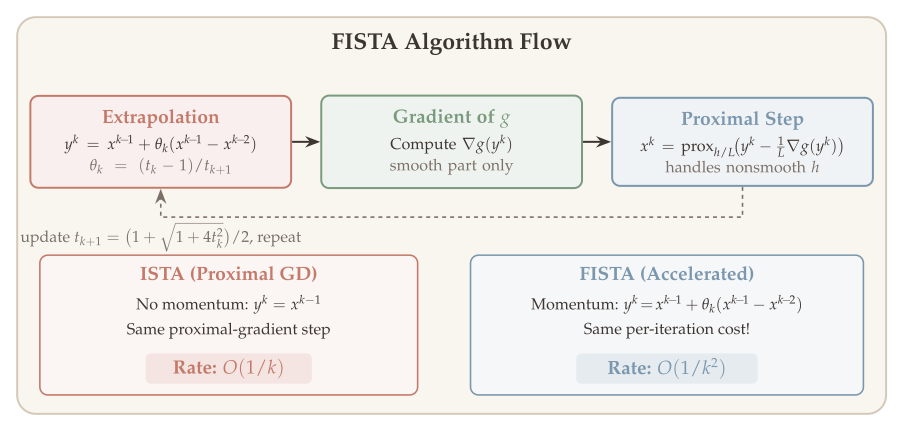
FISTA has the same structure as Nesterov’s accelerated gradient (11.7), but replaces the gradient step with the proximal-gradient step (11.16):
- Compute a proximal-gradient step from the extrapolated point y^k.
- Extrapolate using momentum with coefficient (\theta_k - 1)/\theta_{k+1}.
The \theta_k sequence is identical to the one in (11.11) — the same recursion, the same initial value \theta_1 = 1, and the same momentum schedule. There is no need to introduce separate notation: FISTA is simply Nesterov’s AGD with the gradient step replaced by a proximal-gradient step.
11.6.2 Convergence of FISTA
The following theorem confirms that FISTA achieves the same O(1/k^2) accelerated rate as Nesterov’s method (compare (11.9)), but for the composite objective F = g + h defined in (11.15).
Theorem 11.6 (Convergence of FISTA) Let g be convex and L-smooth, h be closed and convex. Then FISTA satisfies F(x^k) - F(x^*) \leq \frac{2L\|x^0 - x^*\|_2^2}{(k+1)^2}.
Proof. The proof follows the same Lyapunov strategy as Theorem 11.4. The key step is replacing the smooth fundamental inequality (11.10) with a composite analogue.
Step 1: Fundamental proximal inequality. We need to show: for any z, F(x^k) \leq F(z) + \frac{L}{2}\|z - y^k\|_2^2 - \frac{L}{2}\|x^k - y^k\|_2^2. \tag{11.18}
Derivation. Since x^k = \operatorname{prox}_{h/L}(y^k - \frac{1}{L}\nabla g(y^k)), its optimality condition states: there exists \xi \in \partial h(x^k) such that L(y^k - x^k) - \nabla g(y^k) = \xi. By L-smoothness of g (descent lemma): g(x^k) \leq g(y^k) + \langle \nabla g(y^k), x^k - y^k \rangle + \frac{L}{2}\|x^k - y^k\|_2^2. Adding h(x^k) to both sides and using convexity of g at z (g(y^k) \leq g(z) + \langle \nabla g(y^k), y^k - z\rangle): F(x^k) \leq g(z) + \langle \nabla g(y^k), x^k - z \rangle + \frac{L}{2}\|x^k - y^k\|_2^2 + h(x^k). Since \xi = L(y^k - x^k) - \nabla g(y^k) and h(z) \geq h(x^k) + \langle \xi, z - x^k\rangle (convexity of h): h(x^k) \leq h(z) - \langle L(y^k - x^k) - \nabla g(y^k), z - x^k\rangle. Substituting and completing the square (exactly as in the smooth case) yields (11.18).
Step 2: Lyapunov decrease. Since \theta_k satisfies the same recursion (11.11) and identity \theta_k(\theta_k - 1) = \theta_{k-1}^2, define u^k = \theta_{k-1}(x^k - x^*) - (\theta_{k-1} - 1)(x^{k-1} - x^*), \qquad \mathcal{E}_k = \theta_{k-1}^2\bigl(F(x^k) - F(x^*)\bigr) + \frac{L}{2}\|u^k\|_2^2. Applying (11.18) with z = \theta_k^{-1}x^* + (1 - \theta_k^{-1})x^k, the same algebra as Steps 4–5 of Theorem 11.4 (using convexity of F at z and the identity \theta_k(\theta_k - 1) = \theta_{k-1}^2) gives \mathcal{E}_{k+1} \leq \mathcal{E}_k.
Step 3: Conclude. Telescoping: \mathcal{E}_k \leq \mathcal{E}_1 \leq \frac{L}{2}\|x^0 - x^*\|_2^2. Since \theta_{k-1} \geq (k+1)/2: F(x^k) - F(x^*) \leq \frac{L\|x^0 - x^*\|_2^2}{2\theta_{k-1}^2} \leq \frac{2L\|x^0 - x^*\|_2^2}{(k+1)^2}. \blacksquare
11.6.3 Example: Accelerated LASSO
To illustrate FISTA concretely, we apply it to the LASSO problem — one of the most widely used composite optimization problems in statistics and machine learning. The LASSO objective decomposes naturally into a smooth quadratic loss g and a non-smooth \ell_1 penalty h, making it a perfect fit for the FISTA update (11.17).
Example 11.1 (FISTA for LASSO) Consider the LASSO problem: \min_{x \in \mathbb{R}^n}\; \frac{1}{2}\|Ax - b\|_2^2 + \lambda\|x\|_1. Here g(x) = \frac{1}{2}\|Ax - b\|_2^2 is L-smooth with L = \|A^\top A\| (largest eigenvalue of A^\top A), and h(x) = \lambda\|x\|_1.
The proximal operator of h is the soft-thresholding operator: \operatorname{prox}_{\alpha h}(x)_j = \operatorname{sign}(x_j)\max\{|x_j| - \alpha\lambda,\, 0\}, \quad j = 1, \ldots, n.
FISTA for LASSO becomes: \begin{aligned} x^k &= \mathcal{S}_{\lambda/L}\!\left(y^k - \frac{1}{L}A^\top(Ay^k - b)\right), \\ \theta_{k+1} &= \frac{1 + \sqrt{1 + 4\theta_k^2}}{2}, \\ y^{k+1} &= x^k + \frac{\theta_k - 1}{\theta_{k+1}}(x^k - x^{k-1}), \end{aligned} where \mathcal{S}_\tau(x)_j = \operatorname{sign}(x_j)\max\{|x_j| - \tau, 0\} is the soft-thresholding operator.
ISTA converges at rate O(1/k) while FISTA converges at O(1/k^2).
Figure 9.4: ISTA vs. FISTA on a 30-dimensional LASSO problem (\kappa = 20, \lambda = 0.3). Unlike the theoretical curves, the actual FISTA trajectory shows characteristic non-monotone oscillations while still converging quadratically faster than ISTA overall.
11.6.4 Rippling: Effect of Misspecified Momentum
A practical challenge with the strongly convex variant (11.13) is that it requires knowing \mu. If we use a guess \widehat{\mu} in place of \mu, the momentum becomes \beta = (\sqrt{\kappa_{\text{est}}}-1)/(\sqrt{\kappa_{\text{est}}}+1) where \kappa_{\text{est}} = L/\widehat{\mu}. Two failure modes arise:
- \widehat{\mu} < \mu (overestimating \kappa, too much momentum): the iterates overshoot, producing characteristic ripples whose period scales as \sqrt{L/\mu}.
- \widehat{\mu} > \mu (underestimating \kappa, too little momentum): convergence is slower but smoother — we sacrifice the rate improvement but remain stable.
Rippling behavior when the strong convexity parameter is misspecified on a quadratic with true \kappa = 100. Black: optimal \widehat{\mu} = \mu gives fast, smooth convergence. Blue/gold: underestimating \mu (using \widehat{\mu} = \mu/10 or \mu/100) creates oscillations from excessive momentum. Red: overestimating \mu (\widehat{\mu} = 10\mu) gives slower but stable convergence. This asymmetry motivates the restart strategies below.
11.7 Restart Strategies
The convergence guarantees established in Theorem 11.4 and Theorem 11.5 assume exact knowledge of problem parameters. In practice, the convex-case AGD (11.7) has a key limitation: its momentum \beta_k = (\theta_k - 1)/\theta_{k+1} \to 1 grows monotonically, eventually causing oscillations when the function is actually strongly convex. Meanwhile, the strongly convex variant (11.13) requires knowing \mu, which is often unavailable.
Restart techniques resolve this dilemma: run the convex-case AGD, but periodically reset the momentum to zero (i.e., set \theta \leftarrow 1 and y^k \leftarrow x^k). Each restart launches a fresh AGD run from the current iterate, giving a new O(1/k^2) convergence phase. If restarts are timed well, these polynomial phases compound into linear convergence.
11.7.1 Gradient Restart
The most effective adaptive restart criterion uses the gradient to detect overshoot:
Initialize: x^0 = y^0 \in \mathbb{R}^n, \theta = 1.
For k = 0, 1, 2, \ldots:
- Gradient step: y^{k+1} = x^k - \frac{1}{L}\nabla f(x^k).
- Update \theta: \theta_{\text{new}} = \frac{1 + \sqrt{1 + 4\theta^2}}{2}.
- Extrapolation: x^{k+1} = y^{k+1} + \frac{\theta - 1}{\theta_{\text{new}}}(y^{k+1} - y^k).
- Restart check: If \langle \nabla f(y^{k+1}),\, x^{k+1} - x^k \rangle > 0, then: \text{reset:} \quad x^{k+1} \leftarrow y^{k+1}, \quad \theta \leftarrow 1. Otherwise: \theta \leftarrow \theta_{\text{new}}.
Why this condition works. The momentum direction x^{k+1} - x^k is the step taken by extrapolation. The gradient \nabla f(y^{k+1}) points in the direction of steepest ascent. When \langle \nabla f(y^{k+1}), x^{k+1} - x^k \rangle > 0, the extrapolation step has a positive component along the ascent direction — the momentum is pushing the iterates uphill. This is the signature of overshoot: the method has passed the valley floor and is climbing the opposite wall. Resetting \theta \leftarrow 1 kills the momentum and starts a fresh AGD phase from y^{k+1}.
- Function restart: restart when f(y^{k+1}) > f(y^k). Simpler but less sensitive — it waits until the objective actually increases, which may be too late.
- Speed restart: restart when \|y^{k+1} - y^k\| < \|y^k - y^{k-1}\|. The iterates are slowing down, suggesting the method is oscillating.
- Fixed-frequency restart: restart every T iterations. Requires choosing T \approx \sqrt{\kappa}, which needs knowledge of \kappa.
11.7.2 Why Restart Gives Linear Convergence
Theorem 11.7 (Convergence with Restart) If f is \mu-strongly convex and L-smooth but \mu is unknown, applying the convex-case accelerated method (11.7) with fixed-frequency restart every T = \Theta(\sqrt{\kappa}) iterations yields f(y^k) - f(x^*) \leq C \cdot \exp\!\left(-\frac{k}{\sqrt{\kappa}}\right)\bigl(f(x^0) - f(x^*)\bigr), achieving the same O(\sqrt{\kappa}\log(1/\varepsilon)) complexity as the strongly convex variant (11.14).
Proof. Sketch. Within each restart phase of T iterations, the convex-case AGD guarantee (Theorem 11.4) gives f(y^T) - f(x^*) \leq 2L\|x^0_{\text{phase}} - x^*\|^2 / T^2. By strong convexity, \|x^0_{\text{phase}} - x^*\|^2 \leq (2/\mu)(f(x^0_{\text{phase}}) - f(x^*)). Combining: each phase reduces the gap by a factor of 4L/(\mu T^2) = 4\kappa/T^2. Choosing T = 2\sqrt{\kappa} gives a contraction factor \leq 1 per phase, and after k/T phases: f - f^* \leq (4\kappa/T^2)^{k/T}(f^0 - f^*) = e^{-k/(2\sqrt{\kappa})} \cdot \text{const}. \blacksquare
In practice, the adaptive gradient restart criterion triggers at approximately the right frequency without needing to know \kappa, often outperforming both the convex-case AGD (which ignores strong convexity) and the SC variant (which requires knowing \mu).
Gradient restart on a strongly convex quadratic (\kappa = 100). GD (dotted) converges at the slow rate (1-1/\kappa)^k. AGD without restart (red) uses the convex-case momentum and converges at O(1/k^2) with characteristic oscillations — it does not exploit strong convexity. AGD with gradient restart (blue) detects each overshoot via \langle \nabla f, \text{momentum direction}\rangle > 0, resets \theta \leftarrow 1, and achieves linear convergence — recovering the optimal O(\sqrt{\kappa}\log(1/\varepsilon)) rate without knowing \mu.
11.8 Summary and Connections
11.8.1 Key Results
Main takeaways from this lecture:
Heavy-ball method (Polyak, 1964): Adding momentum \theta(x^k - x^{k-1}) with fixed parameters achieves O(\sqrt{\kappa}\log(1/\varepsilon)) for quadratics but does not generalize to all convex functions.
Lower bounds show that gradient descent is suboptimal by a factor of \sqrt{\kappa} (or \sqrt{1/\varepsilon} in the convex case). The tridiagonal hard instances create an information bottleneck.
Nesterov’s accelerated gradient (1983) achieves the optimal rate among first-order methods using time-varying momentum:
- Convex: O(1/k^2) vs. O(1/k) for GD.
- Strongly convex: O(\exp(-k/\sqrt{\kappa})) vs. O(\exp(-k/\kappa)) for GD.
The ODE perspective (Su, Boyd, Candes 2014) explains the momentum coefficient: Nesterov’s method discretizes \ddot{X} + (3/\tau)\dot{X} + \nabla f(X) = 0, where 3 is the smallest damping constant giving O(1/\tau^2) convergence.
Convergence via Lyapunov functions: The \theta_k recursion \theta_k^2 - \theta_k = \theta_{k-1}^2 is derived from the Lyapunov decrease requirement, not assumed. The same proof handles both smooth and composite (FISTA) settings.
FISTA extends acceleration to composite problems \min\; g(x) + h(x), and restart strategies make acceleration practical when \mu is unknown.
11.8.2 Connections to Other Lectures
| Chapter | Connection to Acceleration |
|---|---|
| Chapter 6 (GD) | Acceleration improves GD’s rate by \sqrt{\kappa} |
| Chapter 7 (Subgradient) | Acceleration does not apply to non-smooth optimization without smoothing |
| Chapter 8 (Proximal GD) | FISTA = accelerated proximal gradient |
| Chapter 9 (Mirror Descent) | Accelerated mirror descent exists but requires more sophisticated analysis |
11.8.3 Open Directions
Acceleration via coupling (Allen-Zhu and Orecchia, 2017): Acceleration can be understood as coupling mirror descent with gradient descent — a viewpoint that connects to Chapter 9.
Catalyst framework (Lin, Mairal, Harchaoui, 2015): Any first-order method can be “accelerated” by wrapping it in a proximal point outer loop.
Integral quadratic constraints (Lessard, Recht, Packard, 2016): The heavy-ball and Nesterov methods can be analyzed in a unified framework using tools from robust control theory.
Acceleration for saddle-point problems and minimax optimization extends these ideas to the non-convex and game-theoretic settings studied in modern machine learning.
First-Order Methods: Master Comparison
| Method | Problem Class | Rate (convex) | Rate (strongly convex) | Per-Iteration Cost | Key Feature |
|---|---|---|---|---|---|
| Gradient Descent | Smooth | O(1/k) | O((1-\mu/L)^k) | 1 gradient | Simplest baseline |
| Subgradient | Lipschitz | O(1/\sqrt{k}) | O(1/\sqrt{k}) | 1 subgradient | Handles non-smooth |
| Proximal Gradient | Composite f+g | O(1/k) | O((1-\mu/L)^k) | 1 gradient + 1 prox | Exploits structure |
| Mirror Descent | Simplex/geometry | O(\sqrt{\log n / k}) | — | 1 gradient + mirror map | Dimension-adaptive |
| Heavy-Ball | Smooth quadratic | — | O((1-\sqrt{\mu/L})^k) | 1 gradient | Optimal for quadratics |
| Nesterov’s AGD | Smooth | O(1/k^2) | O((1-\sqrt{\mu/L})^k) | 1 gradient | Optimal rate |
| FISTA | Composite f+g | O(1/k^2) | O((1-\sqrt{\mu/L})^k) | 1 gradient + 1 prox | Accelerated proximal |
| Lower bound | Smooth convex | \Omega(1/k^2) | \Omega((1-\sqrt{\mu/L})^k) | — | Cannot do better |
Here L is the smoothness constant, \mu is the strong convexity parameter, and n is the dimension.
Appendix: ODE Lyapunov Computation
We verify that the Lyapunov function \mathcal{E}(\tau) = \tau^2\bigl(f(X) - f(x^*)\bigr) + 2\left\|X + \frac{\tau}{2}\dot{X} - x^*\right\|^2 is non-increasing along solutions of the ODE \ddot{X} + \frac{3}{\tau}\dot{X} + \nabla f(X) = 0.
Setup. Write \mathcal{E} = A + B where A = \tau^2(f(X) - f^*) and B = 2\|V\|^2 with V = X + \frac{\tau}{2}\dot{X} - x^*.
Differentiating A. By the chain rule: \dot{A} = 2\tau(f(X) - f^*) + \tau^2\langle \nabla f(X),\, \dot{X}\rangle.
Differentiating B. First compute \dot{V}: \dot{V} = \dot{X} + \frac{1}{2}\dot{X} + \frac{\tau}{2}\ddot{X} = \frac{3}{2}\dot{X} + \frac{\tau}{2}\ddot{X}. Substituting the ODE \ddot{X} = -\frac{3}{\tau}\dot{X} - \nabla f(X): \dot{V} = \frac{3}{2}\dot{X} + \frac{\tau}{2}\!\left(-\frac{3}{\tau}\dot{X} - \nabla f(X)\right) = \frac{3}{2}\dot{X} - \frac{3}{2}\dot{X} - \frac{\tau}{2}\nabla f(X) = -\frac{\tau}{2}\nabla f(X). Therefore: \dot{B} = 2 \cdot 2\langle V,\, \dot{V}\rangle = 4\!\left\langle X + \frac{\tau}{2}\dot{X} - x^*,\; -\frac{\tau}{2}\nabla f(X)\right\rangle = -2\tau\langle X - x^* + \frac{\tau}{2}\dot{X},\; \nabla f(X)\rangle.
Combining. Adding \dot{A} + \dot{B}: \dot{\mathcal{E}} = 2\tau(f(X) - f^*) + \tau^2\langle \nabla f(X), \dot{X}\rangle - 2\tau\langle X - x^*, \nabla f(X)\rangle - \tau^2\langle \dot{X}, \nabla f(X)\rangle. The \tau^2\langle \nabla f(X), \dot{X}\rangle terms cancel: \dot{\mathcal{E}} = 2\tau\bigl[f(X) - f^* - \langle \nabla f(X),\, X - x^*\rangle\bigr]. By convexity of f: f(x^*) \geq f(X) + \langle \nabla f(X), x^* - X\rangle, i.e., f(X) - f^* - \langle \nabla f(X), X - x^*\rangle \leq 0. Since \tau \geq 0: \dot{\mathcal{E}}(\tau) \leq 0.
This confirms \mathcal{E} is non-increasing. Since \tau^2(f(X) - f^*) \leq \mathcal{E}(\tau) \leq \mathcal{E}(0), we get f(X(\tau)) - f^* = O(1/\tau^2), which is the continuous analogue of the O(1/k^2) rate. \blacksquare
Appendix: Chebyshev Polynomials
The lower bound proof for strongly convex functions (Theorem 11.2) relies on Chebyshev polynomials, which solve the minimax polynomial approximation problem. We collect their key properties here.
Definition and Recurrence
Definition 11.2 (Chebyshev Polynomials of the First Kind) The Chebyshev polynomial T_k of degree k is defined by T_k(\cos\theta) = \cos(k\theta), \qquad \theta \in [0, \pi]. Equivalently, for |x| \leq 1: T_k(x) = \cos(k\arccos x).
The first few Chebyshev polynomials are: T_0(x) = 1, \quad T_1(x) = x, \quad T_2(x) = 2x^2 - 1, \quad T_3(x) = 4x^3 - 3x, \quad T_4(x) = 8x^4 - 8x^2 + 1.
They satisfy the three-term recurrence: T_{k+1}(x) = 2x\,T_k(x) - T_{k-1}(x), \qquad k \geq 1.
Chebyshev polynomials T_1 through T_5 on [-1, 1]. Each T_k oscillates between -1 and +1 exactly k+1 times, achieving the maximum deviation at the endpoints and at k-1 interior points. This equioscillation property is what makes them optimal for minimax approximation.
Key Properties
(C1) Boundedness. |T_k(x)| \leq 1 for all x \in [-1, 1].
(C2) Equioscillation. T_k attains the values \pm 1 at k + 1 points in [-1, 1]: the Chebyshev nodes x_j = \cos(j\pi/k) for j = 0, 1, \ldots, k.
(C3) Growth outside [-1, 1]. For |x| > 1, T_k grows exponentially: T_k(x) = \frac{1}{2}\left[\bigl(x + \sqrt{x^2 - 1}\bigr)^k + \bigl(x - \sqrt{x^2 - 1}\bigr)^k\right]. In particular, for x > 1: T_k(x) \geq \frac{1}{2}(x + \sqrt{x^2 - 1})^k.
(C4) Minimax optimality. Among all monic polynomials of degree k (leading coefficient = 1), the rescaled Chebyshev polynomial 2^{1-k}T_k has the smallest maximum absolute value on [-1, 1]: \min_{\substack{p \text{ monic} \\ \deg p = k}} \max_{x \in [-1,1]} |p(x)| = 2^{1-k}, \qquad \text{achieved by } p^*(x) = 2^{1-k}T_k(x).
Application to Lower Bounds
In the lower bound proof, we need to approximate 0 on [\mu, L] by polynomials p_k satisfying p_k(0) = 1. The affine change of variables t \mapsto (L + \mu - 2t)/(L - \mu) maps [\mu, L] to [-1, 1] and 0 to (L+\mu)/(L-\mu) > 1. The shifted Chebyshev polynomial p_k^*(t) = \frac{T_k\!\bigl(\frac{L+\mu-2t}{L-\mu}\bigr)}{T_k\!\bigl(\frac{L+\mu}{L-\mu}\bigr)} satisfies p_k^*(0) = 1, |p_k^*(t)| \leq 1/T_k\!\bigl(\frac{L+\mu}{L-\mu}\bigr) on [\mu, L], and is minimax optimal. Using property (C3) with x = (L+\mu)/(L-\mu), we obtain the exponential lower bound \bigl(\frac{\sqrt{\kappa}-1}{\sqrt{\kappa}+1}\bigr)^{2k} as shown in the proof of Theorem 11.2.
Shifted Chebyshev approximation polynomials p_k^*(t) on [\mu, L] = [1, 10] for k = 2, 4, 6, 8, 10. Each polynomial satisfies p_k^*(0) = 1 and approximates 0 on [\mu, L] with exponentially decreasing error as k grows. The equioscillation pattern of the Chebyshev polynomial is visible in the oscillations.
In the next chapter, we shift from classical optimization algorithms to modern deep learning architectures. We will study the Transformer, a computational architecture built on self-attention mechanisms that has revolutionized sequence modeling. Remarkably, Transformers have deep connections to optimization — they can express iterative optimization algorithms as forward passes through their layers.
B. T. Polyak, “Some methods of speeding up the convergence of iteration methods,” USSR Computational Mathematics and Mathematical Physics, 4(5):1–17, 1964.↩︎
Y. Nesterov, “A method of solving a convex programming problem with convergence rate O(1/k^2),” Soviet Mathematics Doklady, 27(2):372–376, 1983.↩︎
W. Su, S. Boyd, and E. J. Candès, “A differential equation for modeling Nesterov’s accelerated gradient method: theory and insights,” Journal of Machine Learning Research, 17(153):1–43, 2016.↩︎
A. Beck and M. Teboulle, “A fast iterative shrinkage-thresholding algorithm for linear inverse problems,” SIAM Journal on Imaging Sciences, 2(1):183–202, 2009.↩︎
B. O’Donoghue and E. Candes, “Adaptive restart for accelerated gradient schemes,” Foundations of Computational Mathematics, 15(3):715–732, 2015.↩︎