5 Convex Optimization
Optimization is hard in general — a function can have countless local minima, saddle points, and deceptive plateaus. So why is it that many of the optimization problems arising in statistics, machine learning, and engineering can be solved reliably and efficiently? The answer, more often than not, is convexity. When both the objective and the constraints are convex, the landscape of the problem simplifies dramatically: every local minimum is automatically a global minimum, and efficient algorithms can find it in polynomial time.
This chapter develops the theory of convex optimization from the ground up. We define the standard form of a convex program, establish its key structural properties — convexity of suboptimal sets, uniqueness under strict convexity, first-order optimality conditions, and the equivalence of local and global optima. We then survey the most important classes of convex programs — LP, QP, SOCP, and SDP — which form a nested hierarchy of increasing expressiveness. Finally, we introduce CVXPY, a modern Python framework that lets us specify and solve convex programs with just a few lines of code, and demonstrate its power through several applications with interactive visualizations.
Hands-on Python notebooks accompany this chapter. Click a badge to open in Google Colab.
 Convex Optimization Examples — LP, QP, SDP, robust optimization, and Chebyshev center in CVXPY
- Portfolio Optimization — Markowitz mean-variance optimization with leverage constraints
- Optimal Control — control trajectory optimization with state and input constraints
- Logistic Regression — \ell_1-regularized logistic regression with cross-validation
What Will Be Covered
- Standard form of optimization problems and the convexity condition
- Key properties: local optima are global, convexity of optimal and suboptimal sets
- First-order optimality conditions for unconstrained and constrained convex programs
- The hierarchy of convex programs: LP, QP, SOCP, and SDP
- Practical modeling with CVXPY: portfolio optimization, optimal control, logistic regression
5.1 Formulation of Optimization Problems
5.1.1 Standard Form
Definition 5.1 (General Optimization — Standard Form) A general optimization problem in standard form is:
\begin{aligned} \min_{x \in \mathbb{R}^n} \quad & f_0(x) \\ \text{subject to} \quad & f_i(x) \leq 0, \quad i = 1, 2, \ldots, m \\ & h_i(x) = 0, \quad i = 1, 2, \ldots, p. \end{aligned}
Here x \in \mathbb{R}^n is the optimization variable (decision variable), f_0 : \mathbb{R}^n \to \mathbb{R} is the objective function (cost function), f_i : \mathbb{R}^n \to \mathbb{R} for i \in [m] are inequality constraint functions, and h_i : \mathbb{R}^n \to \mathbb{R} for i \in [p] are equality constraint functions. If m = p = 0, this reduces to unconstrained optimization: \min_{x \in \mathbb{R}^n} f_0(x).
The standard form provides a unified framework for expressing optimization problems. By separating the objective from the inequality and equality constraints, we can develop general-purpose theory and algorithms that apply across a wide range of applications.
5.1.2 Feasibility and Optimal Value
Definition 5.2 (Domain, Feasible Set, Optimal Value) The domain of the optimization problem is:
\mathcal{D} = \bigcap_{i=0}^{m} \operatorname{dom} f_i \;\cap\; \bigcap_{i=1}^{p} \operatorname{dom} h_i.
A point x_0 \in \mathcal{D} is feasible if f_i(x_0) \leq 0 for all i \in [m] and h_i(x_0) = 0 for all i \in [p].
The feasible set is \Omega = \{x \in \mathcal{D} \mid f_i(x) \leq 0 \;\forall\, i \in [m],\; h_i(x) = 0 \;\forall\, i \in [p]\}.
The optimal value is:
f^* = \inf\{f_0(x) \mid x \in \Omega\}.
Two degenerate cases deserve special notation:
- If \Omega = \emptyset (infeasible), we define f^* = +\infty.
- If there exists a sequence \{x_k\} of feasible points with f_0(x_k) \to -\infty, we define f^* = -\infty and say the problem is unbounded (from below).
Both conventions ensure that f^* is always well-defined.
The domain, feasible set, and optimal value characterize the “landscape” of an optimization problem. The distinction between infeasibility (f^* = +\infty) and unboundedness (f^* = -\infty) is important: both indicate that something is wrong with the problem formulation, but for different reasons.
5.1.3 Optimal Points and Local Optimality
Definition 5.3 (Optimal Point, Active Constraint, Local Optimality) If x_0 is feasible and f_0(x_0) = f^* > -\infty, then x_0 is an optimal point (solution / minimizer). If an optimal point exists, we say f^* is attained and the problem is solvable.
For any \varepsilon > 0, a feasible point x_0 satisfying f_0(x_0) \leq f^* + \varepsilon is called an \varepsilon-optimal solution.
If x is feasible and f_i(x) = 0, we say constraint f_i is active (binding) at x.
A point x_0 is locally optimal if there exists R > 0 such that x_0 solves:
\min f_0(z) \quad \text{s.t.} \quad f_i(z) \leq 0,\; h_i(z) = 0,\; \|z - x_0\| \leq R.
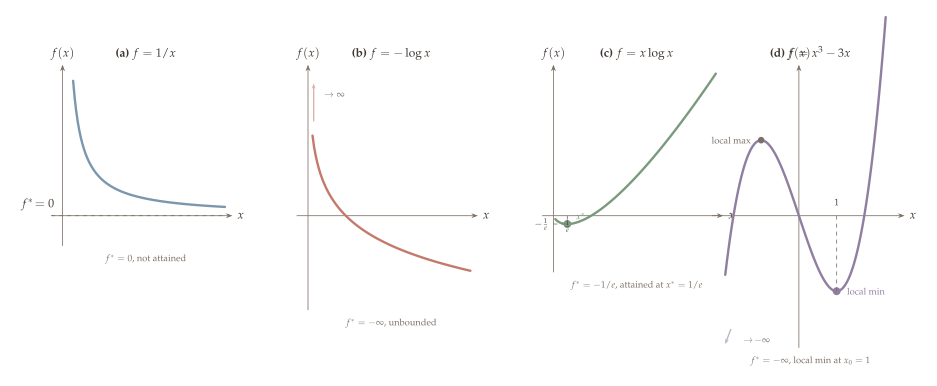
Example 5.1 (Unconstrained Optimization (n=1, m=p=0)) The following examples illustrate the range of possible behaviors for unconstrained optimization in one dimension (Figure 5.1):
(a) f_0 = 1/x on \operatorname{dom}(f_0) = \mathbb{R}_{++}. As x \to \infty, f_0(x) \to 0, so f^* = 0. However, no point achieves this value — the infimum is not attained.
(b) f_0 = -\log x on \operatorname{dom}(f_0) = \mathbb{R}_{++}. As x \to \infty, f_0(x) \to -\infty, so f^* = -\infty and the problem is unbounded below.
(c) f_0 = x \log x on \operatorname{dom}(f_0) = \mathbb{R}_{++}. Setting f_0'(x) = \log x + 1 = 0 gives the unique minimizer x^* = 1/e, with optimal value f^* = -1/e. This is the “well-behaved” case: the minimum exists and is attained.
(d) f_0 = x^3 - 3x on \operatorname{dom}(f_0) = \mathbb{R}. Setting f_0'(x) = 3x^2 - 3 = 0 gives critical points at x = \pm 1. The point x_0 = 1 is a local minimum with f_0(1) = -2, but f_0(x) \to -\infty as x \to -\infty, so the local minimum is not global.
A feasibility problem asks: does there exist x with f_i(x) \leq 0 for all i and h_i(x) = 0 for all i? This is equivalent to minimizing f_0 = 0 subject to the same constraints. The optimal value immediately reveals feasibility: f^* = 0 if the constraints are feasible (the trivial objective is attained), and f^* = +\infty if the constraints are infeasible (no feasible point exists).
5.1.4 Convex Optimization in Standard Form
With the general framework in place, we now specialize to the setting that will occupy most of this course: convex optimization. At its core, a convex optimization problem asks us to minimize a convex objective function over a convex feasible set. The standard form makes this precise by specifying exactly which kinds of objectives and constraints preserve convexity.
Definition 5.4 (Convex Optimization Problem) A convex optimization problem is a problem in standard form with three additional requirements:
- The objective f_0 is convex.
- The inequality constraint functions f_i are convex.
- The equality constraint functions are affine: h_i(x) = a_i^\top x - b_i.
\begin{aligned} \min \quad & f_0(x) \\ \text{s.t.} \quad & f_i(x) \leq 0, \quad i = 1,2,\ldots, m \\ & a_i^\top x = b_i, \quad i = 1,2,\ldots, p. \end{aligned}
The domain is \mathcal{D} = \bigcap_{i=0}^{m} \operatorname{dom} f_i, which is convex (intersection of convex sets).
The three requirements work together to guarantee that the feasible set \Omega is convex, which is what makes the problem tractable. Two of these requirements deserve special emphasis.
Requirement 3 — that equality constraints must be affine — is not an arbitrary restriction. A nonlinear equality constraint h(x) = 0 defines a level set \{x : h(x) = 0\}, which is typically a curved surface, not a convex set. For instance, x_1^2 + x_2^2 = 1 defines a circle, which is not convex. Allowing nonlinear equalities would destroy convexity of the feasible set, and with it all the structural properties that make convex optimization tractable.
Affine equalities a_i^\top x = b_i define hyperplanes, which are convex (in fact, they are both convex and affine subsets of \mathbb{R}^n). Their intersection is an affine subspace — always convex.
The standard form is one way to specify a convex optimization problem, but the essential structure is simpler. A convex optimization problem is equivalently:
\min_{x \in \Omega}\; f_0(x), \qquad \text{where } f_0 \text{ is convex and } \Omega \subseteq \mathbb{R}^n \text{ is a convex set.}
The standard form with convex inequalities and affine equalities is simply the most common way to describe the convex feasible set \Omega. Any problem of the form “minimize a convex function over a convex set” is a convex optimization problem, regardless of how \Omega is represented.
The feasible set of a convex optimization problem is always convex:
\Omega = \mathcal{D} \;\cap\; \underbrace{\bigcap_{i=1}^{m}\{x : f_i(x) \leq 0\}}_{\text{sublevel sets of convex } f_i} \;\cap\; \underbrace{\bigcap_{i=1}^{p}\{x : a_i^\top x = b_i\}}_{\text{hyperplanes}}.
Each sublevel set \{x : f_i(x) \leq 0\} is convex (by Theorem 4.8), each hyperplane is convex, and the intersection of convex sets is convex (by Theorem 3.4).
5.2 Properties of Convex Optimization
What makes convex optimization fundamentally different from general nonlinear optimization? Three structural properties answer this question: the set of near-optimal solutions is always convex, strictly convex objectives have unique minimizers, and – most importantly – every local minimum is automatically global. Together, these properties explain why convex problems are computationally tractable.
Theorem 5.1 (Convex \varepsilon-Suboptimal Sets) For any \varepsilon \geq 0, the \varepsilon-suboptimal set
\{x : f_0(x) \leq f^* + \varepsilon\} \cap \Omega
is a convex set.
Proof. Let S_\varepsilon = \{x \in \Omega : f_0(x) \leq f^* + \varepsilon\}. Take any x, y \in S_\varepsilon and \lambda \in [0,1]. Since \Omega is convex, z = \lambda x + (1{-}\lambda)y \in \Omega. By convexity of f_0,
f_0(z) \leq \lambda f_0(x) + (1{-}\lambda)f_0(y) \leq \lambda(f^* + \varepsilon) + (1{-}\lambda)(f^* + \varepsilon) = f^* + \varepsilon.
Hence z \in S_\varepsilon, so S_\varepsilon is convex. \blacksquare
This means that the set of “nearly optimal” feasible points is always convex. In practice, this implies that if two solutions are both close to optimal, then any convex combination of them is also close to optimal — there are no “gaps” in the set of good solutions.
Theorem 5.2 (Strict Convexity Implies Uniqueness) If f_0 is strictly convex, then the optimal solution (if it exists) is unique. That is,
\{x : f_0(x) = f^*\} \cap \Omega = \{x^*\}.
Proof. Suppose for contradiction that x^* and y^* are both optimal with x^* \neq y^*, so f_0(x^*) = f_0(y^*) = f^*. Since \Omega is convex, the midpoint z = \tfrac{1}{2}x^* + \tfrac{1}{2}y^* is feasible. By strict convexity of f_0,
f_0(z) < \tfrac{1}{2}f_0(x^*) + \tfrac{1}{2}f_0(y^*) = f^*.
This contradicts the definition of f^* as the optimal value. \blacksquare
Strict convexity means the objective function curves strictly upward in every direction, so there can be at most one point at the bottom of the “bowl.” This is a useful structural property: when the optimizer is unique, there is no ambiguity about the solution and algorithms are guaranteed to converge to the same answer regardless of initialization.
Example 5.2 (Lasso) Consider the Lasso problem with y \in \mathbb{R}^n, X \in \mathbb{R}^{n \times d}:
\min_\beta \;\|y - X\beta\|_2^2 \quad \text{s.t.} \quad \|\beta\|_1 \leq s.
The uniqueness of the solution depends on the geometry of the design matrix:
- If n \geq d and X has full column rank, then f_0(\beta) = \|y - X\beta\|_2^2 is strictly convex, giving a unique solution.
- If n < d (high-dimensional case), the solution is not necessarily unique because the objective is only convex (not strictly so).
The first two properties tell us about the structure of the set of optimal and near-optimal solutions. The next property is the most consequential: it tells us that local search suffices for global optimization.
5.2.1 Local Optimality Implies Global Optimality
Theorem 5.3 (Local Min = Global Min) Any local optimal point of a convex problem is also globally optimal.
This is arguably the single most important property of convex optimization. It means that any algorithm which converges to a local minimum automatically finds the global minimum. For nonconvex problems, by contrast, algorithms can get “stuck” at suboptimal local minima, making optimization fundamentally harder.
Proof. Strategy. We argue by contradiction. If x_0 were locally but not globally optimal, there would exist a better feasible point y. By convexity, the line segment from x_0 to y stays feasible, and by convexity of f_0, every point on this segment (except x_0) has strictly lower objective value. But points on this segment close to x_0 lie inside the ball where x_0 is locally optimal – a contradiction.
Suppose x_0 is a local minimum but not global. Then there exists R > 0 such that
z \in \Omega,\; \|z - x_0\| \leq R \implies f_0(z) \geq f_0(x_0),
and there exists y \in \Omega with f_0(x_0) > f_0(y).
Since x_0, y \in \Omega and \Omega is convex, \lambda x_0 + (1-\lambda) y \in \Omega for all \lambda \in [0,1]. Now, applying the definition of convexity of f_0:
f_0(\lambda x_0 + (1-\lambda)y) \leq \lambda f_0(x_0) + (1-\lambda) f_0(y) < f_0(x_0) \quad \text{for all } \lambda \in (0,1).
But when \lambda is close to 1, \|\lambda x_0 + (1-\lambda)y - x_0\| = (1-\lambda)\|y - x_0\| \leq R, so the point lies in the ball where x_0 is locally optimal.
This gives f_0(\lambda x_0 + (1-\lambda)y) \geq f_0(x_0). Contradiction. Therefore x_0 must be globally optimal. This completes the proof. \blacksquare
For convex optimization: every local minimum is a global minimum. This is the fundamental reason why convex problems are “tractable.”
Figure 5.1: A convex function (left) has a single global minimum. A non-convex function (right) can have multiple local minima that are not global.
5.3 Optimality Conditions for Differentiable Problems
The properties above characterize the structure of the optimal set. When the objective is differentiable, we can also give explicit gradient conditions that characterize optimal points. These conditions are the starting point for the gradient-based algorithms developed in subsequent chapters.
5.3.1 Unconstrained Case
Theorem 5.4 (Unconstrained Optimality) If f_0 is convex and differentiable, then x^* is a global minimizer of f_0 over \mathbb{R}^n if and only if:
\nabla f_0(x^*) = 0. \tag{5.1}
For unconstrained convex problems, the familiar calculus condition \nabla f_0(x^*) = 0 is both necessary and sufficient for global optimality — a direct consequence of the first-order characterization of convexity (Equation 4.2).
5.3.2 Equality-Constrained Case
When the only constraints are affine equalities Ax = b, the optimality condition takes a geometric form involving the null space of A.
Theorem 5.5 (Equality-Constrained Optimality) Consider \min f_0(x) subject to Ax = b, where f_0 is convex and differentiable. Then x^* is optimal if and only if:
\nabla f_0(x^*) \perp \mathcal{N}(A), \tag{5.2}
where \mathcal{N}(A) = \{v : Av = 0\} is the null space of A.
Proof. The feasible set is \Omega = \{x : Ax = b\}. By the general constrained optimality condition (Theorem 5.6 below), x^* is optimal if and only if \nabla f_0(x^*)^\top(y - x^*) \geq 0 for all feasible y. Since both x^* and y satisfy Ax = b, we have A(y - x^*) = 0, so y - x^* ranges over the null space \mathcal{N}(A). The condition becomes \nabla f_0(x^*)^\top v \geq 0 for all v \in \mathcal{N}(A). Since \mathcal{N}(A) is a subspace (if v \in \mathcal{N}(A) then -v \in \mathcal{N}(A)), this forces \nabla f_0(x^*)^\top v = 0 for all v \in \mathcal{N}(A). \blacksquare
Geometrically, Equation 5.2 says that at the optimum, the gradient of the objective has no component along the affine subspace of feasible directions — any movement that stays feasible cannot decrease f_0.
5.3.3 General Constrained Case
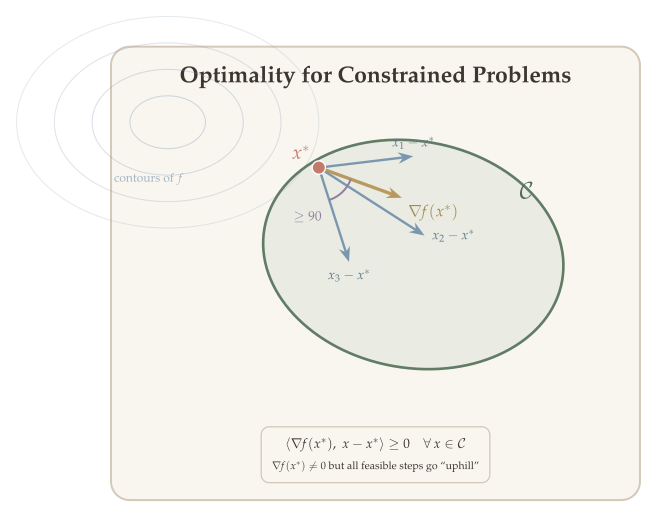
Theorem 5.6 (Constrained Optimality) If f_0 is convex and differentiable, then x^* is optimal for \min_{x \in \Omega} f_0(x) (where \Omega is convex) if and only if:
\nabla f_0(x^*)^\top (y - x^*) \geq 0 \quad \forall\, y \in \Omega. \tag{5.3}
Geometrically, the negative gradient -\nabla f_0(x^*) makes an obtuse angle with every feasible direction from x^*.
Proof. Sufficiency: For any y \in \Omega, by the first-order characterization of convexity:
f_0(y) \geq f_0(x^*) + \nabla f_0(x^*)^\top (y - x^*) \geq f_0(x^*),
where the first inequality uses convexity and the second uses the assumption \nabla f_0(x^*)^\top (y - x^*) \geq 0. Since this holds for every feasible y, x^* is optimal.
Necessity: Suppose x^* is optimal but \exists\, y \in \Omega with \nabla f_0(x^*)^\top (y - x^*) < 0. Then for small t > 0, the point x^* + t(y - x^*) \in \Omega (by convexity of \Omega) and by the first-order Taylor expansion:
f_0(x^* + t(y-x^*)) \approx f_0(x^*) + t \nabla f_0(x^*)^\top(y - x^*) < f_0(x^*),
contradicting optimality of x^*. \blacksquare
The constrained optimality condition Equation 5.3 generalizes both the unconstrained case (Equation 5.1, where \Omega = \mathbb{R}^n and the condition reduces to \nabla f_0(x^*) = 0) and the equality-constrained case (Equation 5.2, where feasible directions are restricted to \mathcal{N}(A)).
5.4 Examples of Convex Optimization
The structural properties and optimality conditions above apply to all convex programs. In practice, however, most convex problems fall into a small number of well-studied classes that form a strict hierarchy: LP \subseteq QP \subseteq QCQP \subseteq SOCP \subseteq SDP. Each class has specialized algorithms that exploit its structure, and recognizing which class a problem belongs to is often the key step in solving it efficiently.
5.4.1 1. Linear Program (LP)
Definition 5.5 (Linear Program) A linear program (introduced in Section 3.3) has a linear objective and linear constraints:
General form:
\min\; c^\top x + d \quad \text{s.t.} \quad Gx \leq h, \; Ax = b.
Standard form: \min\; c^\top x \;\;\text{s.t.}\;\; Ax = b.
Canonical form: \min\; c^\top x \;\;\text{s.t.}\;\; Ax \leq b,\; x \geq 0.
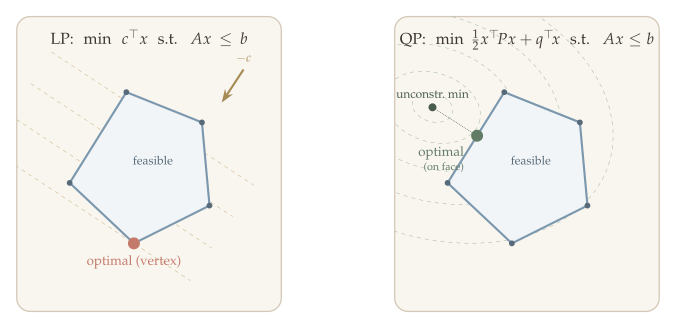
Linear programs are the simplest class of convex optimization problems. Despite their simplicity, they are remarkably expressive and arise in transportation, scheduling, network flows, and many other applications. Their feasible sets are polyhedra, and their solutions always occur at vertices.
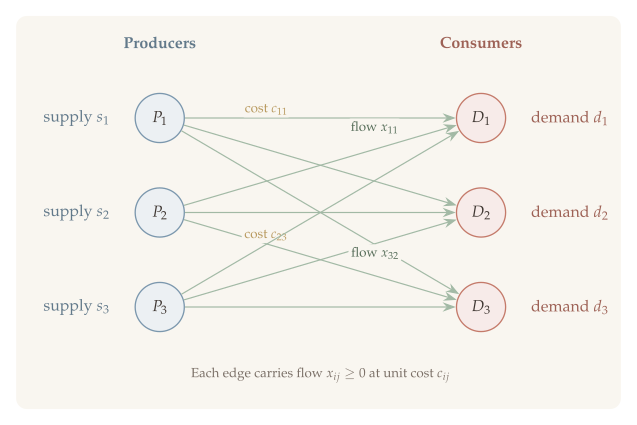
Example 5.3 (Transportation Problem) Given m producers with supply limits s_i and n consumers with demands d_j, and per-unit transport cost c_{ij} from producer i to consumer j (Figure 5.3):
\min_{\{x_{ij}\}} \sum_{i,j} c_{ij} x_{ij} \quad \text{s.t.} \quad \sum_j x_{ij} \leq s_i,\; \sum_i x_{ij} \geq d_j,\; x_{ij} \geq 0.
This is an LP: linear objective, linear inequality constraints.
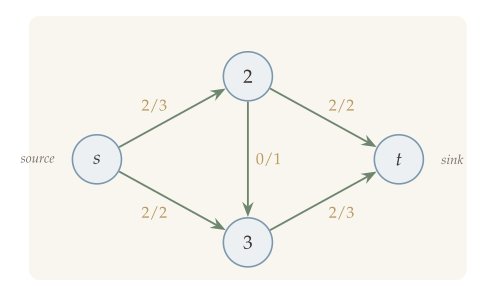
Example 5.4 (Maximum Flow Problem) Given a directed graph G = (V, E) with edge capacities C_{uv}, maximize flow from source to sink (Figure 5.4):
\max_{\{x_{uv}\}} \sum_{\substack{v \in V \\ e_{1v} \in E}} x_{1v} \quad \text{s.t.} \quad 0 \leq x_{uv} \leq C_{uv},\; \sum_{u: e_{uv}\in E} x_{uv} = \sum_{w: e_{vw}\in E} x_{vw} \;\;\forall\, v \in V \setminus \{1,n\}.
The flow conservation constraint (flow in = flow out) holds at every internal node. This is also an LP.
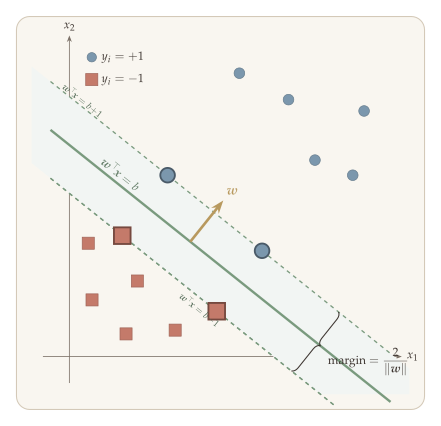
Example 5.5 (Linear Classification (Support Vector Machine)) Given m data points \{(x_i, y_i)\}_{i=1}^m with x_i \in \mathbb{R}^n and labels y_i \in \{+1, -1\}, the data is linearly separable if there exists a hyperplane w^\top x + b = 0 that separates the two classes. Finding such a hyperplane amounts to finding (w, b) with y_i(w^\top x_i + b) \geq 1 for all i, which is a feasibility LP.
Among all separating hyperplanes, the max-margin classifier chooses the one that maximizes the distance (margin = 2/\|w\|_2) between the closest points of each class and the hyperplane (Figure 5.5):
\min_{w, b}\; \tfrac{1}{2}\|w\|_2^2 \quad \text{s.t.} \quad y_i(w^\top x_i + b) \geq 1, \quad i = 1, \ldots, m.
This is a QP (quadratic objective, linear constraints). We will revisit this formulation when we discuss SOCP, where the connection between max-margin and robust classification becomes clear.
Solving systems of linear inequalities dates back to the late 1700s, when Fourier invented Fourier–Motzkin elimination. In the 1930s, Kantorovich and Koopmans brought new life to LP by applying it to resource allocation and transportation problems; they jointly received the Nobel Prize in Economics in 1975. Koopmans was a director of the Cowles Foundation at Yale — his medal is displayed at 30 Hillhouse Avenue.
In 1947, George Dantzig invented the simplex method, the first practical algorithm for solving LPs. Although Dantzig’s version of simplex runs in exponential time in the worst case, it works remarkably well in practice. Von Neumann is credited with developing the theory of LP duality. In 1979, Khachiyan showed that LPs can be solved in polynomial time using the ellipsoid method (a theoretical breakthrough, since the ellipsoid method is quite slow in practice). In 1984, Karmarkar developed the interior-point method, another polynomial-time algorithm that is also efficient in practice. In 2001, Spielman and Teng (Yale) established the smoothed analysis of the simplex method, showing that small random perturbations of LP data can be solved efficiently by simplex.
5.4.2 2. Quadratic Program (QP)
Many problems in statistics and machine learning – least-squares regression, portfolio optimization, support vector machines – naturally involve minimizing a quadratic objective subject to linear constraints. Quadratic programs generalize LPs by allowing a quadratic (but still convex) objective.
Definition 5.6 (Quadratic Program) A quadratic program minimizes a convex quadratic objective subject to linear constraints:
\min_x \;\frac{1}{2} x^\top P x + q^\top x + r \quad \text{s.t.} \quad Gx \leq h,\; Ax = b,
where P \succeq 0 (positive semidefinite). If P \succ 0, the objective is strictly convex and the solution is unique (if it exists).
The positive semidefiniteness condition P \succeq 0 is what ensures convexity of the objective. When P \succ 0 (strictly positive definite), the problem has a unique minimizer, which is the typical situation in regularized regression and portfolio optimization.
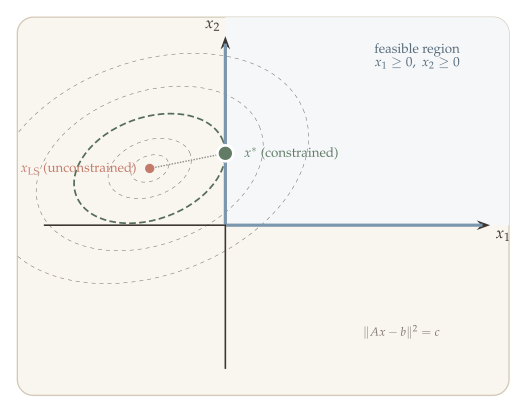
Example 5.6 (Least Squares with Constraints) The constrained least-squares problem \min \|Ax - b\|_2^2 \;\text{s.t.}\; x \geq 0 is a QP with P = 2A^\top A, q = -2A^\top b. Similarly, the Lasso \min \|y - X\beta\|_2^2 subject to \|\beta\|_1 \leq s is a QP (after reformulating the \ell_1-constraint using auxiliary variables).
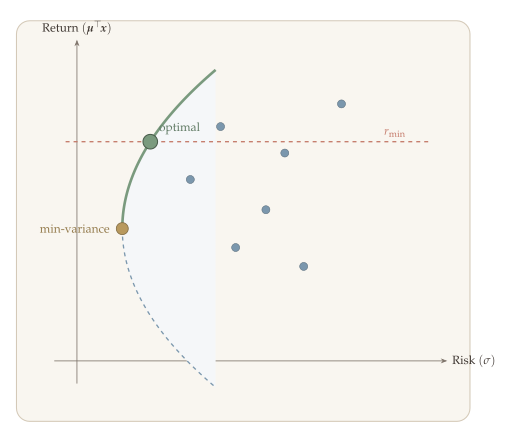
Example 5.7 (Markowitz Portfolio Optimization) Given n assets with expected return vector \mu \in \mathbb{R}^n and covariance matrix \Sigma \in \mathbb{S}^n_+, an investor allocates weight x_i to asset i (with \sum_i x_i = 1, x_i \geq 0). The portfolio variance is x^\top \Sigma x and the expected return is \mu^\top x (Figure 5.8). The minimum-variance portfolio for a target return r_{\min} is:
\min_x \; x^\top \Sigma x \quad \text{s.t.} \quad \mu^\top x \geq r_{\min}, \quad \mathbf{1}^\top x = 1, \quad x \geq 0.
This is a QP: quadratic objective (\Sigma \succeq 0), linear constraints.
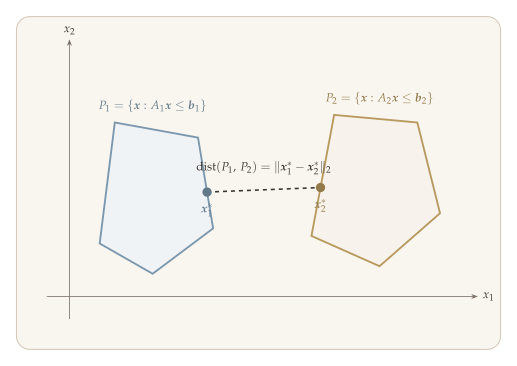
Example 5.8 (Distance Between Polyhedra) Given two polyhedra P_1 = \{x : A_1 x \leq b_1\} and P_2 = \{x : A_2 x \leq b_2\} (Figure 5.9), their distance \operatorname{dist}(P_1, P_2) = \inf_{x_1 \in P_1, x_2 \in P_2} \|x_1 - x_2\|_2 can be computed by solving the QP:
\min_{x_1, x_2} \; \|x_1 - x_2\|_2^2 \quad \text{s.t.} \quad A_1 x_1 \leq b_1, \quad A_2 x_2 \leq b_2.
5.4.3 Quadratically Constrained QP (QCQP)
A natural extension of QP allows quadratic (not just linear) constraints. This leads to the quadratically constrained quadratic program.
Definition 5.7 (Definition (QCQP)) A QCQP minimizes a convex quadratic objective subject to convex quadratic inequality constraints:
\min_x \; \tfrac{1}{2}x^\top P_0 x + q_0^\top x + r_0 \quad \text{s.t.} \quad \tfrac{1}{2}x^\top P_i x + q_i^\top x + r_i \leq 0, \;\; i \in [m], \quad Ax = b,
where P_0, P_1, \ldots, P_m \succeq 0. When P_i \succ 0, the constraint \{x : \tfrac{1}{2}x^\top P_i x + q_i^\top x + r_i \leq 0\} is an ellipsoid, so the feasible set of a QCQP is the intersection of ellipsoids with an affine subspace.
The hierarchy so far: LP \subseteq QP \subseteq QCQP (LP is QP with P = 0; QP is QCQP with P_1 = \cdots = P_m = 0).
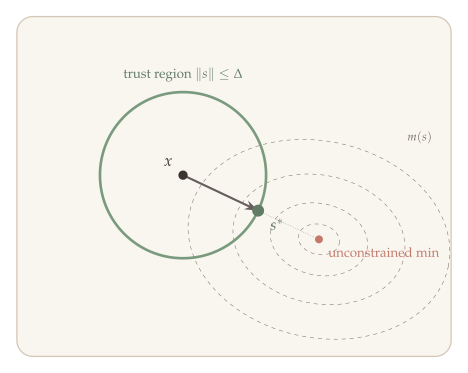
Example 5.9 (Trust Region Optimization) At each step of a trust-region method, we minimize a local quadratic model m(s) = f(x) + \nabla f(x)^\top s + \tfrac{1}{2}s^\top \nabla^2 f(x)\, s within a trust region \|s\| \leq \Delta (Figure 5.10):
\min_s \; f(x) + \nabla f(x)^\top s + \tfrac{1}{2}s^\top \nabla^2 f(x)\, s \quad \text{s.t.} \quad s^\top s \leq \Delta^2.
This is a QCQP with one quadratic constraint (the trust region).
Example 5.10 (Portfolio Optimization with Risk Constraints) Suppose asset returns have a factor structure: the risk exposure is captured by a matrix F \in \mathbb{R}^{k \times n} (where F_{ij} is asset j’s exposure to risk factor i). We want to minimize variance while bounding the total factor risk exposure \|Fw\|_2^2 \leq \text{risk}_{\max}:
\min_w \; w^\top \Sigma w \quad \text{s.t.} \quad \mu^\top w \geq r_{\min}, \quad \|Fw\|_2^2 \leq \text{risk}_{\max}, \quad 0 \leq w_i \leq 0.1, \quad \sum_i w_i = 1.
The norm-squared constraint \|Fw\|_2^2 = w^\top F^\top F w \leq \text{risk}_{\max} is a convex quadratic constraint (since F^\top F \succeq 0), making this a QCQP. The bound w_i \leq 0.1 ensures no single asset exceeds 10% of the portfolio.
5.4.4 3. Second-Order Cone Program (SOCP)
Some problems require constraints that bound the Euclidean norm of an affine expression – for example, robust optimization under uncertainty, or placing bounds on prediction errors. These norm constraints are more expressive than the linear constraints of LPs and QPs but still preserve convexity.
Definition 5.8 (SOCP) A second-order cone program has the form:
\min_x\; f^\top x \quad \text{s.t.} \quad \|A_i x + b_i\|_2 \leq c_i^\top x + d_i, \quad i = 1, \ldots, m,\quad Fx = g.
The constraint \|Ax+b\|_2 \leq c^\top x + d defines a second-order cone. SOCPs generalize both LPs and QPs.
The constraint \|Ax + b\|_2 \leq c^\top x + d requires the point (Ax + b,\; c^\top x + d) to lie in the second-order cone \mathcal{C}_{n+1} = \{(u, t) : \|u\|_2 \leq t\}. When c_i = 0 for all i, the norm constraints reduce to quadratic constraints and SOCP reduces to QCQP. The full hierarchy so far is LP \subseteq QP \subseteq QCQP \subseteq SOCP.
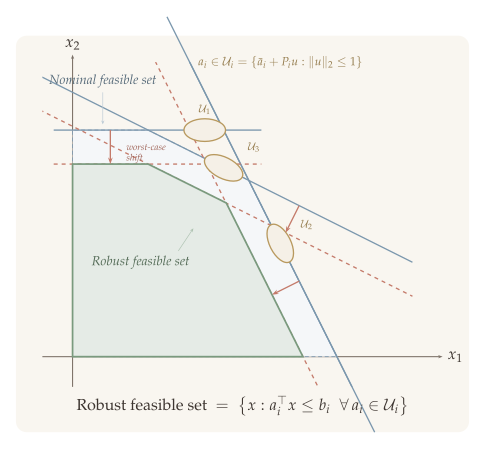
Example 5.11 (Robust LP with Ellipsoidal Uncertainty) In many applications, the constraint coefficients a_i are not known exactly but lie in an ellipsoidal uncertainty set \mathcal{E}_i = \{\bar{a}_i + P_i u : \|u\|_2 \leq 1\} (where P_i \in \mathbb{R}^{n \times n}). A robust LP requires the constraint to hold for all possible values of a_i (Figure 5.11):
\min\; c^\top x \quad \text{s.t.} \quad a_i^\top x \leq b_i \;\;\forall\, a_i \in \mathcal{E}_i, \quad i \in [m].
Since \sup_{\|u\| \leq 1} (\bar{a}_i + P_i u)^\top x = \bar{a}_i^\top x + \|P_i^\top x\|_2, the robust constraint becomes \bar{a}_i^\top x + \|P_i^\top x\|_2 \leq b_i, which is a second-order cone constraint. The robust LP is therefore an SOCP.
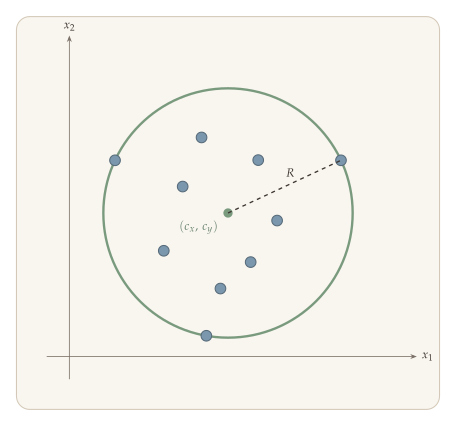
Example 5.12 (Smallest Enclosing Circle) Given n points (x_i, y_i) in \mathbb{R}^2, find the smallest circle enclosing all of them (Figure 5.12). With center (c_x, c_y) and radius R:
\min_{c_x, c_y, R}\; R \quad \text{s.t.} \quad \sqrt{(x_i - c_x)^2 + (y_i - c_y)^2} \leq R, \quad i = 1, \ldots, n.
Each constraint is a second-order cone constraint, making this an SOCP.
Example 5.13 (Robust Classification and Max-Margin SVM) Suppose each data point x_i is not known exactly but lies in a ball \mathcal{E}_i = \{x_i + u : \|u\|_2 \leq \rho\}. We want a linear classifier (w, b) that correctly classifies every point in every ball: y_i(w^\top(x_i + u) + b) \geq 1 for all \|u\| \leq \rho. Taking the worst case over u gives y_i(w^\top x_i + b) - \rho\|w\|_2 \geq 1, or equivalently:
\rho\|w\|_2 \leq y_i(w^\top x_i + b) - 1 \quad \forall\, i \in [m].
Maximizing the robustness radius \rho is equivalent to \max_{\rho, w, b} \rho subject to \rho\|w\|_2 \leq y_i(w^\top x_i + b) for all i. Setting \rho\|w\| = 1 (a rescaling) recovers the max-margin SVM: \min \|w\|_2 subject to y_i(w^\top x_i + b) \geq 1. The robust classification perspective reveals that maximizing margin is equivalent to maximizing robustness to input perturbations.
5.4.5 4. Semidefinite Program (SDP)
Semidefinite programs are the most expressive class in the standard hierarchy. They arise naturally in combinatorial optimization (relaxations of graph problems), control theory (Lyapunov stability), and statistics (covariance estimation). The key ingredient is a constraint on the eigenvalues of a matrix.
Definition 5.9 (Definition (SDP)) A semidefinite program (in standard form) optimizes a linear objective over the cone of positive semidefinite matrices:
\min_{X \in \mathbb{S}^n}\; \langle C, X \rangle \quad \text{s.t.} \quad \langle A_i, X \rangle = b_i, \; i \in [m], \quad X \succeq 0,
where C, A_1, \ldots, A_m \in \mathbb{S}^n are symmetric matrices, and \langle A, B \rangle = \operatorname{tr}(A^\top B) = \operatorname{vec}(A)^\top \operatorname{vec}(B) is the matrix inner product.
SDPs are a natural generalization of LPs: an LP \min c^\top x subject to Ax = b, x \geq 0 constrains a vector to be componentwise nonnegative, while an SDP constrains a matrix to be positive semidefinite (all eigenvalues nonnegative). SDPs generalize SOCPs (and hence all preceding classes).
Just as LPs have duals (\min c^\top x s.t. Ax = b, x \geq 0 has dual \max b^\top y s.t. A^\top y \leq c), the SDP above has the dual:
\max\; b^\top y \quad \text{s.t.} \quad \sum_{i=1}^{m} y_i A_i \preceq C.
However, unlike LP, strong duality does not always hold for SDP — there can be a gap between the primal and dual optimal values. Strong duality holds under a regularity condition (Slater’s condition): if there exists a strictly feasible point X \succ 0 satisfying all equality constraints.
Example 5.14 (Computing the Largest Eigenvalue via SDP) The largest eigenvalue of a symmetric matrix \Sigma can be expressed as \lambda_{\max}(\Sigma) = \max_{\|x\|_2 = 1} x^\top \Sigma x. This is a nonconvex problem (the constraint \|x\| = 1 is not convex). However, it admits an exact SDP relaxation. Writing X = xx^\top, the problem becomes \max \langle \Sigma, X \rangle subject to \langle I, X \rangle = 1, X = xx^\top. Relaxing the rank-one constraint X = xx^\top to X \succeq 0 gives the SDP:
\max_{X}\; \langle \Sigma, X \rangle \quad \text{s.t.} \quad \langle I, X \rangle = 1, \quad X \succeq 0.
This relaxation is tight: the optimal value equals \lambda_{\max}(\Sigma), since \langle \Sigma, X \rangle \leq \|\Sigma\|_2 \cdot \|X\|_{\text{nuc}} = \lambda_{\max}(\Sigma) \cdot \operatorname{tr}(X) = \lambda_{\max}(\Sigma).
Alternatively, since \lambda_{\max}(\Sigma) is the smallest t such that tI \succeq \Sigma, we can write \lambda_{\max}(\Sigma) = \min t subject to \Sigma \preceq tI, which is also an SDP.
Hierarchy of convex programs: LP \subseteq QP \subseteq QCQP \subseteq SOCP \subseteq SDP \subseteq General Convex.
5.5 Equivalent Transformations
Many optimization problems that do not initially appear to fit the standard form can be reformulated as equivalent convex programs through clever variable substitutions and constraint reformulations. The following examples demonstrate some common transformations.
5.5.1 Epigraph and Piecewise Linear Minimization
Any convex optimization problem \min f_0(x) subject to constraints can be rewritten in epigraph form:
\min_t \; t \quad \text{s.t.} \quad f_0(x) \leq t, \;\; \text{(original constraints)}.
This transforms a problem with a nonlinear objective into one with a linear objective and an additional constraint.
Example 5.15 (Piecewise Linear Minimization) Minimizing f(x) = \max_{i=1,\ldots,m}\{a_i^\top x + b_i\} is equivalent to the LP:
\min_t\; t \quad \text{s.t.} \quad a_i^\top x + b_i \leq t \;\;\forall\, i \in \{1,\ldots,m\}.
Concrete example. A factory operates n machines and must handle m demand scenarios. In scenario i, the cost is a_i^\top x + b_i where x is the production plan. Minimizing worst-case cost across all scenarios is exactly \min_x \max_i (a_i^\top x + b_i), which the epigraph form converts to an LP.
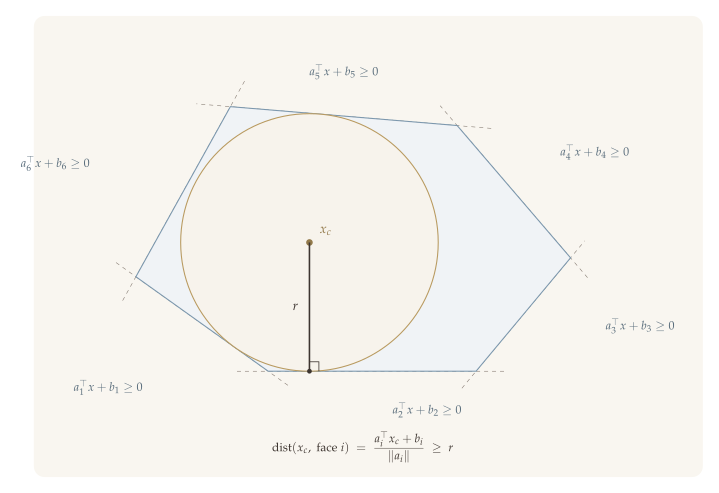
Example 5.16 (Largest Inscribed Circle in a Polytope) Given a polytope P = \{x : a_i^\top x + b_i \geq 0\}, find the largest circle (center x_c, radius r) inside P (Figure 5.13):
\max_{x_c, r}\; r \quad \text{s.t.} \quad a_i^\top x_c + b_i \geq r\|a_i\| \;\;\forall\, i.
This is an LP in (x_c, r)!
Example 5.17 (Linear Fractional Programming) Minimizing f_0(x) = \frac{c^\top x + d}{e^\top x + f} (with e^\top x + f > 0) subject to Gx \leq h,\; Ax = b can be transformed via the substitution y = x/(e^\top x + f), z = 1/(e^\top x + f) into the LP:
\min\; c^\top y + d \cdot z \quad \text{s.t.} \quad Gy - hz \leq 0,\; Ay - bz = 0,\; e^\top y + fz = 1,\; z \geq 0.
Concrete example. A firm wants to maximize its return on investment: \max\; \frac{\text{revenue}(x)}{\text{cost}(x)} = \frac{c^\top x + d}{e^\top x + f} subject to resource constraints Gx \leq h. Maximizing this ratio is a quasilinear program, but the Charnes–Cooper substitution converts it to a standard LP.
5.5.2 Eliminating and Introducing Equality Constraints
Several standard transformations convert between different representations of the feasible set.
Eliminating equality constraints. If Ax = b and x_0 is any particular solution (so Ax_0 = b), then x = Fz + x_0 where F is a matrix whose columns span the null space \mathcal{N}(A). Substituting eliminates the equality constraint:
\min f_0(x) \;\;\text{s.t.}\;\; f_i(x) \leq 0,\; Ax = b \quad \iff \quad \min_z f_0(Fz + x_0) \;\;\text{s.t.}\;\; f_i(Fz + x_0) \leq 0.
This is particularly useful in LP, where eliminating equalities leads to the concept of basic feasible solutions.
Concrete example. In portfolio optimization with n = 3 assets and the budget constraint x_1 + x_2 + x_3 = 1, we can substitute x_3 = 1 - x_1 - x_2 and optimize only over (x_1, x_2). This reduces the problem from 3 variables with 1 equality to 2 unconstrained variables (plus any remaining inequalities like x_i \geq 0).
Introducing equality constraints. Conversely, if the objective and constraints involve compositions f_i(A_i x + b_i), we can introduce new variables y_i = A_i x + b_i and rewrite the problem with simpler objectives at the cost of additional equality constraints:
\min_x f_0(A_0 x + b_0) \;\;\text{s.t.}\;\; f_i(A_i x + b_i) \leq 0 \quad \iff \quad \min_{x, y_0, \ldots, y_m} f_0(y_0) \;\;\text{s.t.}\;\; f_i(y_i) \leq 0,\; y_i = A_i x + b_i.
Introducing slack variables. An inequality Ax \leq b can be converted to an equality by introducing a nonneg slack variable s \geq 0: Ax + s = b, s \geq 0. This is the standard technique for converting LP inequalities into equational form.
Concrete example. The LP \min\; 2x_1 + 3x_2 subject to x_1 + x_2 \leq 4, x_1 \leq 3, x_1, x_2 \geq 0 becomes, after introducing slacks s_1, s_2 \geq 0:
\min\; 2x_1 + 3x_2 \quad \text{s.t.} \quad x_1 + x_2 + s_1 = 4,\; x_1 + s_2 = 3,\; x_1, x_2, s_1, s_2 \geq 0.
This equational form is the starting point for the simplex method (Chapter 7).
5.5.3 Minimizing Over Some Variables
If a problem has two blocks of variables and one block appears only in separable constraints, we can minimize over it analytically:
\min_{x_1, x_2} f_0(x_1, x_2) \;\;\text{s.t.}\;\; f_i(x_1) \leq 0,\; g_j(x_2) \leq 0 \quad \iff \quad \min_{x_1} \widetilde{f}_0(x_1) \;\;\text{s.t.}\;\; f_i(x_1) \leq 0,
where \widetilde{f}_0(x_1) = \inf_{x_2 : g_j(x_2) \leq 0} f_0(x_1, x_2) is convex by the partial minimization rule (Theorem 4.6).
Example 5.18 (Schur Complement) Consider minimizing a block-quadratic over x_2:
\min_{x_1, x_2} \begin{pmatrix} x_1 \\ x_2 \end{pmatrix}^\top \begin{pmatrix} P_{11} & P_{12} \\ P_{12}^\top & P_{22} \end{pmatrix} \begin{pmatrix} x_1 \\ x_2 \end{pmatrix} \quad \text{s.t.} \quad f_i(x_1) \leq 0.
Minimizing over x_2 analytically (completing the square) gives x_2^* = -P_{22}^{-1} P_{12}^\top x_1, and the reduced problem is \min_{x_1} x_1^\top (P_{11} - P_{12} P_{22}^{-1} P_{12}^\top) x_1 subject to f_i(x_1) \leq 0. The matrix P_{11} - P_{12} P_{22}^{-1} P_{12}^\top is the Schur complement of P_{22} in P, and it is PSD whenever P \succeq 0.
5.6 Solving Convex Programs with CVXPY
The theory developed in this chapter — standard forms, properties, and the program hierarchy — tells us what convex problems are and why they are tractable. But how do we actually solve them in practice? Modern domain-specific languages (DSLs) for convex optimization let us specify problems in a natural mathematical syntax and automatically translate them into a form that efficient solvers can handle.
CVXPY is a Python library that implements disciplined convex programming (DCP): a system of composition rules that can verify convexity of an optimization problem at specification time, before any numerical computation begins. The DCP rules mirror the preservation rules from Theorem 4.6 — nonnegative sums of convex functions, compositions with monotone functions, pointwise maxima, etc. If CVXPY can verify that a problem follows these rules, it knows the problem is convex and can solve it.
5.6.1 Basic Pattern
The CVXPY workflow has four steps: define variables, define the objective, define constraints, and solve:
import cvxpy as cp
import numpy as np

# 1. Define variables
x = cp.Variable(n)

# 2. Define objective
objective = cp.Minimize(f(x))   # or cp.Maximize(...)

# 3. Define constraints
constraints = [A @ x <= b, C @ x == d, x >= 0]

# 4. Solve
prob = cp.Problem(objective, constraints)
prob.solve()

print("Optimal value:", prob.value)
print("Optimal x:", x.value)
CVXPY calls an appropriate solver depending on the problem class: ECOS or SCS for SOCPs, OSQP for QPs, SCS or MOSEK for SDPs.
5.6.2 Example: Portfolio Optimization
The Markowitz portfolio problem from Example 5.7 can be solved in just a few lines:
import cvxpy as cp
import numpy as np

# Data: 4 assets
mu = np.array([0.12, 0.10, 0.07, 0.03])  # expected returns
Sigma = np.array([                          # covariance matrix
    [0.0064, 0.0008, 0.0002, 0.0000],
    [0.0008, 0.0025, 0.0003, 0.0000],
    [0.0002, 0.0003, 0.0016, 0.0000],
    [0.0000, 0.0000, 0.0000, 0.0001]])

w = cp.Variable(4)
ret = mu @ w
risk = cp.quad_form(w, Sigma)

# Sweep over target returns to trace the efficient frontier
for r_min in np.linspace(0.03, 0.12, 50):
    prob = cp.Problem(cp.Minimize(risk),
                      [cp.sum(w) == 1, w >= 0, ret >= r_min])
    prob.solve()
    # Record: (sqrt(risk.value), r_min)
The interactive plot below shows the efficient frontier — the set of portfolios achieving minimum variance for each target return level. Individual assets are shown as scatter points; the frontier (blue curve) represents the best achievable risk-return trade-off.
Figure: Markowitz efficient frontier for a two-asset portfolio. The frontier traces the minimum-variance portfolio for each target return. No portfolio below the frontier is achievable; portfolios above it are suboptimal.
5.6.3 Example: Chebyshev Center of a Polytope
The largest inscribed circle problem from Example 5.16 finds the Chebyshev center of a polytope — the point farthest from all boundary faces:
import cvxpy as cp
import numpy as np

# Polytope: A @ x <= b (6 halfplanes forming a hexagon-like shape)
A = np.array([[ 1, 0], [-1, 0], [0,  1], [0, -1], [1, 1], [-1, -1]])
b = np.array([2, 2, 2, 2, 3, 3])
norms = np.linalg.norm(A, axis=1)

x = cp.Variable(2)
r = cp.Variable()
constraints = [A @ x + r * norms <= b, r >= 0]
prob = cp.Problem(cp.Maximize(r), constraints)
prob.solve()

print(f"Center: {x.value}, Radius: {r.value:.4f}")
Figure: Chebyshev center (largest inscribed circle) of a polytope. The center maximizes the minimum distance to all boundary faces.
5.6.4 Example: Lasso Regularization Path
The \ell_1-regularized regression (Lasso) \min_\beta \|y - X\beta\|_2^2 + \lambda\|\beta\|_1 shrinks coefficients toward zero as \lambda increases. CVXPY can sweep over \lambda to produce the regularization path:
import cvxpy as cp
import numpy as np

# Generate synthetic data
np.random.seed(0)
n, d = 50, 8
X = np.random.randn(n, d)
beta_true = np.array([3, -2, 0, 0, 1.5, 0, 0, -1])
y = X @ beta_true + 0.5 * np.random.randn(n)

beta = cp.Variable(d)
lambd = cp.Parameter(nonneg=True)
prob = cp.Problem(cp.Minimize(cp.sum_squares(X @ beta - y) + lambd * cp.norm1(beta)))

# Sweep lambda
for lam_val in np.logspace(-2, 2, 100):
    lambd.value = lam_val
    prob.solve()
    # Record beta.value for each lambda
Figure: Lasso regularization path. Each curve shows how one coefficient evolves as the penalty λ increases. Coefficients shrink toward zero; for the orthogonal case shown, the soft-thresholding formula β*(λ) = sign(β̂)·max(|β̂| - λ, 0) applies.
As \lambda increases from zero, coefficients shrink toward zero and eventually vanish entirely — this is the sparsity-inducing property of \ell_1-regularization. The coefficients with the largest OLS estimates (in absolute value) persist the longest, while small or noise-driven coefficients are eliminated first.
Summary
- Standard form. A convex optimization problem minimizes a convex objective f_0 subject to convex inequality constraints f_i(x) \leq 0 and affine equality constraints Ax = b. The affine restriction on equalities is essential: nonlinear equalities can destroy convexity of the feasible set.
- Abstract view. Every convex program is equivalently: minimize a convex function over a convex set \Omega. The standard form is simply the most common way to describe \Omega.
- Key properties. (1) \varepsilon-suboptimal sets are convex; (2) strict convexity implies a unique minimizer; (3) every local minimum is a global minimum — the fundamental reason convex problems are tractable.
- Optimality conditions. For differentiable f_0: unconstrained optimality \Leftrightarrow \nabla f_0(x^*) = 0; with equality constraints Ax = b, optimality \Leftrightarrow \nabla f_0(x^*) \perp \mathcal{N}(A); over a general convex set \Omega, optimality \Leftrightarrow \nabla f_0(x^*)^\top(y - x^*) \geq 0 for all y \in \Omega.
- Problem hierarchy. LP \subseteq QP \subseteq QCQP \subseteq SOCP \subseteq SDP \subseteq General Convex, each with specialized algorithms and increasing modeling power.
- Solving in practice. CVXPY implements disciplined convex programming: specify the problem in mathematical syntax, verify convexity automatically, and dispatch to an efficient solver.
Optimization Problem Hierarchy
| Problem | Objective | Constraints | Example |
|---|---|---|---|
| LP | c^\top x | Ax \leq b | Transportation, max flow, SVM |
| QP | \tfrac{1}{2}x^\top Px + q^\top x | Gx \leq h | Portfolio, Lasso, least squares |
| QCQP | convex quadratic | convex quadratic | Trust region, risk-bounded portfolio |
| SOCP | c^\top x | \|A_i x + b_i\|_2 \leq c_i^\top x + d_i | Robust LP, enclosing circle |
| SDP | \langle C, X \rangle | \langle A_i, X \rangle = b_i,\; X \succeq 0 | Eigenvalue, relaxations |
Each row generalizes the rows above it: LP \subset QP \subset QCQP \subset SOCP \subset SDP \subset Convex Program.
With the framework, properties, and solution tools for convex optimization established, we turn next to the geometry of linear programming in detail — vertices, extreme points, basic feasible solutions, and the structure of the LP polytope that underlies the simplex method.