13 LP Applications and Game Theory
Linear programming is not merely an abstract mathematical framework – it is a powerful modeling tool that captures a remarkable range of optimization problems. In this chapter we explore three celebrated applications of LP duality: the max-flow/min-cut theorem in network optimization, robust LP under parameter uncertainty, and two-player zero-sum games.
We begin with the max-flow problem, which asks how much “stuff” (goods, data, fluid) can be pushed through a capacitated network from a source to a sink. We then introduce the min-cut problem, which asks for the cheapest way to disconnect the source from the sink. These two problems appear very different – one is a continuous LP, the other a combinatorial optimization – yet LP duality reveals they have the same optimal value. The key is the theory of integral polyhedra and totally unimodular matrices, which guarantees that certain LP relaxations are automatically tight. We then turn to robust LP, where duality converts worst-case optimization under polyhedral uncertainty into a single larger LP, and finally show that computing Nash equilibria in zero-sum games reduces to solving a pair of dual LPs.
What Will Be Covered
- The max-flow problem and the max-flow/min-cut theorem via LP duality
- Totally unimodular matrices and integrality of LP solutions
- Robust LP: handling parameter uncertainty via duality
- Two-player zero-sum games and Nash equilibria via LP
13.1 The Max-Flow Problem
13.1.1 Transportation Networks
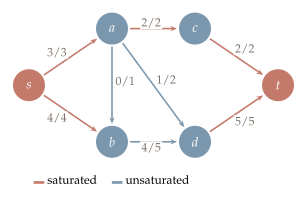
Many real-world problems involve moving goods, data, or resources through a network with limited capacity. The max-flow problem provides a clean mathematical formulation for these scenarios.
Consider a directed graph G = (V, \mathcal{E}) with the following components:
- A source s \in V: where flow originates
- A sink t \in V: where flow is absorbed
- Each edge e \in \mathcal{E} has a capacity u_e \geq 0: the maximum amount of flow that can traverse edge e
The goal is to push as much flow as possible from s to t while respecting the capacity constraints and conservation of flow at every intermediate node.
13.1.2 LP Formulation of Max-Flow
We assign a decision variable x_e to each edge e \in \mathcal{E}, representing the amount of flow along that edge. The max-flow problem is then a linear program:
\begin{aligned} \max \quad & \sum_{(s,v) \in \mathcal{E}} x_{(s,v)} \\ \text{s.t.} \quad & 0 \leq x_e \leq u_e \quad \forall\, e \in \mathcal{E} \quad &\text{(capacity constraints)} \\ & \sum_{(u,v) \in \mathcal{E}} x_{(u,v)} = \sum_{(v,w) \in \mathcal{E}} x_{(v,w)} \quad \forall\, v \in V \setminus \{s, t\} \quad &\text{(flow conservation)} \end{aligned} \tag{13.1}
The objective maximizes total flow leaving the source. The capacity constraints ensure flow on each edge is between 0 and the edge capacity. The flow conservation constraints require that at every intermediate node, total in-flow equals total out-flow.
Note the key structural features of this LP:
- Number of decision variables: |\mathcal{E}| (one per edge)
- Number of inequality constraints: |\mathcal{E}| (capacity upper bounds; nonnegativity is also |\mathcal{E}| constraints)
- Number of equality constraints: |V| - 2 (flow conservation at each non-source/non-sink node)
These counts will be important when we derive the dual LP and connect it to the min-cut problem.
The max-flow LP has a clean structure: flow conservation constraints are equalities, and capacity constraints are inequalities. Taking the dual of this LP will lead us to a problem that looks remarkably like finding the smallest bottleneck in the network.
13.2 The Min-Cut Problem
Having formulated max-flow as an LP (Equation 13.1), we now turn to its combinatorial counterpart. Our goal is to show that these two seemingly different problems have the same optimal value — a deep fact that follows from LP duality.
13.2.1 Cuts and Their Capacity
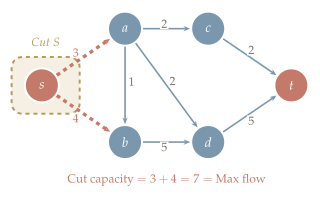
While max-flow asks “how much can we push through?”, the min-cut problem asks “what is the cheapest bottleneck?” – the cheapest way to sever all paths from s to t.
Definition 13.1 (Definition (Cut)) A cut in a directed graph G = (V, \mathcal{E}) with source s and sink t is a partition of V into two sets C and \bar{C} = V \setminus C such that s \in C and t \in \bar{C}.
The capacity of a cut C is the total capacity of all edges crossing from C to \bar{C}:
\text{Capacity}(C) = \sum_{\substack{(u,v) \in \mathcal{E} \\ u \in C,\; v \in \bar{C}}} u_{(u,v)}.
Intuitively, low-capacity cuts are bottlenecks in the network. The flow from s to t is bounded by the capacity of any cut, because all flow must cross from the source side to the sink side.
Definition 13.2 (Definition (Min-Cut Problem)) The min-cut problem asks for the cut C^* with minimum capacity:
\min_{C \subseteq V:\; s \in C,\; t \notin C} \; \text{Capacity}(C).
13.2.2 Integer Programming Formulation of Min-Cut
The min-cut problem can be formulated as an integer program. For each node v \in V, introduce a binary variable:
z_v = \begin{cases} 1 & \text{if } v \in C \text{ (source side)} \\ 0 & \text{if } v \in \bar{C} \text{ (sink side)} \end{cases}
An edge (u,v) crosses the cut from C to \bar{C} if and only if u \in C and v \notin C, i.e., z_u = 1 and z_v = 0. We can capture this with \max\{0, z_u - z_v\}. The capacity of the cut is then:
\text{Capacity}(C) = \sum_{(u,v) \in \mathcal{E}} \max\{0, z_u - z_v\} \cdot u_{(u,v)}.
\begin{aligned} \min \quad & \sum_{(u,v) \in \mathcal{E}} \max\{0, z_u - z_v\} \cdot u_{(u,v)} \\ \text{s.t.} \quad & z_v \in \{0, 1\} \quad \forall\, v \in V \\ & z_s = 1, \quad z_t = 0 \end{aligned} \tag{13.2}
To convert this into a more standard form, we introduce auxiliary variables b_{(u,v)} \geq 0 for each edge, with b_{(u,v)} \geq z_u - z_v. Together with b_{(u,v)} \geq 0, this gives b_{(u,v)} \geq \max\{0, z_u - z_v\}:
\begin{aligned} \min \quad & \sum_{(u,v) \in \mathcal{E}} b_{(u,v)} \cdot u_{(u,v)} \\ \text{s.t.} \quad & b_{(u,v)} \geq z_u - z_v \quad \forall\, (u,v) \in \mathcal{E} \\ & b_{(u,v)}, z_u, z_v \in \{0, 1\} \\ & z_s = 1, \quad z_t = 0 \end{aligned}
13.3 The LP Relaxation and Duality Connection
We now connect the max-flow LP (Equation 13.1) and the min-cut IP (Equation 13.2) through LP duality. The key step is to take the dual of the max-flow LP and observe that it is exactly the LP relaxation of the min-cut problem.
13.3.1 Dual of the Max-Flow LP
The dual of the max-flow LP (Equation 13.1) can be derived using the techniques from LP duality. The derivation (left as an exercise) yields:
\begin{aligned} \min \quad & \sum_{(u,v) \in \mathcal{E}} b_{(u,v)} \cdot u_{(u,v)} \\ \text{s.t.} \quad & b_{(u,v)} + z_v - z_u \geq 0 \quad \forall\, (u,v) \in \mathcal{E} \\ & b_{(u,v)} \geq 0 \quad \forall\, (u,v) \in \mathcal{E} \\ & z_s = 1 \quad \text{(source)} \\ & z_t = 0 \quad \text{(sink)} \end{aligned} \tag{13.3}
Here b_{(u,v)} \geq 0 are the dual variables corresponding to the capacity constraints, and z_v \in \mathbb{R} (unrestricted) are the dual variables corresponding to the flow conservation equality constraints at each node.
13.3.2 Comparing the Dual LP with the Min-Cut IP
Now observe the structural similarity between the dual LP (Equation 13.3) and the min-cut integer program (Equation 13.2):
| Feature | Dual LP (LP-Relaxed Min-Cut) | Min-Cut IP |
|---|---|---|
| Objective | \min \sum b_{(u,v)} u_{(u,v)} | \min \sum b_{(u,v)} u_{(u,v)} |
| Edge variables | b_{(u,v)} \geq z_u - z_v, b_{(u,v)} \geq 0 | b_{(u,v)} \geq z_u - z_v, b_{(u,v)} \geq 0 |
| Node variables | z_v \in \mathbb{R} (unrestricted) | z_v \in \{0, 1\} |
| Source/Sink | z_s = 1, z_t = 0 | z_s = 1, z_t = 0 |
These two problems share the same objective and same constraint structure, but the LP relaxation allows z_v to take any real value, while the IP requires z_v \in \{0,1\}. Since the feasible set of the IP is contained in the feasible set of the LP:
\{z : z_v \in \{0,1\}\} \subseteq \{z : z_v \in \mathbb{R}\},
the LP relaxation provides a lower bound on the IP:
\text{Optimal value of LP-Relaxed Min-Cut} \leq \text{Optimal value of Min-Cut IP}.
13.3.3 The Chain of Inequalities
We can now assemble the key relationship:
\underbrace{\text{Capacity of min-cut}}_{\text{IP optimal}} \;\geq\; \underbrace{\text{LP-relaxed min-cut optimal}}_{\text{dual LP optimal}} \;=\; \underbrace{\text{Value of max-flow}}_{\text{primal LP optimal}}.
The equality follows from strong duality: both the primal (max-flow) and dual (LP-relaxed min-cut) are feasible (zero flow is feasible for the primal; setting z_s = 1, z_t = 0, z_v = 0 for all other v, and b_{(u,v)} = 1 for all edges gives a feasible dual solution). Therefore neither problem is unbounded, strong duality applies, and the optimal values coincide.
The remarkable fact is that the inequality \geq is actually an equality. Proving this requires showing that the LP relaxation is tight – that the fractional optimum equals the integer optimum. This is the content of the celebrated Max-Flow Min-Cut Theorem, and the key tool is the theory of totally unimodular matrices.
13.4 The Max-Flow Min-Cut Theorem
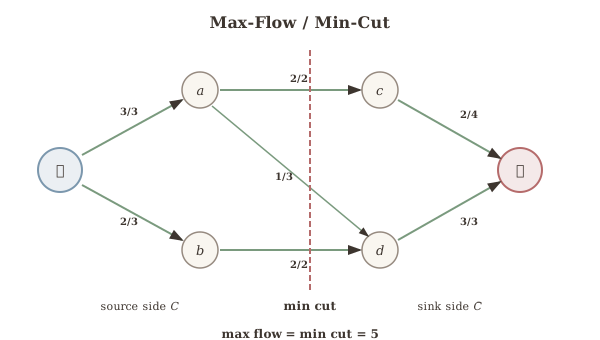
Theorem 13.1 (Theorem (Max-Flow Min-Cut)) In any directed network G = (V, \mathcal{E}) with source s, sink t, and edge capacities u_e \geq 0:
\text{Maximum flow from } s \text{ to } t \;=\; \text{Minimum cut capacity}.
This theorem is one of the cornerstones of combinatorial optimization. It says that the maximum amount of flow that can be pushed through a network is exactly equal to the capacity of the smallest bottleneck (minimum cut).
13.4.1 Proof via LP Duality
The proof has three steps: (1) use strong duality to equate max-flow with the LP-relaxed min-cut, (2) show via a clipping argument that the LP relaxation has an optimal solution in [0,1], and (3) invoke the total unimodularity of the constraint matrix to obtain an integral optimal solution.
Proof. Proof of the Max-Flow Min-Cut Theorem.
From the chain of inequalities in Section 13.3.3, we already know:
\text{Max flow} = \text{LP-relaxed min-cut optimal} \leq \text{Min-cut capacity (IP optimal)}.
It remains to show that the LP relaxation is tight, i.e., that the LP-relaxed min-cut has the same optimal value as the integer min-cut. We will show this in two steps.
Step 1: Reformulating the dual LP. In the dual LP (Equation 13.3), the constraints b_{(u,v)} \geq z_u - z_v and b_{(u,v)} \geq 0 together imply b_{(u,v)} \geq \max\{0, z_u - z_v\}. At optimality, the minimization drives b_{(u,v)} down to this lower bound, so the dual LP is equivalent to:
\begin{aligned} \min \quad & \sum_{(u,v) \in \mathcal{E}} u_{(u,v)} \cdot \max\{0, z_u - z_v\} \quad &\text{(LP-3)} \\ \text{s.t.} \quad & z \in \mathbb{R}^{|V|}, \quad z_s = 1, \quad z_t = 0. \end{aligned}
Note that z is unrestricted. We want to show that (LP-3) has an optimal solution satisfying z_u \in [0,1] for all u \in V, and moreover that this solution is integral (i.e., z_u \in \{0, 1\}).
Step 2: Clipping to [0,1]. Given any optimal solution z^* of (LP-3), define the clipped solution:
\widetilde{z}_u = \text{clip}_{[0,1]}(z^*_u) = \max\{0, \min\{z^*_u, 1\}\} \quad \forall\, u \in V.
We claim that clipping does not increase the objective. Consider any edge (u,v) \in \mathcal{E}:
Case 1: z^*_u \leq z^*_v. Then \max\{0, z^*_u - z^*_v\} = 0. Since \text{clip}_{[0,1]} is monotone, \widetilde{z}_u \leq \widetilde{z}_v, so \max\{0, \widetilde{z}_u - \widetilde{z}_v\} = 0. The contribution is unchanged.
Case 2: z^*_u > z^*_v and both are above 1 or both are below 0. Then \max\{0, z^*_u - z^*_v\} > 0, but after clipping both values are mapped to the same endpoint (both to 1 or both to 0), so \max\{0, \widetilde{z}_u - \widetilde{z}_v\} = 0. The contribution decreases.
Case 3: z^*_u > 1 \geq z^*_v. Then z^*_u - z^*_v > 1 - z^*_v \geq \text{clip}_{[0,1]}(z^*_u) - \text{clip}_{[0,1]}(z^*_v) = 1 - \widetilde{z}_v. The contribution decreases.
Case 4: z^*_v < 0 \leq z^*_u. Then z^*_u - z^*_v > z^*_u - 0 \geq \widetilde{z}_u - \widetilde{z}_v. The contribution decreases.
In all cases, each term in the objective either stays the same or decreases. Since \widetilde{z}_s = \text{clip}_{[0,1]}(1) = 1 and \widetilde{z}_t = \text{clip}_{[0,1]}(0) = 0, the clipped solution is feasible with an objective value no larger than the original. By optimality of z^*, the clipped solution \widetilde{z} is also optimal, with \widetilde{z}_u \in [0,1] for all u.
Therefore the dual LP (LP-3) is equivalent to:
\begin{aligned} \min \quad & \sum_{(u,v) \in \mathcal{E}} \max\{0, z_u - z_v\} \cdot u_{(u,v)} \quad &\text{(LP-4)} \\ \text{s.t.} \quad & 0 \leq z_u \leq 1 \quad \forall\, u \in V \\ & z_s = 1, \quad z_t = 0 \end{aligned}
Step 3: Integrality. We will show in Section 13.5.3 that the constraint matrix of this LP is totally unimodular (TUM). By the Integral Polyhedron Theorem (Theorem 13.2), every vertex of the feasible polyhedron has integer coordinates. Since the LP has an optimal solution at a vertex (by the Fundamental Theorem of LP), there exists an optimal solution with z_u \in \{0, 1\} for all u.
An integral optimal solution z^* with z^*_v \in \{0,1\}, z^*_s = 1, z^*_t = 0 defines a valid cut C = \{v : z^*_v = 1\} with capacity equal to the LP optimal value. Therefore:
\text{Min-cut capacity} \leq \text{Capacity of cut } C = \text{LP-relaxed min-cut optimal} = \text{Max flow}.
Combined with the earlier inequality \text{Max flow} \leq \text{Min-cut capacity}, we conclude:
\text{Max flow} = \text{Min-cut capacity}. \quad \blacksquare
13.5 LP Relaxation and Integral Polyhedra
The proof of the Max-Flow Min-Cut Theorem relied on the LP relaxation being “tight” – the LP optimal value equaling the IP optimal value. This tightness is not always guaranteed; it is a special structural property. We now develop the general theory that explains when LP relaxations are tight, culminating in the notion of totally unimodular matrices.
13.5.1 LP Relaxation Gap
Consider a general integer program (IP):
\min \; c^\top x \quad \text{s.t.} \quad Ax \leq b, \quad x \in \mathbb{Z}_+^n,
where \mathbb{Z}_+^n = \{x \in \mathbb{Z}^n : x \geq 0\} denotes the nonnegative integers. Its LP relaxation simply drops the integrality constraint:
\min \; c^\top x \quad \text{s.t.} \quad Ax \leq b, \quad x \geq 0.
Since \{x : Ax \leq b, \; x \in \mathbb{Z}_+^n\} \subseteq \{x : Ax \leq b, \; x \geq 0\}, the LP relaxation has a larger feasible set, and therefore:
\text{Optimal value of LP relaxation} \leq \text{Optimal value of IP}.
The LP relaxation always provides a lower bound (for minimization problems). The question is: when is this bound tight?
13.5.2 When LP Relaxations are Tight: Integral Polyhedra
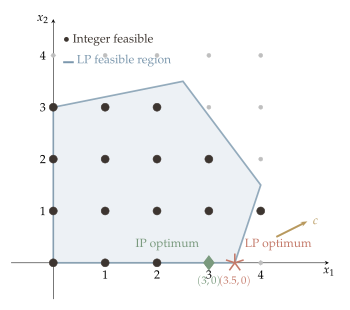
The LP relaxation is tight precisely when the LP optimum happens to be an integer point. By the Fundamental Theorem of LP, the optimum is attained at a vertex of the feasible polyhedron. So the relaxation is tight for every objective c if and only if every vertex of the polyhedron is integral.
Definition 13.3 (Definition (Integral Polyhedron)) A polyhedron P = \{x : Ax \leq b, \; x \geq 0\} is called integral if every vertex (extreme point) of P has integer coordinates.
If P is integral, then for any linear objective c, the LP \min\{c^\top x : x \in P\} has an optimal solution that is an integer point (by the Fundamental Theorem of LP). This means the LP relaxation is tight:
\min\{c^\top x : x \in P, \; x \in \mathbb{Z}^n\} = \min\{c^\top x : x \in P\}.
The question becomes: how do we recognize when a polyhedron is integral?
13.5.3 Totally Unimodular Matrices
13.5.3.1 Definition and Examples
Having identified integral polyhedra as the key to tight LP relaxations, we now present the most powerful sufficient condition: total unimodularity of the constraint matrix.
Definition 13.4 (Definition (Totally Unimodular Matrix)) A matrix A \in \mathbb{R}^{m \times n} is totally unimodular (TUM) if every square submatrix of A has determinant in \{-1, 0, +1\}.
Note that this condition applies to every square submatrix, not just the full matrix. In particular:
- Every 1 \times 1 submatrix (i.e., every entry) must be in \{-1, 0, +1\}
- Every 2 \times 2 submatrix must have determinant in \{-1, 0, +1\}
- And so on, up to the largest square submatrix
Example 13.1 (Incidence Matrix of a Bipartite Graph) Consider a bipartite graph with vertex sets X and Y, and edges from X to Y. The incidence matrix A has rows indexed by vertices and columns indexed by edges, with A_{v,e} = 1 if vertex v is an endpoint of edge e, and A_{v,e} = 0 otherwise.
For example, with X = \{a, b\}, Y = \{c, d, e\}, and edges (a,c), (a,d), (a,e), (b,d), (b,e):
A = \begin{pmatrix} 1 & 1 & 1 & 0 & 0 \\ 0 & 0 & 0 & 1 & 1 \\ 1 & 0 & 0 & 0 & 0 \\ 0 & 1 & 0 & 1 & 0 \\ 0 & 0 & 1 & 0 & 1 \end{pmatrix}
This matrix is totally unimodular. More generally, the incidence matrix of any bipartite graph is TUM.
13.5.3.2 The Integral Polyhedron Theorem
The following theorem is the bridge between TUM and integral polyhedra. It is the key ingredient needed to complete the proof of the Max-Flow Min-Cut Theorem.
Theorem 13.2 (Theorem (Integral Polyhedron via TUM)) Let A \in \mathbb{R}^{m \times n} be a totally unimodular matrix and b \in \mathbb{Z}^m an integer vector. Then:
- P_1 = \{x : Ax \leq b\} is an integral polyhedron.
- P_2 = \{x : Ax \leq b, \; x \geq 0\} is an integral polyhedron.
The proof uses Cramer’s rule: at any vertex the binding constraints form an invertible submatrix whose determinant is \pm 1 by TUM, so the vertex coordinates are automatically integers.
Proof. Proof of the Integral Polyhedron Theorem.
The strategy is to apply Cramer’s rule at each vertex: TUM ensures the basis determinant is \pm 1, which forces all coordinates to be integers.
We prove part (2); part (1) is similar. Let x^* be any vertex of P_2. By the definition of a vertex, there exist n linearly independent binding constraints at x^*. Let \widehat{A} \in \mathbb{R}^{n \times n} be the submatrix of the constraint matrix corresponding to these n binding constraints, and let \widehat{b} \in \mathbb{R}^n be the corresponding right-hand side. Then x^* is the unique solution to:
\widehat{A} x^* = \widehat{b}.
Since the rows of \widehat{A} are linearly independent, \widehat{A} is invertible. By Cramer’s rule, the j-th component of x^* is:
x^*_j = \frac{\det(\widehat{A}_j)}{\det(\widehat{A})},
where \widehat{A}_j is the matrix \widehat{A} with its j-th column replaced by \widehat{b}.
Now we use the TUM property:
- \widehat{A} is a square submatrix of A (possibly augmented with rows of \pm I, which preserves TUM), so \det(\widehat{A}) \in \{-1, +1\} (it cannot be 0 since \widehat{A} is invertible).
- \widehat{A}_j has the same rows as \widehat{A} except one column is replaced by \widehat{b} \in \mathbb{Z}^n. Since \det(\widehat{A}) = \pm 1, \widehat{A} is an integer matrix, and \widehat{b} is an integer vector, \det(\widehat{A}_j) \in \mathbb{Z}.
Therefore:
x^*_j = \frac{\det(\widehat{A}_j)}{\pm 1} = \pm \det(\widehat{A}_j) \in \mathbb{Z}.
Every component of x^* is an integer, so every vertex of P_2 is integral. \blacksquare
The proof reveals why TUM is so powerful: at any vertex, the basis matrix has determinant \pm 1, which means Cramer’s rule produces integer solutions whenever the right-hand side is integral. This is a much stronger property than simply requiring A to have integer entries.
With the Integral Polyhedron Theorem in hand, we can now return to the Max-Flow Min-Cut Theorem and complete the proof by verifying that the relevant constraint matrix is TUM.
13.5.4 Why the Max-Flow LP Relaxation is Tight
Armed with the Integral Polyhedron Theorem (Theorem 13.2) and the theory of TUM matrices, we can now complete the proof of the Max-Flow Min-Cut Theorem by showing that the constraint matrix of the dual LP (Equation 13.3) is totally unimodular.
Lemma 13.1 (Lemma (Node-Edge Incidence Matrix is TUM)) The constraint matrix of the LP:
\begin{aligned} \min \quad & \sum_{(u,v) \in \mathcal{E}} b_{(u,v)} \cdot u_{(u,v)} \\ \text{s.t.} \quad & b_{(u,v)} + z_v - z_u \geq 0 \quad \forall\, (u,v) \in \mathcal{E} \\ & b_{(u,v)} \geq 0 \quad \forall\, (u,v) \in \mathcal{E} \\ & z_s = 1, \quad z_t = 0 \end{aligned}
is totally unimodular.
The constraint matrix arises from the node-edge incidence matrix of the directed graph G = (V, \mathcal{E}). For a directed graph, the incidence matrix M \in \mathbb{R}^{|V| \times |\mathcal{E}|} is defined by:
M_{v,e} = \begin{cases} +1 & \text{if edge } e \text{ enters node } v \\ -1 & \text{if edge } e \text{ leaves node } v \\ 0 & \text{otherwise} \end{cases}
We now prove that M is TUM by showing every square submatrix has determinant in \{0, \pm 1\}, by induction on the submatrix size k.
Proof. Base case (k=1). Every entry of M is 0, +1, or -1, so every 1 \times 1 submatrix has determinant in \{0, \pm 1\}.
Inductive step. Let B be a k \times k submatrix of M. Each column of M has at most one +1 and at most one -1 (and all other entries zero). So each column of B inherits this property: at most two nonzero entries, one +1 and one -1. There are three cases:
- Some column of B is all zeros. Then \det(B) = 0.
- Some column of B has exactly one nonzero entry (\pm 1). Expanding \det(B) along this column gives \det(B) = \pm \det(B'), where B' is a (k\!-\!1) \times (k\!-\!1) submatrix of M. By induction, \det(B') \in \{0, \pm 1\}, so \det(B) \in \{0, \pm 1\}.
- Every column of B has exactly two nonzero entries: one +1 and one -1. Then every column of B sums to zero, i.e., \mathbf{1}^\top B = \mathbf{0}^\top. The rows of B are linearly dependent, so \det(B) = 0. \blacksquare
Since M is TUM, the constraint matrix of the dual LP — built from this incidence matrix with identity blocks for the b variables — is also TUM (augmenting a TUM matrix with identity rows/columns preserves the TUM property).
By the Integral Polyhedron Theorem (Theorem 13.2), since the constraint matrix is TUM and the right-hand side (0, \ldots, 0, 1, 0) is integral, the feasible polyhedron of the dual LP is integral. Therefore the LP optimal solution is an integer point, and the LP relaxation of the min-cut is tight.
This completes the chain:
\text{Max flow} \;=\; \text{LP-relaxed min-cut} \;=\; \text{Min-cut capacity}.
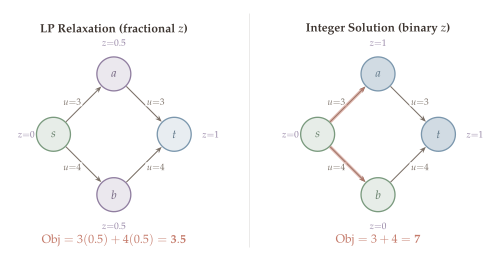
The LP relaxation being tight for this problem is not a coincidence – it is a structural consequence of the totally unimodular property of graph incidence matrices. This same TUM structure guarantees tight LP relaxations for many other network optimization problems, including the transportation problem, shortest path, and bipartite matching.
13.5.5 The Complete Chain
The main results of the max-flow/min-cut theory form a logical chain:
- Max-flow is an LP; its dual is the LP-relaxed min-cut.
- By strong duality: max-flow value = LP-relaxed min-cut value.
- The LP-relaxed min-cut value \leq integer min-cut value (LP relaxation is a lower bound).
- The constraint matrix of the LP-relaxed min-cut is the node-edge incidence matrix of a directed graph, which is totally unimodular.
- By the Integral Polyhedron Theorem (TUM + integer RHS \Rightarrow integral polyhedron), the LP relaxation is tight.
- Therefore: max flow = min cut.
The theory of totally unimodular matrices provides a powerful lens for identifying when LP relaxations of integer programs are tight. Whenever the constraint matrix is TUM and the right-hand side is integral, we get an integral polyhedron “for free,” and LP solvers can be used to solve the corresponding integer program exactly – with no need for branch-and-bound or other combinatorial search methods.
The Max-Flow Min-Cut Theorem is just one application of LP duality in combinatorial optimization. In the remainder of this chapter, we explore two further applications – robust LP and zero-sum games – where LP duality again provides surprising structural insights.
In practice, the parameters of a linear program – the cost vector c, the right-hand side b, or the constraint vectors a_i – may not be known exactly. They could be estimated from noisy data, subject to modeling errors, or inherently stochastic. A natural question arises: how should we solve an LP when we are uncertain about its parameters?
Robust optimization answers this by adopting a worst-case perspective: we optimize assuming that an adversary picks the most unfavorable parameters from a given uncertainty set. This minimax viewpoint connects LP to game theory in a profound way. When the uncertainty sets are polyhedral, the robust LP can be reformulated as a single, larger LP via LP duality – a striking demonstration of duality’s power.
This connection motivates the second half of the chapter: two-player zero-sum matrix games. We show that computing Nash equilibria in such games reduces to solving a pair of dual LPs, and that strong duality guarantees the existence of a game value and optimal mixed strategies for both players.
13.6 Robust LP
13.6.1 Motivation
Consider a linear program in the following form:
\min_{x} \; c^\top x \quad \text{s.t.} \quad a_i^\top x \leq b_i, \;\; i \in [m], \quad x \in \mathbb{R}^n.
For simplicity, we drop the constraint x \geq 0 from the canonical form. (If x \geq 0 is present, it can be absorbed by writing it as -I \cdot x \leq 0.)
The parameters (c, b, \{a_i\}_{i \in [m]}) define the LP. In practice, these parameters are sometimes unknown or stochastic. To handle such uncertainty, robust LP assumes that:
- The parameters are selected from some uncertainty sets.
- We want to find the optimal value for the worst instance in the uncertainty set.
13.6.2 Robust LP Formulation
Mathematically, let \mathcal{U}_i be the uncertainty set of a_i \in \mathbb{R}^n (with \mathcal{U}_i \subseteq \mathbb{R}^n). The robust LP is formulated as:
\boxed{\text{Robust-LP:} \quad \min_{x} \; c^\top x \quad \text{s.t.} \quad a_i^\top x \leq b_i \;\; \forall \, a_i \in \mathcal{U}_i, \;\; i = 1, 2, \ldots, m.} \tag{13.4}
For any choice \{a_i\} \in \{\mathcal{U}_i\}, define the feasible region:
\Omega(\{a_i\}) = \{x : a_i^\top x \leq b_i, \; i \in [m]\}.
Then the robust LP can equivalently be written as:
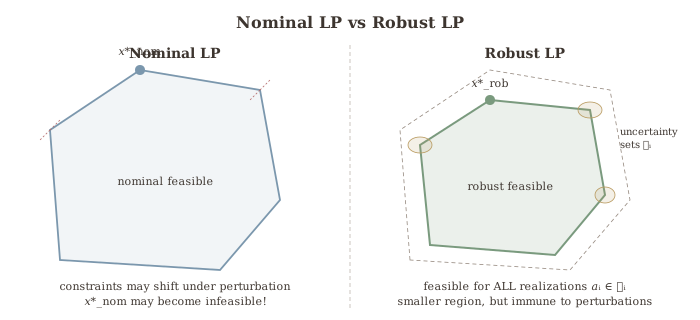
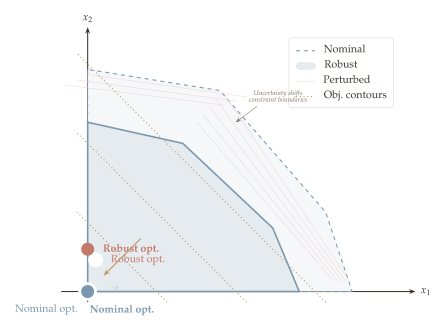
\min \; c^\top x \quad \text{s.t.} \quad x \in \bigcap_{\substack{\{a_i\} \in \{\mathcal{U}_i\}}} \Omega(\{a_i\}).
The feasible set of the robust LP is the intersection of all feasible regions \Omega(\{a_i\}) over every possible realization of the uncertain parameters.
Without loss of generality, we can assume the objective c^\top x and the right-hand side b \in \mathbb{R}^m are deterministic. The reasons are:
(a) If c is uncertain with c \in \mathcal{U}_c, we can introduce an auxiliary variable \alpha and reformulate:
\max_{x} \min_{c \in \mathcal{U}_c} c^\top x \iff \max_{x, \alpha} \; \alpha \quad \text{s.t.} \quad \alpha \leq c^\top x \;\; \forall \, c \in \mathcal{U}_c, \;\; x \in \Delta_m.
This converts the uncertain objective into deterministic constraints with a deterministic objective \alpha.
(b) If b_i is uncertain with b_i \in [\check{b}_i, \widehat{b}_i], the worst case for the optimizer is the smallest b_i, so we will always choose \check{b}_i. The binding constraint is \{x : a_i^\top x \leq b\}_{b \in [\check{b}_i, \widehat{b}_i]}, which is tightest at b = \check{b}_i.
13.6.3 Game-Theoretic Interpretation
The robust LP formulation (Equation 13.4) has a natural adversarial interpretation that motivates the connection to game theory developed in the second half of this chapter. We can view robust LP as a game between an Optimizer and an Adversary:
- Optimizer picks x \in \mathbb{R}^n.
- Adversary picks a feasible region \Omega(\{a_i\}) by choosing \{a_i\} from the uncertainty sets.
- The cost of the Optimizer is:
\text{cost}(x, \{a_i\}) = \begin{cases} c^\top x & \text{if } x \text{ is feasible, i.e., } x \in \Omega(\{a_i\}), \\ +\infty & \text{if } x \text{ is infeasible.} \end{cases}
- The Optimizer’s goal is to achieve the smallest cost, while the Adversary wants to jeopardize that.
What should the Optimizer do? Consider the worst-case scenario: find the most pessimistic solution – the best reward assuming the Adversary always chooses the most challenging feasible set.
- For any x \in \mathbb{R}^n, if there exists \{a_i\} such that \Omega(\{a_i\}) \not\ni x, then the Adversary will choose that \{a_i\}, making the cost +\infty.
- Thus, the Optimizer can only choose from \{x : x \in \Omega(\{a_i\}) \;\; \forall \, a_i \in \mathcal{U}_i\}.
Definition 13.5 (Definition (Minimax Strategy)) The Optimizer’s strategy of choosing x to minimize the worst-case cost is called a minimax strategy. The robust LP is precisely the minimax formulation:
\min_{x} \; \max_{\{a_i\} \in \{\mathcal{U}_i\}} \; \text{cost}(x, \{a_i\}).
Depending on the exact form of the uncertainty set \mathcal{U}_i, the robust LP itself might not be an LP. In the following, we focus on a special case where the uncertainty sets are polyhedra.
13.6.4 Robust LP with Polytopical Uncertainty
Having established the minimax interpretation of robust LP, we now show that when the uncertainty sets are polyhedral, the robust LP can be reformulated as a single, larger LP. The key tool is LP duality.
Suppose each uncertainty set is a polyhedron:
\mathcal{U}_i = \{a_i \in \mathbb{R}^n : D_i a_i \leq d_i\}, \quad \forall \, i \in [m],
where D_i \in \mathbb{R}^{k_i \times n} and d_i \in \mathbb{R}^{k_i} are given as input. Then the robust LP becomes:
\min_{x} \; c^\top x \quad \text{s.t.} \quad \left[\max_{\substack{a_i \in \mathbb{R}^n \\ D_i a_i \leq d_i}} a_i^\top x \right] \leq b_i, \quad \forall \, i = 1, 2, \ldots, m. \tag{LP-in-LP-1}
This is an LP with another LP in the constraint. Each constraint requires that the maximum of a_i^\top x over the uncertainty set \mathcal{U}_i is at most b_i.
13.6.4.1 Taking the Dual of the Inner LP
Because we only care about the optimal value of the LP in the constraint, we can take its dual and apply strong duality.
The inner LP for each constraint i is:
\max_{a_i} \; a_i^\top x \quad \text{s.t.} \quad D_i a_i \leq d_i, \quad a_i \in \mathbb{R}^n.
Taking the dual (with dual variable p_i \in \mathbb{R}^{k_i}):
\min_{p_i} \; p_i^\top d_i \quad \text{s.t.} \quad D_i^\top p_i = x, \quad p_i \geq 0, \quad p_i \in \mathbb{R}^{k_i}.
By strong duality, the primal and dual have the same optimal value (assuming the inner LP is feasible and bounded). Substituting, the LP-in-LP becomes:
\min_{x} \; c^\top x \quad \text{s.t.} \quad \left[\min_{\substack{p_i \in \mathbb{R}^{k_i} \\ D_i^\top p_i = x \\ p_i \geq 0}} p_i^\top d_i \right] \leq b_i, \quad i \in [m]. \tag{LP-in-LP-2}
13.6.4.2 Combining into a Single LP
Now we have a minimization inside a minimization. Since both the outer and inner problems are minimizations over the same objective direction, we can combine them and write a single big LP:
\boxed{\text{(LP-3):} \quad \min_{\substack{x \in \mathbb{R}^n \\ p_i \in \mathbb{R}^{k_i}}} \; c^\top x \quad \text{s.t.} \quad p_i^\top d_i \leq b_i, \quad D_i^\top p_i = x, \quad p_i \geq 0, \quad \forall \, i = 1, 2, \ldots, m.}
This is a single LP in the variables (x, p_1, \ldots, p_m). The robust LP with polyhedral uncertainty has been converted into a standard LP!
13.6.4.3 Equivalence of LP-in-LP and LP-3
Theorem 13.3 (Theorem (Equivalence of LP-in-LP-2 and LP-3)) The formulations (LP-in-LP-2) and (LP-3) have the same optimal value and the same set of optimal x.
Proof. We prove that every feasible solution of one formulation can be mapped to a feasible solution of the other with the same (or better) objective value.
Direction 1: LP-in-LP-2 \Rightarrow LP-3.
Suppose x^* is feasible for (LP-in-LP-2). Then for each i \in [m], the inner minimization
\min_{p_i} \; p_i^\top d_i \quad \text{s.t.} \quad D_i^\top p_i = x^*, \quad p_i \geq 0
has a solution p_i^* satisfying (p_i^*)^\top d_i \leq b_i. This means:
(p_i^*)^\top d_i \leq b_i, \quad D_i^\top p_i^* - x^* = 0, \quad p_i^* \geq 0.
Therefore (x^*, p_1^*, \ldots, p_m^*) is feasible for (LP-3), and the optimal value of (LP-3) \leq c^\top x^* = optimal value of (LP-in-LP-2).
Direction 2: LP-3 \Rightarrow LP-in-LP-2.
Suppose (\widetilde{x}, \widetilde{p}_1, \ldots, \widetilde{p}_m) is feasible for (LP-3). Then for each i:
(\widetilde{p}_i)^\top d_i \leq b_i, \quad D_i^\top \widetilde{p}_i = \widetilde{x}, \quad \widetilde{p}_i \geq 0.
Thus \widetilde{p}_i is feasible for the inner minimization at x = \widetilde{x}, and:
\min_{\substack{p_i : D_i^\top p_i = \widetilde{x} \\ p_i \geq 0}} p_i^\top d_i \leq (\widetilde{p}_i)^\top d_i \leq b_i.
Therefore \widetilde{x} is feasible for (LP-in-LP-2), and the optimal value of (LP-in-LP-2) \leq c^\top \widetilde{x} = optimal value of (LP-3).
Combining both directions, the two formulations have the same optimal value. \blacksquare
13.7 Two-Player Matrix Games
The minimax structure \max_x \min_\delta f(x, \delta) that appeared in robust LP (Equation 13.4) is not specific to uncertainty — it is the defining structure of competitive games. In robust LP, the “adversary” was nature perturbing the constraints; here the adversary is a strategic opponent choosing actions to oppose us. This connection is more than an analogy: we will show that finding optimal game strategies is solving a pair of dual LPs, and the celebrated Minimax Theorem of von Neumann follows directly from LP strong duality.
13.7.1 Setup
Consider a game between Alice and Bob, defined by:
- Alice chooses from m actions: \mathcal{A} = \{a_1, a_2, \ldots, a_m\}.
- Bob chooses from n actions: \mathcal{B} = \{b_1, b_2, \ldots, b_n\}.
- They act simultaneously: Alice picks a_i \in \mathcal{A}, Bob picks b_j \in \mathcal{B}.
- Alice receives payoff A_{ij}; Bob receives B_{ij}.
- The matrices A, B \in \mathbb{R}^{m \times n} are the payoff matrices.
- Each player seeks to maximize their own payoff, without knowing the other’s choice in advance.
The two-player matrix game (also called a normal-form game) is denoted (A, B).
13.7.2 Zero-Sum Games
Definition 13.6 (Definition (Zero-Sum Game)) A two-player matrix game (A, B) is a zero-sum game if
A + B = 0 \in \mathbb{R}^{m \times n}.
That is, one player’s gain is the other player’s loss.
In a zero-sum game, B = -A, so the entire game is characterized by the single matrix A:
- Alice (the max-player) wants to maximize A_{ij}.
- Bob (the min-player) wants to minimize A_{ij}.
Every dollar Alice gains is a dollar Bob loses. The game is purely competitive, and the matrix A contains all the information needed to analyze it.
13.7.3 Pure and Mixed Strategies
Definition 13.7 (Definition (Pure Strategy)) A pure strategy is a deterministic choice of a single action: a_i \in \mathcal{A} for Alice or b_j \in \mathcal{B} for Bob. There are m pure strategies for Alice and n for Bob.
Definition 13.8 (Definition (Mixed Strategy)) A mixed strategy is a probability distribution over the action set. Formally, define the probability simplex in \mathbb{R}^k:
\Delta_k = \left\{(p_1, \ldots, p_k) : p_\ell \geq 0 \;\; \forall \, \ell \in [k], \;\; \sum_{\ell=1}^{k} p_\ell = 1 \right\} = \left\{x \in \mathbb{R}^k : \mathbf{1}^\top x = 1, \; x \geq 0\right\}.
- Alice’s space of mixed strategies: \Delta_m. A mixed strategy x \in \Delta_m means Alice plays action a_i with probability x_i.
- Bob’s space of mixed strategies: \Delta_n. A mixed strategy y \in \Delta_n means Bob plays action b_j with probability y_j.
13.7.3.1 Expected Payoff
When Alice plays x \in \Delta_m and Bob plays y \in \Delta_n:
- The expected payoff received by Alice is x^\top A y.
- Bob receives payoff -x^\top A y in expectation.
Why? Because:
x^\top A y = \sum_{i=1}^{m} \sum_{j=1}^{n} A_{ij} \cdot x_i \cdot y_j,
where A_{ij} is the payoff of the action pair (a_i, b_j), and x_i \cdot y_j = \mathbb{P}(\text{Alice plays } a_i \text{ and Bob plays } b_j).
13.7.3.2 Example: Rock-Paper-Scissors
The classic game of Rock-Paper-Scissors is a zero-sum game with payoff matrix:
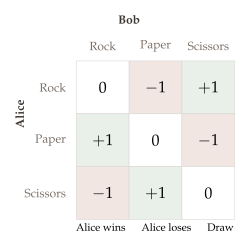
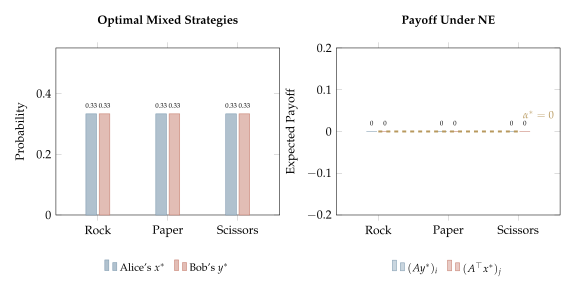
A = \begin{pmatrix} 0 & -1 & 1 \\ 1 & 0 & -1 \\ -1 & 1 & 0 \end{pmatrix}, \quad \text{rows: Alice (R, P, S)}, \quad \text{columns: Bob (R, P, S)}.
For example, if Alice plays Rock (i=1) and Bob plays Scissors (j=3), Alice receives A_{13} = 1 (a win), and Bob receives -1 (a loss).
13.7.4 Designing Optimal Strategies via LP
How should Alice choose her mixed strategy? This is where the connection to robust LP becomes precise.
13.7.4.1 Alice’s Perspective
If Bob’s strategy y were known, Alice would simply solve \max_{x \in \Delta_m} x^\top A y — a linear program over the simplex. But y is unknown, chosen adversarially by Bob. From Alice’s viewpoint, the “objective coefficient” c_y = Ay lies in the uncertainty set \mathcal{U}_A = \{Ay : y \in \Delta_n\}, which is exactly a polyhedral uncertainty set (the image of the simplex under A).
This is the robust LP framework from Section 13.6 with a strategic twist: the uncertainty is not random noise but an intelligent adversary. Following the same pessimistic reasoning, Alice should optimize against the worst case:
\max_{x \in \Delta_m} \min_{y \in \Delta_n} \; x^\top A y. \tag{13.5}
13.7.4.2 Bob’s Best Response is a Pure Strategy
To convert Equation 13.5 into an LP, we need to handle the inner \min_{y \in \Delta_n}. The key insight is that a linear function minimized over a simplex always attains its minimum at a vertex — which means Bob’s optimal response to any fixed x is always a pure strategy. This dramatically simplifies the problem.
Following the robust LP framework from Section 13.6:
\max_{x, \alpha} \; \alpha \quad \text{s.t.} \quad \alpha \leq c^\top x \;\; \forall \, c \in \mathcal{U}_A, \quad x \in \Delta_m.
This is equivalent to:
\max_{x \in \mathbb{R}^m, \alpha \in \mathbb{R}} \; \alpha \quad \text{s.t.} \quad \alpha \leq \min_{\substack{y \in \Delta_n}} x^\top A y, \quad x \in \Delta_m.
The key insight is that the inner minimization \min_{y \in \Delta_n} x^\top A y has a closed-form solution.
Write A = (\alpha_1 \; \alpha_2 \; \cdots \; \alpha_n) where \alpha_j \in \mathbb{R}^m is the j-th column of A. Then:
x^\top A y = \sum_{j=1}^{n} y_j \cdot \alpha_j^\top x.
This is a linear function of y being minimized over the simplex \Delta_n.
Proposition 13.1 (Proposition (Bob’s Best Response)) When Alice’s strategy x \in \Delta_m is fixed, Bob has a best strategy which is a pure strategy:
\min_{y \in \Delta_n} \; x^\top A y = \min_{j \in [n]} \; \alpha_j^\top x.
The optimal y^* is given by y_j^* = 1 if j = \arg\min_{\ell \in [n]} \{\alpha_\ell^\top x\} and y_j^* = 0 otherwise.
Proof. The inner problem \min_{y \in \Delta_n} x^\top A y is equivalent to:
\min_{y} \; \sum_{j=1}^{n} y_j \cdot \alpha_j^\top x \quad \text{s.t.} \quad y_j \geq 0, \quad \sum_{j=1}^{n} y_j = 1.
This is a linear program over the simplex \Delta_n. By the Fundamental Theorem of LP, the minimum is attained at a vertex of \Delta_n. The vertices of \Delta_n are the standard basis vectors e_1, \ldots, e_n, which correspond to pure strategies. Therefore:
\min_{y \in \Delta_n} x^\top A y = \min_{j \in [n]} \; e_j^\top (\alpha_1^\top x, \ldots, \alpha_n^\top x)^\top = \min_{j \in [n]} \; \alpha_j^\top x. \qquad \blacksquare
13.7.5 Alice’s LP
With Bob’s best response reduced to a pure strategy, the minimax problem collapses into a standard LP. Using Proposition 13.1, Alice’s problem (Equation 13.5) becomes:
\max_{x \in \mathbb{R}^m, \alpha \in \mathbb{R}} \; \alpha \quad \text{s.t.} \quad \alpha \leq \min_{j \in [n]} \{\alpha_j^\top x\}, \quad x \in \Delta_m.
The constraint \alpha \leq \min_j \{\alpha_j^\top x\} is equivalent to \alpha \leq \alpha_j^\top x for all j \in [n], which can be written as:
\alpha \cdot \mathbf{1}_n \leq A^\top x.
This gives Alice’s LP:
\boxed{\text{(A-LP):} \quad \max_{x, \alpha} \; \alpha \quad \text{s.t.} \quad \alpha \cdot \mathbf{1}_n - A^\top x \leq 0, \quad x^\top \mathbf{1}_m = 1, \quad x \geq 0.}
In matrix form, with decision variable (x, \alpha)^\top:
\max \; \begin{pmatrix} 0_m \\ 1 \end{pmatrix}^\top \begin{pmatrix} x \\ \alpha \end{pmatrix} \quad \text{s.t.} \quad \begin{pmatrix} -A^\top & \mathbf{1}_n \\ \mathbf{1}_m^\top & 0 \end{pmatrix} \begin{pmatrix} x \\ \alpha \end{pmatrix} \leq \begin{pmatrix} 0_n \\ 1 \end{pmatrix}, \quad x \geq 0, \; \alpha \in \mathbb{R}.
This is an LP. It has an optimal solution (x^*, \alpha^*) with optimal value f^* = \alpha^*. (The problem is bounded because \|A\|_{\max} provides an upper bound on \alpha.)
Note that \alpha \in \mathbb{R} (unrestricted in sign), so the last dual constraint corresponding to \alpha will be an equality.
13.7.6 Bob’s LP
Alice’s LP (A-LP) is a primal LP. What is its dual? The beautiful answer is that the dual is precisely Bob’s optimization problem — the LP that Bob would derive from his own minimax reasoning \min_{y \in \Delta_n} \max_{x \in \Delta_m} x^\top A y. The dual of (A-LP) is:
\min \; \begin{pmatrix} 0_n \\ 1 \end{pmatrix}^\top \begin{pmatrix} y \\ \beta \end{pmatrix} \quad \text{s.t.} \quad \begin{pmatrix} -A & \mathbf{1}_m \\ \mathbf{1}_n^\top & 0 \end{pmatrix} \begin{pmatrix} y \\ \beta \end{pmatrix} \geq \begin{pmatrix} 0_m \\ 1 \end{pmatrix}, \quad y \geq 0, \; \beta \in \mathbb{R}.
Unpacking the dual constraints and simplifying:
\boxed{\text{(B-LP):} \quad \min_{y, \beta} \; \beta \quad \text{s.t.} \quad \beta \cdot \mathbf{1}_m - A y \geq 0, \quad y^\top \mathbf{1}_n = 1, \quad y \geq 0.}
Equivalently: \min_{y, \beta} \; \beta subject to \beta \geq (Ay)_i for all i \in [m], y^\top \mathbf{1}_n = 1, y \geq 0.
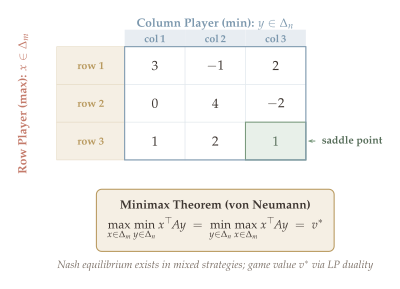
This is precisely Bob’s optimization problem: minimize the worst-case payoff to Alice, over all mixed strategies y \in \Delta_n.
13.7.7 Nash Equilibrium via Strong Duality
We now have the complete picture: Alice’s maximin problem is the LP (A-LP), and Bob’s minimax problem is its dual (B-LP). The punchline is that LP strong duality (Chapter 11) does all the heavy lifting — it immediately implies that Alice’s guaranteed payoff equals Bob’s guaranteed cost, and the resulting strategy pair is a Nash equilibrium.
By strong duality:
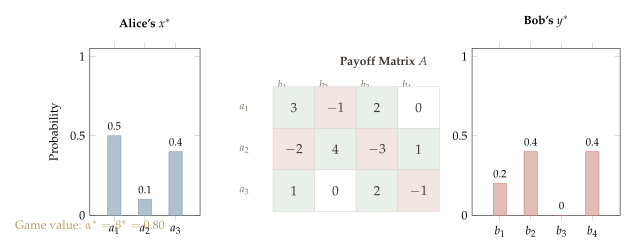
\alpha^* = \beta^*.
This common value is called the value of the game.
The optimal solutions (x^*, \alpha^*) of (A-LP) and (y^*, \beta^*) of (B-LP) give a pair of mixed strategies (x^*, y^*).
Definition 13.9 (Definition (Nash Equilibrium)) A pair of mixed strategies (\widetilde{x}, \widetilde{y}) is a Nash Equilibrium (NE) of the zero-sum game if:
\begin{cases} x^\top A \widetilde{y} \leq \widetilde{x}^\top A \widetilde{y} & \forall \, x \in \Delta_m, \\ \widetilde{x}^\top A \widetilde{y} \leq \widetilde{x}^\top A y & \forall \, y \in \Delta_n. \end{cases}
In other words, when Alice plays \widetilde{x}, Bob’s optimal play is \widetilde{y}. And if Bob plays \widetilde{y}, Alice’s optimal play is \widetilde{x}. Neither player can unilaterally improve their payoff by deviating.
Theorem 13.4 (Theorem (Nash Equilibrium from LP Duality)) The pair (x^*, y^*) obtained from the optimal solutions of (A-LP) and (B-LP) is a Nash Equilibrium of the zero-sum game.
Proof. The strategy is to combine the LP feasibility constraints from (A-LP) and (B-LP) with the equality \alpha^* = \beta^* from strong duality. Each LP’s constraints give one direction of the saddle-point inequality; strong duality ties them together.
From the constraints of (A-LP) and (B-LP), and strong duality:
Step 1. From the feasibility of (x^*, \alpha^*) for (A-LP):
\alpha^* \cdot \mathbf{1}_n \leq A^\top x^*.
Multiplying both sides by any y \in \Delta_n (note \mathbf{1}_n^\top y = 1):
\alpha^* = \alpha^* (\mathbf{1}_n^\top y) \leq (x^*)^\top A y, \quad \forall \, y \in \Delta_n.
Step 2. From the feasibility of (y^*, \beta^*) for (B-LP):
\beta^* \cdot \mathbf{1}_m \geq A y^*.
Multiplying both sides by any x \in \Delta_m (note \mathbf{1}_m^\top x = 1):
\beta^* = \beta^* (\mathbf{1}_m^\top x) \geq x^\top A y^*, \quad \forall \, x \in \Delta_m.
Step 3. By strong duality: \alpha^* = \beta^*.
Combining Steps 1–3:
x^\top A y^* \leq \beta^* = \alpha^* \leq (x^*)^\top A y, \quad \forall \, x \in \Delta_m, \; \forall \, y \in \Delta_n.
Setting y = y^* in Step 1 and x = x^* in Step 2:
\alpha^* \leq (x^*)^\top A y^* \leq \beta^* = \alpha^*.
Therefore (x^*)^\top A y^* = \alpha^* = \beta^*, and:
x^\top A y^* \leq (x^*)^\top A y^* \leq (x^*)^\top A y, \quad \forall \, x \in \Delta_m, \; \forall \, y \in \Delta_n.
This is exactly the definition of Nash Equilibrium. \blacksquare
The result above is a constructive proof of one of the foundational results of game theory. For every finite two-player zero-sum game with payoff matrix A:
\underbrace{\max_{x \in \Delta_m} \min_{y \in \Delta_n} x^\top A y}_{\text{Alice's guarantee}} = \underbrace{\min_{y \in \Delta_n} \max_{x \in \Delta_m} x^\top A y}_{\text{Bob's guarantee}} = v^*.
The common value v^* is the value of the game. In words: the order of play does not matter — Alice’s best guaranteed payoff equals Bob’s best guaranteed cost. This is a direct consequence of LP strong duality applied to the primal-dual pair (A-LP)/(B-LP).
13.8 Summary
Max-Flow / Min-Cut:
- The max-flow problem is an LP; its dual is the LP relaxation of the min-cut problem. Strong duality equates their optimal values.
- Totally unimodular matrices (TUM) guarantee that LP relaxations of integer programs are tight: every vertex of the feasible polyhedron is integral.
- The Max-Flow Min-Cut Theorem follows from TUM structure of graph incidence matrices, combined with LP strong duality.
Robust LP:
- When LP parameters are uncertain, robust LP optimizes for the worst-case realization from the uncertainty sets.
- The robust LP has a natural game-theoretic interpretation: the optimizer plays a minimax strategy against an adversary.
- When the uncertainty sets are polyhedral, the robust LP reduces to a single LP via duality – the LP-in-LP structure collapses by taking the dual of the inner problem and applying strong duality.
Two-Player Zero-Sum Games:
- A zero-sum game is fully characterized by a single payoff matrix A. Alice (max-player) and Bob (min-player) have opposing objectives.
- When one player’s strategy is fixed, the other player’s best response is always a pure strategy (a vertex of the simplex).
- Alice’s optimal mixed strategy is found by solving (A-LP); Bob’s by solving (B-LP), which is the dual of (A-LP).
- By strong duality, the LP solutions yield a Nash Equilibrium where $^* = ^* = $ game value, and neither player can unilaterally improve.
The three applications in this chapter – network optimization, robust LP, and game theory – all hinge on LP duality as the unifying engine. The connection between robust optimization and game theory runs especially deep: the minimax framework provides both algorithms and lower bounds in more general optimization settings.