12 The Dual Simplex Method
(Optional)
This chapter is optional. The dual simplex method is a powerful algorithmic tool used in modern LP solvers, but it is not required for the remainder of the course. It is included for students who want a deeper understanding of the primal-dual interplay and how solvers re-optimize after adding constraints.
The simplex method solves a linear program by walking along the vertices of the primal feasible region, improving the objective at each step. At every iteration it maintains primal feasibility (\widetilde{b} \geq 0) and works toward dual feasibility (\widetilde{c} \leq 0 for maximization, equivalently all reduced costs non-positive). But what if we turned things around? What if we instead maintained dual feasibility and worked toward primal feasibility?
This reversal leads to the dual simplex method – an algorithm that implicitly runs the simplex method on the dual LP, but does so entirely through the primal dictionary. The key insight is the negative transpose property: the dual dictionary is always the negative transpose of the primal dictionary. This elegant algebraic relationship means that every primal pivot corresponds to a dual pivot, and we never need to explicitly form the dual problem.
The dual simplex method is not merely a theoretical curiosity. It is the workhorse algorithm behind modern LP solvers when constraints are added to an already-optimal tableau, when sensitivity analysis modifies the right-hand side, or when branch-and-bound algorithms need to re-optimize after adding cutting planes. Understanding the primal-dual interplay through the dictionary is essential for mastering computational optimization.
What Will Be Covered
- Recap of the primal simplex method and optimality conditions
- The negative transpose property: the dual dictionary is the negative transpose of the primal
- The dual simplex algorithm: maintaining dual feasibility while restoring primal feasibility
- Pivoting rules for the dual simplex method
- Applications: sensitivity analysis, adding constraints, and warm-starting after cuts
12.1 Recap of the Primal Simplex Method
Consider the standard-form LP and its dual:
\text{(P):} \quad \max \; c^\top x \quad \text{s.t.} \quad Ax \leq b, \; x \geq 0, \quad x \in \mathbb{R}^n,
\text{(D):} \quad \min \; b^\top y \quad \text{s.t.} \quad A^\top y \geq c, \; y \geq 0.
We introduce m slack variables w_i = x_{n+i} \geq 0 so that (P) becomes:
\max \; \bar{c}^\top x \quad \text{s.t.} \quad \bar{A} x = b, \; x \geq 0, \quad x \in \mathbb{R}^{n+m},
where \bar{A} = (A \mid I_m) and \bar{c} = \begin{pmatrix} c \\ 0 \end{pmatrix}.
The simplex method partitions the variable indices [n+m] into a basis B of size m and nonbasic set N = [n+m] \setminus B. Given a basis B, we compute:
- Current BFS: x_B^* = \bar{A}_B^{-1} b, x_N^* = 0.
- Reduced costs: \widetilde{c} = \bar{c}_N - \widetilde{A}^\top \bar{c}_B where \widetilde{A} = \bar{A}_B^{-1} \bar{A}_N.
- Transformed RHS: \widetilde{b} = \bar{A}_B^{-1} b = x_B^*.
- Objective value: \widetilde{\zeta} = \bar{c}_B^\top x_B^*.
The primal dictionary (tableau) is then:
\begin{array}{c|c} \widetilde{\zeta} & \widetilde{c}^\top \\ \hline \widetilde{b} & -\widetilde{A} \end{array}
The primal simplex method maintains \widetilde{b} \geq 0 (primal feasibility) and works toward \widetilde{c} \leq 0 (dual feasibility / optimality). At each step it chooses an entering variable q \in N with \widetilde{c}_q > 0 and a leaving variable p \in B via the minimum ratio test, then pivots (p, q).
The key question is: what happens if we write down the dual dictionary alongside the primal? A remarkably clean algebraic relationship – the negative transpose property – connects the two, and understanding it is the gateway to the dual simplex method.
12.2 The Primal-Dual Dictionary Relationship
Having reviewed the primal simplex method, we now uncover the algebraic structure that connects the primal and dual dictionaries. The relationship between the primal and dual dictionaries is one of the most elegant facts in linear programming. We demonstrate this through a concrete example and then state the general result.
12.2.1 A Detailed Example
Consider the primal-dual pair:
\text{(P):} \quad \max \; 4x_1 + x_2 + 3x_3 \quad \text{s.t.} \quad x_1 + 4x_2 \leq 1, \;\; 3x_1 - x_2 + x_3 \leq 3,
\text{(D):} \quad \min \; y_1 + 3y_2 \quad \text{s.t.} \quad y_1 + 3y_2 \geq 4, \;\; 4y_1 - y_2 \geq 1, \;\; y_2 \geq 3.
Introduce slack variables w_1, w_2 for the primal constraints. The initial basis is B = \{w_1, w_2\}, giving x_1 = x_2 = x_3 = 0, w_1 = 1, w_2 = 3. The primal dictionary is:
\text{(P):} \quad \zeta = 4x_1 + x_2 + 3x_3,
w_1 = 1 - x_1 - 4x_2, \qquad w_2 = 3 - 3x_1 + x_2 - x_3.
Now write the dual dictionary. The dual has decision variables y_1, y_2 and slack variables z_1, z_2, z_3. The initial dual dictionary is:
\text{(D):} \quad -\xi = -y_1 - 3y_2,
z_1 = -4 + y_1 + 3y_2, \qquad z_2 = -1 + 4y_1 - y_2, \qquad z_3 = -3 + y_2.
Write the primal tableau as a matrix:
\text{(P):} \quad \begin{pmatrix} 0 & 4 & 1 & 3 \\ 1 & -1 & -4 & 0 \\ 3 & -3 & 1 & -1 \end{pmatrix}
and the dual tableau:
\text{(D):} \quad \begin{pmatrix} 0 & -1 & -3 \\ -4 & 1 & 3 \\ -1 & 4 & -1 \\ -3 & 0 & 1 \end{pmatrix}.
The dual dictionary is the negative transpose of the primal dictionary. That is, if the primal tableau is a matrix T, then the dual tableau is -T^\top.
This is not a coincidence for this particular example – it holds in general and is preserved under pivoting.
Primal–Dual Dictionary Explorer
Step through the pivots and hover any cell to verify: T[i,j] + (−T⊤)[j,i] = 0
12.2.2 Variable Correspondence
The negative transpose property reveals a deep symmetry between primal and dual variables:
| Primal | Dual |
|---|---|
| Decision variable x_j | Slack variable z_j |
| Slack variable w_i (= x_{n+i}) | Decision variable y_i (= z_{n+i}) |
| Basic variable | Nonbasic variable |
| Nonbasic variable | Basic variable |
In the example above, the initial primal basis is B = \{w_1, w_2\} (slack variables basic), so x_1, x_2, x_3 are nonbasic. In the dual, this means y_1, y_2 are nonbasic (set to zero) and z_1, z_2, z_3 are basic.
12.2.3 Pivoting Preserves the Negative Transpose
Continuing the example, suppose we pivot in the primal dictionary with entering variable x_3 and leaving variable w_2. After the pivot:
\text{(P):} \quad \zeta = 9 - 5x_1 + 4x_2 - 3w_2,
w_1 = 1 - x_1 - 4x_2, \qquad x_3 = 3 - 3x_1 + x_2 - w_2.
The new basis is B = \{w_1, x_3\} with w_1 = 1, x_3 = 3, and x_1 = x_2 = w_2 = 0.
The corresponding dual dictionary (after y_2 enters and z_3 leaves the dual basis) becomes:
\text{(D):} \quad -\xi = -9 - y_1 - 3z_3,
z_1 = 5 + y_1 + 3z_3, \qquad z_2 = -4 + 4y_1 - z_3, \qquad y_2 = 3 + z_3.
Write these as matrices:
\text{(P):} \quad \begin{pmatrix} 9 & -5 & 4 & -3 \\ 1 & -1 & -4 & 0 \\ 3 & -3 & 1 & -1 \end{pmatrix}, \qquad \text{(D):} \quad \begin{pmatrix} -9 & -1 & -3 \\ 5 & 1 & 3 \\ -4 & 4 & -1 \\ 3 & 0 & 1 \end{pmatrix}.
The negative transpose property still holds after pivoting. This is a general fact: since the primal pivot and the dual pivot are the same algebraic operation (expressed in transposed form), the structural relationship is preserved at every iteration.
After a second pivot with entering x_2 and leaving w_1 in the primal:
\text{(P):} \quad \zeta = 10 - 6x_1 - w_1 - 3w_2, \qquad \text{(primal optimal)}
x_2 = 0.25 - 0.25x_1 - 0.25w_1, \qquad x_3 = 3.25 - 3.25x_1 - 0.25w_1 - w_2.
\text{(D):} \quad -\xi = -10 - 0.25z_2 - 3.25z_3, \qquad \text{(dual optimal)}
z_1 = 6 + 0.25z_2 + 3.25z_3, \qquad y_1 = 1 + 0.25z_2 + 0.25z_3, \qquad y_2 = 3 + z_3.
Both are now optimal: the primal has \widetilde{c} \leq 0 and \widetilde{b} \geq 0; the dual has \widetilde{b}_{\text{dual}} \geq 0 and \widetilde{c}_{\text{dual}} \leq 0. The optimal value is \zeta^* = 10 for the primal (max) and \xi^* = 10 for the dual (min), confirming strong duality.
The example reveals several structural patterns about how primal and dual dictionaries evolve in tandem. We now distill these into five general observations that underpin the dual simplex method.
12.3 Five Key Observations
The example above illustrates several fundamental facts about the primal-dual relationship through dictionaries. These observations hold in general and provide the foundation for the dual simplex method. Understanding them is essential before we derive the dual simplex pivot rules in the next section.
Proposition 12.1 (Key Observations about Primal-Dual Pivoting) Let (P) and (D) be a primal-dual LP pair, and consider the simplex method applied to (P). The following five properties describe how the primal and dual dictionaries evolve in lockstep:
Negative transpose is preserved. The dual dictionary is always the negative transpose of the primal dictionary, at every iteration.
Basic/nonbasic sets swap. If x_j is in the primal basis B (resp. nonbasic set N), then the corresponding dual variable z_j is in the dual nonbasic set N_D (resp. basis B_D). Similarly, if w_i is in B (resp. N), then y_i is in N_D (resp. B_D).
Pivots correspond. If w_i / x_j enters/leaves the primal basis B, then y_i / z_j leaves/enters the dual basis B_D. Complementary slackness is preserved.
Feasibility vs. optimality swap. During our pivots, the first two dictionaries were infeasible for the dual (some \widetilde{b}_{\text{dual}} < 0). But the final dictionary gives the optimal BFS for the dual.
Simplex implicitly solves the dual. We can solve (D) entirely by running simplex on (P). The simplex method for the primal LP implicitly solves the dual LP.
Observation 4 reveals a striking symmetry between the primal and dual dictionaries:
- Primal feasible (\widetilde{b} \geq 0) \longleftrightarrow Dual optimal (all dual reduced costs \leq 0)
- Primal optimal (\widetilde{c} \leq 0) \longleftrightarrow Dual feasible (\widetilde{b}_{\text{dual}} \geq 0)
This is precisely the content of complementary slackness and strong duality, but observed through the lens of the dictionary.
12.4 Derivation of the Dual Simplex Method
The five observations above suggest a powerful idea: instead of running simplex on the dual LP directly (which would require explicitly forming the dual), we can run it using the primal dictionary. We now make this precise by deriving the pivot rules from the negative transpose property.
12.4.1 The Idea
Recall the primal tableau structure for a general basis B:
\begin{array}{c|c} \widetilde{\zeta} & \widetilde{c}^\top \\ \hline \widetilde{b} & -\widetilde{A} \end{array} \qquad \longleftrightarrow \qquad \begin{array}{c|c} \widetilde{\zeta} & -z_N^{*\top} \\ \hline x_B^* & -\widetilde{A} \end{array}
where we have used the correspondence \widetilde{c} = -z_N^* (the reduced costs are the negatives of the dual nonbasic variable values) and \widetilde{b} = x_B^* (the transformed RHS is the primal basic variable values).
The dual dictionary, by the negative transpose property, is:
\begin{array}{c|c} -\widetilde{\zeta} & -\widetilde{b}^\top \\ \hline -\widetilde{c} & \widetilde{A} \end{array}
Running standard simplex on the dual means:
- Dual feasibility requires -\widetilde{c} \geq 0, i.e., \widetilde{c} \leq 0 in the primal. This means all primal reduced costs are non-positive.
- Dual optimality requires -\widetilde{b} \leq 0, i.e., \widetilde{b} \geq 0 in the primal. This means the primal BFS is feasible.
So from the primal dictionary’s perspective:
- Maintain \widetilde{c} \leq 0 (dual feasibility, equivalently primal optimality condition on reduced costs).
- Work toward \widetilde{b} \geq 0 (dual optimality, equivalently primal feasibility).
12.4.2 Deriving the Pivot Rules
In the dual simplex method, we work directly with the primal dictionary but follow the dual’s logic.
Choosing the leaving variable (entering in the dual): We look for a basic variable x_p with \widetilde{b}_p < 0. In the dual dictionary, this corresponds to a positive reduced cost (-\widetilde{b}_p > 0), so it is the entering variable for the dual simplex. We select:
p \in \{i \in B : \widetilde{b}_i < 0\}.
Choosing the entering variable (leaving in the dual): We need a ratio test. The row for x_p in the primal dictionary is:
x_p = \widetilde{b}_p - \sum_{j \in N} \widetilde{A}_{pj} \, x_j.
When we increase x_p away from its current value (which is \widetilde{b}_p < 0), we need to maintain dual feasibility. The new reduced costs after pivoting must remain non-positive. For the dual to remain feasible, we need:
\widetilde{c}_j - t \cdot \widetilde{A}_{pj} \leq 0 \quad \text{for all } j \in N,
where t is the step size. When \widetilde{A}_{pj} < 0, this becomes t \leq \frac{\widetilde{c}_j}{\widetilde{A}_{pj}}. Since \widetilde{c}_j \leq 0 and \widetilde{A}_{pj} < 0, the ratio \frac{\widetilde{c}_j}{\widetilde{A}_{pj}} \geq 0. We choose the tightest bound:
q = \operatorname*{argmin}_{j \in N} \left\{ \frac{-\widetilde{c}_j}{\widetilde{A}_{pj}} \;\Big|\; \widetilde{A}_{pj} < 0 \right\} = \operatorname*{argmin}_{j \in N} \left\{ \frac{|\widetilde{c}_j|}{|\widetilde{A}_{pj}|} \;\Big|\; \widetilde{A}_{pj} < 0 \right\}. \tag{12.1}
If no \widetilde{A}_{pj} < 0 exists, then the dual is unbounded, which means the primal is infeasible.
In practice, it is easier to work directly with the dictionary coefficients a_{pj} (the numbers appearing in the dictionary row x_p = \widetilde{b}_p + \sum_j a_{pj}\,x_j) rather than the \widetilde{A} entries. Since \widetilde{A}_{pj} = -a_{pj}, the condition “\widetilde{A}_{pj} < 0” is the same as “a_{pj} > 0” (positive dictionary coefficient). The ratio test becomes:
q = \operatorname*{argmin}_{j \in N} \left\{ \frac{|\widetilde{c}_j|}{a_{pj}} \;\Big|\; a_{pj} > 0 \right\}.
Rule of thumb: in the leaving row, look for positive dictionary coefficients; compute the ratio of the corresponding absolute reduced cost to the coefficient; choose the smallest ratio.
12.5 The Dual Simplex Algorithm
We now state the primal and dual simplex algorithms side by side. Both operate on the same primal dictionary – the difference is which condition they maintain and which they achieve.
12.5.1 Side-by-Side Comparison
Step 0 (Feasibility). Start with a basis B such that \widetilde{b} = x_B^* \geq 0 (primal feasible BFS).
Step 1 (Optimality check). If \widetilde{c} \leq 0, STOP – current BFS is optimal.
Step 2 (Select entering variable). Choose q \in N such that \widetilde{c}_q > 0. (Bland’s rule: choose smallest index.)
Step 3 (Select leaving variable). If \widetilde{A}_{iq} \leq 0 for all i \in B, STOP – problem is unbounded. Otherwise:
p = \operatorname*{argmin}_{i \in B} \left\{ \frac{\widetilde{b}_i}{\widetilde{A}_{iq}} \;\Big|\; \widetilde{A}_{iq} > 0 \right\}.
Step 4 (Pivot). Pivot on (p, q): p leaves B, q enters B. Go to Step 1.
Step 0 (Feasibility). Start with a basis B such that \widetilde{c} \leq 0 (dual feasible, i.e., z_N^* \geq 0).
Step 1 (Optimality check). If \widetilde{b} \geq 0, STOP – current basis is both primal and dual feasible, hence optimal.
Step 2 (Select leaving variable). Choose p \in B such that \widetilde{b}_p < 0. (Choose most negative, or smallest index for Bland’s rule.)
Step 3 (Select entering variable). If \widetilde{A}_{pj} \geq 0 for all j \in N, STOP – dual is unbounded, primal is infeasible. Otherwise:
q = \operatorname*{argmin}_{j \in N} \left\{ \frac{-\widetilde{c}_j}{\widetilde{A}_{pj}} \;\Big|\; \widetilde{A}_{pj} < 0 \right\}.
Step 4 (Pivot). Pivot on (p, q): p leaves B, q enters B. Go to Step 1.
12.5.2 Structural Comparison
The following table summarizes the structural differences between primal and dual simplex.
| Aspect | Primal Simplex | Dual Simplex |
|---|---|---|
| Maintains | Primal feasibility: \widetilde{b} \geq 0 | Dual feasibility: \widetilde{c} \leq 0 |
| Achieves | Dual feasibility: \widetilde{c} \leq 0 | Primal feasibility: \widetilde{b} \geq 0 |
| Optimality | \widetilde{c} \leq 0 | \widetilde{b} \geq 0 |
| Choose first | Entering q (positive reduced cost) | Leaving p (negative \widetilde{b}_p) |
| Choose second | Leaving p (min ratio on \widetilde{b}/\widetilde{A}) | Entering q (min ratio on \widetilde{c}/\widetilde{A}) |
| Unbounded detection | No positive \widetilde{A}_{iq} in column | No negative \widetilde{A}_{pj} in row |
| Unbounded means | Primal unbounded | Dual unbounded (primal infeasible) |
| Objective movement | Increases (for max) | Decreases (for max) |
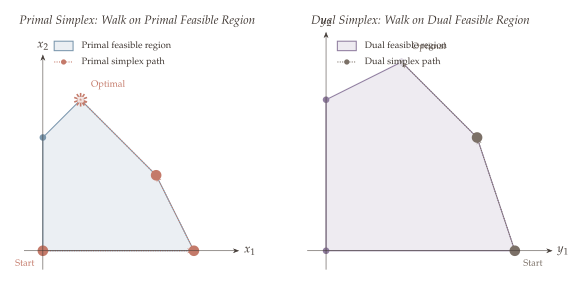
Primal simplex moves through primal feasible vertices, improving the objective until dual feasibility is achieved.
Dual simplex moves through dual feasible bases (which may correspond to primal infeasible points), decreasing the objective until primal feasibility is achieved. The objective starts too good (super-optimal) and comes down to the true optimum.
With the algorithm stated precisely, we now trace through a complete numerical example to see each step in action.
12.6 Worked Example
Having derived the dual simplex pivot rules, including the ratio test (Equation 12.1), we now demonstrate the method on a complete example.
12.6.1 Problem Setup
Consider the LP:
\min \; x_1 + 3x_2 \quad \text{s.t.} \quad x_1 + 3x_2 \geq 4, \;\; 4x_1 - x_2 \geq 1, \;\; x_2 \geq 3.
To apply the simplex framework, convert to maximization and \leq constraints:
\max \; -x_1 - 3x_2 \quad \text{s.t.} \quad -x_1 - 3x_2 \leq -4, \;\; -4x_1 + x_2 \leq -1, \;\; -x_2 \leq -3.
Introduce slack variables x_3, x_4, x_5 \geq 0:
x_3 = x_1 + 3x_2 - 4, \qquad x_4 = 4x_1 - x_2 - 1, \qquad x_5 = x_2 - 3.
The initial dictionary is:
\zeta = -x_1 - 3x_2,
x_3 = -4 + x_1 + 3x_2, \qquad x_4 = -1 + 4x_1 - x_2, \qquad x_5 = -3 + x_2.
The initial tableau is:
\begin{array}{c|rr} & x_1 & x_2 \\ \hline \zeta = 0 & -1 & -3 \\ x_3 = -4 & 1 & 3 \\ x_4 = -1 & 4 & -1 \\ x_5 = -3 & 0 & 1 \end{array}
12.6.2 Checking Initial Conditions
- Reduced costs: \widetilde{c}_1 = -1 \leq 0 and \widetilde{c}_2 = -3 \leq 0. So \widetilde{c} \leq 0: dual feasibility holds.
- RHS values: \widetilde{b}_3 = -4 < 0, \widetilde{b}_4 = -1 < 0, \widetilde{b}_5 = -3 < 0. So \widetilde{b} \not\geq 0: primal feasibility fails.
This is exactly the setup for dual simplex: we have dual feasibility but not primal feasibility.
12.6.3 Iteration 1
Step 1: \widetilde{b} \not\geq 0, so we are not optimal. Continue.
Step 2 (Choose leaving p): We need a basic variable with \widetilde{b}_p < 0. All three are negative: \widetilde{b}_3 = -4, \widetilde{b}_4 = -1, \widetilde{b}_5 = -3. We choose p = x_5.
Before applying the ratio test, let us clarify the sign convention. The dictionary row for a basic variable x_p is written as:
x_p = \widetilde{b}_p + a_{p1}\,x_1 + a_{p2}\,x_2 + \cdots
where a_{pj} are the dictionary coefficients (the numbers that appear directly in the equation). In the tableau notation, the -\widetilde{A} block stores these same coefficients with a sign flip: (-\widetilde{A})_{pj} = a_{pj}, so \widetilde{A}_{pj} = -a_{pj}.
The dual simplex ratio test (Equation 12.1) requires \widetilde{A}_{pj} < 0, which means we look for dictionary coefficients a_{pj} > 0 (positive entries in the dictionary row). The ratio is then:
q = \operatorname*{argmin}_{j:\, a_{pj} > 0} \frac{|\widetilde{c}_j|}{a_{pj}}.
Step 3 (Choose entering q): The dictionary row for x_5 is:
x_5 = -3 + 0 \cdot x_1 + 1 \cdot x_2.
The dictionary coefficient of x_1 is 0 (does not qualify) and the dictionary coefficient of x_2 is +1 (positive, so it qualifies). Since only x_2 qualifies:
q = x_2, \qquad \text{ratio} = \frac{|\widetilde{c}_2|}{a_{5,2}} = \frac{|-3|}{1} = 3.
Step 4: Pivot (x_5, x_2). Solve for x_2 from the x_5 row:
x_5 = -3 + x_2 \implies x_2 = 3 + x_5.
Substitute into all other rows:
\zeta = -(x_1) - 3(3 + x_5) = -9 - x_1 - 3x_5,
x_3 = -4 + x_1 + 3(3 + x_5) = 5 + x_1 + 3x_5,
x_4 = -1 + 4x_1 - (3 + x_5) = -4 + 4x_1 - x_5.
The new dictionary after Iteration 1:
\zeta = -9 - x_1 - 3x_5,
x_3 = 5 + x_1 + 3x_5, \qquad x_4 = -4 + 4x_1 - x_5, \qquad x_2 = 3 + x_5.
New tableau:
\begin{array}{c|rr} & x_1 & x_5 \\ \hline -9 & -1 & -3 \\ 5 & 1 & 3 \\ -4 & 4 & -1 \\ 3 & 0 & 1 \end{array}
Check: \widetilde{c}_1 = -1 \leq 0, \widetilde{c}_5 = -3 \leq 0: dual feasibility is maintained. But \widetilde{b}_4 = -4 < 0: not yet primal feasible.
12.6.4 Iteration 2
Step 1: \widetilde{b} \not\geq 0 (since \widetilde{b}_4 = -4). Continue.
Step 2 (Choose leaving p): The only negative \widetilde{b} is \widetilde{b}_4 = -4, so p = x_4.
Step 3 (Choose entering q): The dictionary row for x_4 is:
x_4 = -4 + 4x_1 - 1 \cdot x_5.
The dictionary coefficient of x_1 is +4 > 0 (qualifies) and the dictionary coefficient of x_5 is -1 < 0 (does not qualify). Only x_1 qualifies:
q = x_1, \qquad \text{ratio} = \frac{|\widetilde{c}_1|}{a_{4,1}} = \frac{|-1|}{4} = 0.25.
Step 4: Pivot (x_4, x_1). Solve for x_1 from the x_4 row:
x_4 = -4 + 4x_1 - x_5 \implies x_1 = 1 + 0.25 x_4 + 0.25 x_5.
Substitute:
\zeta = -9 - (1 + 0.25x_4 + 0.25x_5) - 3x_5 = -10 - 0.25x_4 - 3.25x_5,
x_3 = 5 + (1 + 0.25x_4 + 0.25x_5) + 3x_5 = 6 + 0.25x_4 + 3.25x_5,
x_2 = 3 + x_5.
Final dictionary:
\zeta = -10 - 0.25 x_4 - 3.25 x_5,
x_3 = 6 + 0.25 x_4 + 3.25 x_5, \qquad x_1 = 1 + 0.25 x_4 + 0.25 x_5, \qquad x_2 = 3 + x_5.
Final tableau:
\begin{array}{c|rr} & x_4 & x_5 \\ \hline -10 & -0.25 & -3.25 \\ 6 & 0.25 & 3.25 \\ 1 & 0.25 & 0.25 \\ 3 & 0 & 1 \end{array}
12.6.5 Verifying Optimality
- Reduced costs: \widetilde{c}_4 = -0.25 \leq 0, \widetilde{c}_5 = -3.25 \leq 0. Dual feasibility maintained.
- RHS values: \widetilde{b}_3 = 6 \geq 0, \widetilde{b}_1 = 1 \geq 0, \widetilde{b}_2 = 3 \geq 0. Primal feasibility achieved!
Both conditions hold, so we have reached optimality. The optimal solution is:
x_1^* = 1, \quad x_2^* = 3, \quad \zeta^* = -10.
Since the original problem was \min \, x_1 + 3x_2, the minimum value is \boxed{10}, achieved at (x_1, x_2) = (1, 3). The dual simplex method reached optimality in just two pivots, maintaining dual feasibility throughout and restoring primal feasibility at termination.
Dual Simplex Iteration Visualizer
The dual simplex starts at a super-optimal (infeasible) point and pivots toward the feasible region
12.7 When to Use the Dual Simplex Method
The dual simplex method is not just a theoretical mirror of the primal simplex. It arises naturally in several important practical situations.
12.7.1 Adding a New Constraint
Suppose you have already solved an LP to optimality and now need to add a new constraint. The current optimal basis satisfies \widetilde{c} \leq 0 (optimality / dual feasibility), but the new constraint may violate primal feasibility (\widetilde{b} \not\geq 0 for the new row). This is exactly the setting for dual simplex: maintain dual feasibility, pivot to restore primal feasibility.
This situation arises constantly in:
- Branch-and-bound for integer programming: each node adds a branching constraint (x_i \leq k or x_i \geq k+1) to the parent LP.
- Cutting-plane methods: violated inequalities are added iteratively, and the LP must be re-optimized after each cut.
- Sensitivity analysis: when the right-hand side b changes, the current basis may lose primal feasibility but retain dual feasibility.
12.7.2 Natural Dual Feasibility
Some LPs arise with a natural initial basis that is dual feasible but not primal feasible. The worked example above is typical: when all constraints are of the \geq type (converted to \leq by multiplying by -1), the initial slack basis often has \widetilde{c} \leq 0 but \widetilde{b} < 0.
12.7.3 Warm-Starting After Constraint Changes
When solving a sequence of related LPs (as in column generation or Benders decomposition), the dual simplex method allows efficient warm-starting: the previous optimal basis provides dual feasibility, and only a few pivots may be needed to restore primal feasibility after the problem is modified.
| Situation | Use Primal Simplex | Use Dual Simplex |
|---|---|---|
| Natural starting BFS available | Yes | – |
| \widetilde{c} \leq 0 but \widetilde{b} \not\geq 0 | – | Yes |
| Adding constraints to optimal LP | – | Yes |
| Branch-and-bound / cutting planes | – | Yes |
| RHS perturbation / sensitivity | – | Yes |
| Objective change | Yes | – |
12.8 Summary of the Primal-Dual Framework
The two simplex variants are mirror images of each other, differing only in which feasibility condition is maintained as an invariant and which is achieved through pivoting:
Primal simplex maintains primal feasibility and drives toward dual feasibility:
- x_B^* is primal feasible (\widetilde{b} \geq 0) at every iteration
- z_N^* eventually becomes dual feasible (\widetilde{c} \leq 0) through pivots
- Complementary slackness is preserved at every step
Dual simplex maintains dual feasibility and drives toward primal feasibility:
- z_N^* is dual feasible (\widetilde{c} \leq 0) at every iteration
- x_B^* eventually becomes primal feasible (\widetilde{b} \geq 0) through pivots
- Complementary slackness is preserved at every step
Both methods terminate at the same optimal solution, where both primal and dual feasibility hold simultaneously. This is the algebraic expression of strong duality. The complementary slackness conditions are maintained as an invariant throughout both algorithms.
The dual simplex method, combined with the primal simplex, gives us a complete toolkit for solving linear programs and re-optimizing after modifications. These tools are the backbone of modern LP solvers and form the computational engine behind integer programming, robust optimization, and large-scale decomposition methods.