18 Transformers
In 2017, a team at Google published a paper titled “Attention Is All You Need.” The architecture it introduced — the Transformer — has since become the foundation of virtually every major AI system: ChatGPT and GPT-4 (OpenAI), Claude (Anthropic), Gemini (Google), LLaMA (Meta), and many more. Beyond language, transformers power image generation (DALL-E, Stable Diffusion), protein structure prediction (AlphaFold), code completion (Copilot), and even chip design.
What makes the transformer so powerful? At its core, it is built from a small set of mathematical operations we have studied throughout this course — matrix multiplications, softmax normalization, and elementwise nonlinearities — all trained end-to-end with gradient descent. The key innovation is the attention mechanism: a learned, content-dependent weighted average that allows every token in a sequence to dynamically gather information from every other token. This simple idea, combined with positional encodings, residual connections, and layer normalization, scales to networks with hundreds of billions of parameters.
This chapter develops the transformer architecture from the ground up. We start with how words become vectors, build up the attention mechanism step by step, assemble the full decoder architecture, and conclude by analyzing the parameter count of GPT-3 to build concrete intuition for the scale of modern language models.
Companion notebooks for this chapter are coming soon.
What Will Be Covered
- Language tasks and three types of transformer models
- Token embedding, positional encoding, and the softmax prediction head
- The attention mechanism: cross attention and self-attention
- Multi-head attention, causal masking, MLP layers
- Residual connections and layer normalization
- Full transformer decoder architecture
- GPT-3 parameter analysis
18.1 From Words to Predictions: The Big Picture
Before diving into details, let us sketch the full pipeline of an autoregressive language model like GPT. The model takes a sequence of words (tokens), processes them through many layers, and outputs a probability distribution over what word comes next.
The Transformer Pipeline (using GPT-3 as reference):
| Stage | Description | Size |
|---|---|---|
| Input | Token sequence w_1, \ldots, w_L (one-hot) | L \times V |
| Embedding | Map tokens to vectors: x_i = W_E w_i + \text{pe}_i | L \times d |
| Transformer blocks | 96 layers of attention + MLP + normalization | L \times d |
| Unembedding | Project to vocabulary: W_U z_\ell | L \times V |
| Softmax | Probability distribution over next token | L \times V |
Here V = 50{,}257 (vocabulary), d = 12{,}288 (model dimension), L = 2{,}048 (context window).
We will now build each component from scratch.
18.2 Motivation: Why Transformers?
18.2.1 The Landscape of AI Models
Transformers have become the universal architecture across AI:
- Language: GPT-4, Claude, LLaMA, Gemini — all decoder-only transformers
- Vision: Vision Transformer (ViT) matches or exceeds CNNs on image classification
- Protein science: AlphaFold2 uses attention to predict 3D protein structures
- Multimodal: DALL-E 3, Stable Diffusion use transformers for text-conditioned image generation
Today, transformer-based models dominate the LMSYS Chatbot Arena Leaderboard, with models like GPT-4, Claude, and Gemini at the top.
18.2.2 Language Tasks
Definition 18.1 (Two Main Types of Language Tasks) Language tasks broadly fall into two categories:
1. Generative tasks (conditional generation): translation, summarization, code generation, dialogue. \mathbb{P}(\text{output text} \mid \text{input text / image}).
2. Discriminative tasks (classification): sentiment analysis, part-of-speech tagging, spam detection. \mathbb{P}(\text{label} \mid \text{input text}).
This distinction directly determines which transformer architecture is appropriate.
18.3 Three Types of Transformer Models
Depending on the task, transformers come in three variants that differ in how information flows through the model.
18.3.1 Encoder-Only (Feature Extraction)
Definition 18.2 (Encoder-Only Transformer) Creates a sequence of contextual features from the input.
- Input: tokens w_1, \ldots, w_L
- Output: features z_1, z_2, \ldots, z_L \in \mathbb{R}^d
- Key property: each z_\ell depends on the entire input \{w_1, \ldots, w_L\} (bidirectional attention)
- Use case: downstream classification (sentiment, NER, part-of-speech)
- Examples: BERT, Vision Transformer (ViT)
18.3.2 Decoder-Only (Autoregressive Generation)
Definition 18.3 (Decoder-Only Transformer) Generates text one token at a time, left to right.
- Input: tokens w_1, w_2, \ldots, w_L
- Output: features z_1, z_2, \ldots, z_L
- Key property: each z_\ell depends only on w_1, \ldots, w_\ell (autoregressive — cannot look into the future)
- Predict w_{\ell+1} from z_\ell via a softmax prediction layer
- Examples: GPT family, LLaMA, Mistral, Claude
18.3.3 Encoder-Decoder
Definition 18.4 (Encoder-Decoder Transformer) The original architecture from “Attention Is All You Need” (Vaswani et al., 2017). The encoder processes the input into features; the decoder autoregressively generates the output, attending to encoder features via cross attention.
- Use case: machine translation, summarization
- Example: T5, the original Transformer
Decoder-only models dominate modern practice. They can handle both generative and discriminative tasks, making encoder-only and encoder-decoder architectures largely superseded. The main exception is Vision Transformer (ViT), which is encoder-only.
18.4 Token Embedding
The first step is to convert discrete words into continuous vectors that a neural network can process.
Definition 18.5 (Word/Token Embedding) Each word w (a one-hot vector in \mathbb{R}^V) is mapped to a dense vector x_w \in \mathbb{R}^d via a learned embedding matrix W_E \in \mathbb{R}^{d \times V}: x_i = W_E \, w_i \in \mathbb{R}^d.
For GPT-3: V = 50{,}257 (vocabulary size), d = 12{,}288 (embedding dimension), L = 2{,}048 (context length).
The embedding matrix converts sparse one-hot vectors in a very high-dimensional space (\mathbb{R}^V) into dense, continuous vectors in a much lower-dimensional space (\mathbb{R}^d). This is essential because all subsequent operations — attention, MLP layers, optimization — operate on continuous vectors.
Word embeddings equip words with geometric structure. Similar words end up close in the embedding space (measured by cosine similarity \cos(u,v) = u^\top v / (\|u\|\|v\|)). Famously, Word2Vec and GloVe embeddings capture semantic analogies as linear relationships:
\text{king} - \text{man} + \text{woman} \approx \text{queen}.
Once words live in Euclidean space, we can apply calculus, linear algebra, and all the optimization tools from this course.
18.5 Prediction Head and Softmax
At the output end, the transformer produces a vector z_\ell \in \mathbb{R}^d at each position. For next-token prediction, we need a probability distribution over the vocabulary. The softmax function converts raw scores into probabilities.
Definition 18.6 (Softmax Function) For any vector of real numbers v = (v_1, \ldots, v_N) \in \mathbb{R}^N:
\text{Softmax}(v)_i = \frac{\exp(v_i)}{\sum_{j=1}^{N} \exp(v_j)}, \qquad i = 1, \ldots, N.
This produces a valid probability distribution: all entries are positive and sum to one. Larger logits receive exponentially more probability mass, making softmax a “soft” version of argmax.
The transformer output z_\ell \in \mathbb{R}^d is mapped to vocabulary-sized logits via the unembedding matrix W_U \in \mathbb{R}^{V \times d}, then softmax produces a distribution:
\underbrace{W_U}_{\mathbb{R}^{V \times d}} \cdot z_\ell \in \mathbb{R}^V \xrightarrow{\text{Softmax}} \mathbb{P}(w_{\ell+1} \mid w_1, \ldots, w_\ell) \in \Delta_V.
18.5.1 Loss Function: Cross-Entropy
The natural training objective is to maximize the probability of the correct next token at each position, leading to the cross-entropy loss.
Definition 18.7 (Cross-Entropy Loss (Maximum Likelihood)) At each position \ell, the transformer outputs a distribution p_\ell \in \Delta_V over the vocabulary. The next-token label is w_{\ell+1}. The training loss is:
\mathcal{L}(\theta) = -\sum_{\ell=1}^{L-1} \log \mathbb{P}_\theta(w_{\ell+1} \mid w_1, \ldots, w_\ell).
This is equivalent to maximum likelihood estimation (MLE), and is minimized via gradient descent with backpropagation.
18.5.2 Autoregressive Generation
Example 18.1 (Autoregressive Generation) Given the prompt “My name is X.”, generation proceeds step by step:
| Step | Context | Prediction |
|---|---|---|
| 1 | “My name is X.” | \mathbb{P}(\text{"I"} \mid \text{prompt}) |
| 2 | “My name is X. I” | \mathbb{P}(\text{"am"} \mid \text{context}) |
| 3 | “My name is X. I am” | \mathbb{P}(\text{"a"} \mid \text{context}) |
| 4 | “My name is X. I am a” | \mathbb{P}(\text{"Yale"} \mid \text{context}) |
| 5 | “My name is X. I am a Yale” | \mathbb{P}(\text{"student"} \mid \text{context}) |
Each generated word is appended to the input for the next prediction. This is why decoder-only models are called autoregressive: the output at each step feeds back as input.
18.6 The Attention Mechanism
The central innovation of the transformer is attention: a mechanism that computes a weighted average of values, where the weights are determined by learned similarity between a query and a set of keys.
Definition 18.8 (Attention) Given a set of vector values and a vector query, attention computes a weighted sum of the values, dependent on the query. The query attends to the values.
- In attention, the query matches all keys softly (weights between 0 and 1).
- In a lookup table, the query matches one key exactly.
Attention is just a weighted average — but it becomes very powerful when the weights are learned!
18.6.1 Cross Attention
We first formalize attention where the query comes from one source and the key-value pairs from another (this generalizes to self-attention later).
Theorem 18.1 (Cross Attention Formula) Given (key, value) pairs \{(k_i, v_i)\}_{i \in [L]} with k_i \in \mathbb{R}^{d_k}, v_i \in \mathbb{R}^{d_v}, and a query q \in \mathbb{R}^{d_k}:
Similarity scores: e_i = q^\top k_i for each i \in [L]
Attention weights (via softmax with scaling): \alpha_i = \frac{\exp(q^\top k_i / \sqrt{d_k})}{\sum_{j=1}^{L} \exp(q^\top k_j / \sqrt{d_k})}
Output (weighted sum of values): h = \sum_{i=1}^{L} \alpha_i \cdot v_i \in \mathbb{R}^{d_v}
The 1/\sqrt{d_k} scaling factor prevents the dot products from growing too large in high dimensions, which would push softmax into near-zero gradient regions.
If the entries of q and k_i are independent with zero mean and unit variance, then q^\top k_i has variance d_k. The scaling ensures the variance of the logits is approximately 1, keeping softmax in a well-behaved regime.
18.6.2 Self-Attention
The breakthrough insight of the transformer is to apply attention within a single sequence — the queries, keys, and values are all computed from the same input. This is self-attention.
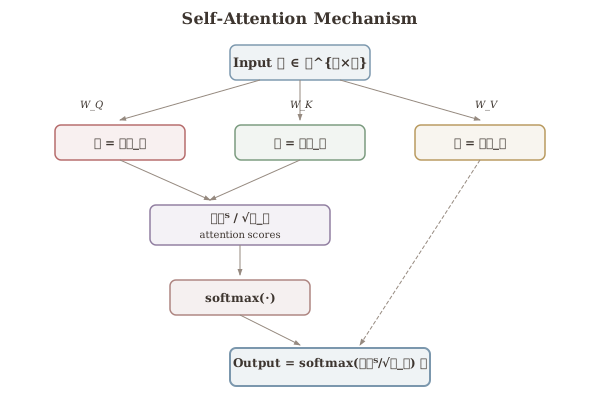
Definition 18.9 (Self-Attention) Given post-embedding sequence X = (x_1, \ldots, x_L) \in \mathbb{R}^{L \times d}, we compute:
Q = X W_Q, \quad K = X W_K, \quad V = X W_V \quad \in \mathbb{R}^{L \times d_k},
where W_Q, W_K, W_V \in \mathbb{R}^{d \times d_k} are learnable weight matrices. At position \ell:
\alpha_{\ell j} = \frac{\exp(q_\ell^\top k_j / \sqrt{d_k})}{\sum_{s=1}^{L} \exp(q_\ell^\top k_s / \sqrt{d_k})} = \frac{\exp(x_\ell^\top W_Q^\top W_K x_j / \sqrt{d_k})}{\sum_{s=1}^{L} \exp(x_\ell^\top W_Q^\top W_K x_s / \sqrt{d_k})},
and the output is: h_\ell = \sum_{j=1}^{L} \alpha_{\ell j} \cdot v_j = \sum_{j=1}^{L} \alpha_{\ell j} \cdot (W_V x_j).
Given input X \in \mathbb{R}^{L \times d}:
- Compute projections: Q = XW_Q, K = XW_K, V = XW_V
- Compute attention scores: E = QK^\top \in \mathbb{R}^{L \times L}
- Scale and normalize: A = \text{Softmax}(E / \sqrt{d_k}) \in \mathbb{R}^{L \times L}
- Output: H = AV = \text{Softmax}(QK^\top / \sqrt{d_k}) \cdot V \in \mathbb{R}^{L \times d_k}
18.6.3 Permutation Invariance
Corollary 18.1 (Permutation Invariance) The attention output h = \sum_{i=1}^{L} \alpha_i \cdot v_i is unchanged if we permute the key-value pairs \{(k_i, v_i)\}_{i \in [L]}.
This means self-attention treats its input as a set, not a sequence. Since word order clearly matters in language (“the cat chased the dog” \neq “the dog chased the cat”), we must explicitly inject positional information. This leads to the next section.
18.7 Three Challenges and Their Solutions
Self-attention is a powerful building block, but it has three limitations that must be addressed before it can serve as the basis for a language model:
| Challenge | Solution |
|---|---|
| No notion of token order (permutation invariant) | Positional embedding |
| Can see future tokens during training | Causal masking |
| Output is a linear weighted average (no nonlinearity) | MLP / feed-forward layers |
We address each in turn.
18.7.1 Positional Embedding
Since self-attention is permutation invariant, we explicitly encode position by adding a positional embedding to each token embedding:
Definition 18.10 (Positional Embedding) The embedding of (token, position) is additive: x_i = W_E \, w_i + \text{pe}_i \in \mathbb{R}^d,
where \text{pe}_i \in \mathbb{R}^d encodes position i in the sequence.
There are three major approaches:
1. Absolute (learned) embedding. Each position \ell gets a learnable vector \text{pe}_\ell \in \mathbb{R}^d. Simple but cannot generalize beyond the training context length.
2. Sinusoidal encoding (Vaswani et al., 2017). Use fixed sinusoidal functions at different frequencies:
\vec{p}_t = \begin{pmatrix} \sin(\omega_1 \cdot t) \\ \cos(\omega_1 \cdot t) \\ \sin(\omega_2 \cdot t) \\ \cos(\omega_2 \cdot t) \\ \vdots \\ \sin(\omega_{d/2} \cdot t) \\ \cos(\omega_{d/2} \cdot t) \end{pmatrix}, \qquad \omega_k = \frac{1}{10000^{2k/d}}.
Low-frequency sinusoids vary slowly across positions (capturing coarse position), while high-frequency ones oscillate rapidly (capturing fine position). The key insight is that relative position information is encoded via rotation matrices: \vec{p}_{t+\Delta} can be expressed as a linear function of \vec{p}_t.
3. Rotary Position Embedding (RoPE). Used in LLaMA and most modern models. Encodes relative positions i - j directly into the attention score: \alpha_i = \text{Softmax}\!\left(\{q_i^\top(k_j + \vec{P}_{i-j})\}_{j \in [L]}\right).
18.7.2 Causal Masking
For autoregressive generation, token \ell must not attend to future tokens j > \ell. We enforce this by masking.
Definition 18.11 (Causal Masking) Set the attention score to -\infty for all future positions:
\text{Masked Attention} = \text{Softmax}\!\left(\frac{QK^\top}{\sqrt{d_k}} + M\right) V, \qquad M_{\ell j} = \begin{cases} 0 & \text{if } j \leq \ell, \\ -\infty & \text{if } j > \ell. \end{cases}
After softmax, the -\infty entries become zero, so each token can only attend to itself and previous tokens.
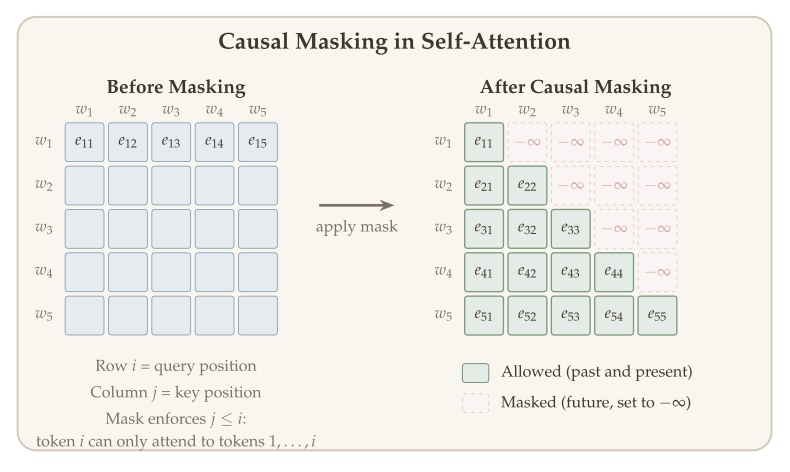
- Encoder-only (BERT): uses global attention — every token sees every other token.
- Decoder-only (GPT): uses causal masking — tokens can only look backward.
18.7.3 MLP / Feed-Forward Layer
The self-attention output \sum_j \alpha_{\ell j} \cdot W_V x_j is a weighted average of linear functions — stacking more attention layers without nonlinearities would just produce another weighted average. To give the model nonlinear expressivity, we add a pointwise MLP after each attention layer.
Definition 18.12 (Feed-Forward (MLP) Layer) A 2-layer neural network applied independently at each position \ell \in [L]:
\text{MLP}(x) = W_2 \cdot \sigma(W_1 x + b_1) + b_2,
where \sigma is a nonlinearity (ReLU or GELU), W_1 \in \mathbb{R}^{d_f \times d}, W_2 \in \mathbb{R}^{d \times d_f}.
Typically d_f = 4d (the MLP expands the dimension by 4x, applies the nonlinearity, then projects back).
18.8 Multi-Head Attention
A single attention head can only capture one type of relationship between tokens. In practice, language has many simultaneous structures — syntactic dependencies, semantic similarity, coreference — that require different attention patterns. Multi-head attention runs multiple attention operations in parallel, each with its own learned projections.
Definition 18.13 (Multi-Head Attention) Let H be the number of attention heads. Each head h has its own projection matrices W_Q^h, W_K^h, W_V^h \in \mathbb{R}^{d \times d_k}, where d_k = d / H.
For each head h: \text{head}^h = \text{Attention}(XW_Q^h, XW_K^h, XW_V^h) \in \mathbb{R}^{L \times d_k}.
The outputs from all heads are concatenated and mixed via an output matrix W_O \in \mathbb{R}^{d \times d}:
\text{MultiHead}(X) = W_O \begin{pmatrix} \text{head}^1 \\ \vdots \\ \text{head}^H \end{pmatrix} \in \mathbb{R}^{L \times d}.
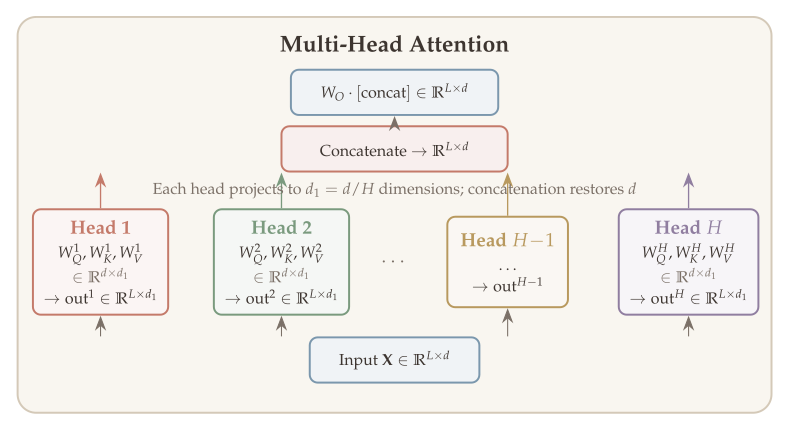
Empirically, different heads specialize in different patterns:
- Some heads attend to the previous token (bigram patterns)
- Some heads attend to syntactic heads (subject-verb agreement)
- Some heads attend to semantically similar words
- Some heads form induction heads that copy patterns from earlier in the context
18.9 Residual Connections and Layer Normalization
A transformer stacks dozens (or nearly a hundred) layers of attention and MLP blocks. Training such deep networks requires two critical ingredients.
18.9.1 Residual Connections
Definition 18.14 (Residual Connection) Instead of X^{(i)} = \text{Layer}(X^{(i-1)}), we use: X^{(i)} = X^{(i-1)} + \text{Layer}(X^{(i-1)}).
This biases the mapping toward the identity, so each layer only needs to learn “the residual” — a small correction to its input.
Residual connections provide a direct gradient pathway from the output back to early layers, preventing the vanishing gradient problem. From an optimization perspective, they smooth the loss landscape.
18.9.2 Layer Normalization
Definition 18.15 (Layer Normalization) For a vector x \in \mathbb{R}^d, compute:
- Mean: \mu = \frac{1}{d} \sum_{j=1}^{d} x_j
- Standard deviation: \sigma = \sqrt{\frac{1}{d} \sum_{j=1}^{d} (x_j - \mu)^2}
- Normalization: \text{LayerNorm}(x) = \frac{x - \mu}{\sigma + \varepsilon}
Applied independently to each token’s feature vector x_1, x_2, \ldots, x_L.
Layer normalization ensures that the inputs to each sub-layer have consistent scale, preventing the magnitude of activations from growing or shrinking uncontrollably across layers.
18.10 The Full Transformer Decoder
We now assemble all components into the complete architecture.
The Transformer Decoder is a stack of identical blocks. Each block consists of:
- (Masked) Multi-Head Self-Attention
- Add & Norm (residual connection + layer normalization)
- Feed-Forward Network (MLP)
- Add & Norm
Two design variants: Post-norm (original) applies LayerNorm after each sub-layer. Pre-norm (more common now) applies LayerNorm before each sub-layer, yielding better training stability.
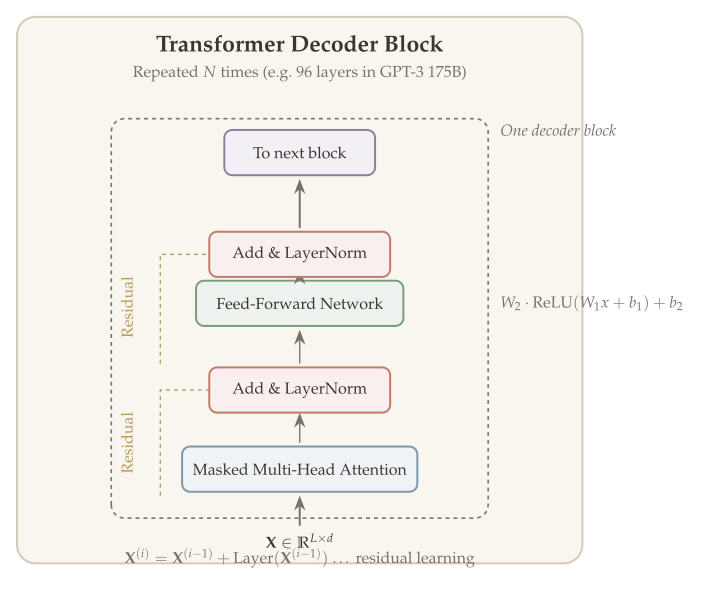
- Encoder-only (BERT): no causal masking; trained by masking random tokens and predicting them.
- Decoder-only (GPT): causal masking; trained to predict the next token.
- Encoder-decoder (T5): encoder uses global attention; decoder uses causal masking and attends to encoder features via cross attention at each layer.
18.11 Understanding GPT-3: Parameter Analysis
To build concrete intuition for the scale of modern language models, let us count the parameters of GPT-3.
18.11.1 GPT-3 Model Variants
| Model | Parameters | Layers | d_\text{model} | Heads | d_\text{head} |
|---|---|---|---|---|---|
| GPT-3 Small | 125M | 12 | 768 | 12 | 64 |
| GPT-3 Medium | 350M | 24 | 1,024 | 16 | 64 |
| GPT-3 Large | 760M | 24 | 1,536 | 16 | 96 |
| GPT-3 XL | 1.3B | 24 | 2,048 | 24 | 128 |
| GPT-3 6.7B | 6.7B | 32 | 4,096 | 32 | 128 |
| GPT-3 13B | 13.0B | 40 | 5,140 | 40 | 128 |
| GPT-3 175B | 175.0B | 96 | 12,288 | 96 | 128 |
Note: d_\text{model} = n_\text{heads} \times d_\text{head} in all cases.
18.11.2 Counting Parameters
Let d = 12{,}288, V = 50{,}257, L = 2{,}048, n_\text{layers} = 96.
1. Word embedding: W_E \in \mathbb{R}^{V \times d} \Rightarrow V \cdot d \approx 617\text{M}
2. Position embedding: W_{PE} \in \mathbb{R}^{L \times d} \Rightarrow L \cdot d \approx 25\text{M}
3. Self-attention per layer: W_Q, W_K, W_V \in \mathbb{R}^{d \times d} (each is H heads of d \times d_k, totaling d \times d), plus W_O \in \mathbb{R}^{d \times d} \Rightarrow 4d^2 per layer
4. MLP per layer: W_1 \in \mathbb{R}^{4d \times d}, W_2 \in \mathbb{R}^{d \times 4d} \Rightarrow 8d^2 per layer
Total (neglecting biases and layer norms):
\text{Parameters} = V \cdot d + L \cdot d + 12d^2 \times n_\text{layers} \approx 174{,}074{,}267{,}648 \approx 174 \times 10^9.
This is 99.5% of the reported 175B parameter count!
18.12 Transformer Circuits and the Residual Stream
A useful perspective on transformers comes from viewing the residual connections as a residual stream — a persistent information highway that each attention and MLP layer reads from and writes to.
Theorem 18.2 (Single-Layer Attention-Only Transformer) For a single-layer, attention-only transformer, the output logits can be written as:
T(X) = X \underbrace{W_E^\top W_U^\top}_{\text{direct path (residual)}} + \sum_{h=1}^{H} A^h \cdot X \cdot \underbrace{W_E^\top (W_{OV}^h)^\top W_U^\top}_{\text{attention path}},
where A^h = \text{Softmax}(X W_{QK}^h X^\top) is the attention pattern for head h, W_{QK}^h = W_Q^{h\top} W_K^h / \sqrt{d_k} is the QK-circuit (which tokens to attend to), and W_{OV}^h = W_O^h W_V^h is the OV-circuit (what information to move).
This decomposition reveals that each attention head performs two distinct functions: the QK-circuit determines where to look, while the OV-circuit determines what to copy. The residual stream provides a direct path from input to output, so each layer only needs to make incremental contributions.
This “circuits” perspective has led to a growing field of mechanistic interpretability, which aims to reverse-engineer the algorithms learned by transformers by studying the QK and OV circuits of individual attention heads. Researchers have identified specific heads that perform induction (pattern completion), heads that handle syntax, and heads that track entities across long contexts.
Summary
- Token embedding. Discrete words are mapped to dense vectors x_i = W_E w_i \in \mathbb{R}^d via a learned embedding matrix; positional information is added as x_i + \text{pe}_i.
- Attention mechanism. The core operation computes \text{Attention}(Q,K,V) = \text{softmax}(QK^\top / \sqrt{d_k}) V, where queries, keys, and values are linear projections of the input; each token attends to all other tokens with learned, content-dependent weights.
- Positional encoding. Since self-attention is permutation invariant, positional embeddings (sinusoidal or learned) inject sequence-order information; causal masking further enforces autoregressive structure by preventing attention to future tokens.
- Transformer block. Each block applies multi-head self-attention followed by a position-wise MLP, with residual connections and layer normalization around each sub-layer, enabling stable training of very deep models.
- Multi-head attention. Running H attention heads in parallel with independent projections lets the model capture diverse relational patterns; outputs are concatenated and projected back to the model dimension.
- Scale. GPT-3 175B has 96 layers, d = 12{,}288, and 96 attention heads; over 99% of its $$174B parameters reside in the attention (4d^2 per layer) and MLP (8d^2 per layer) weights.